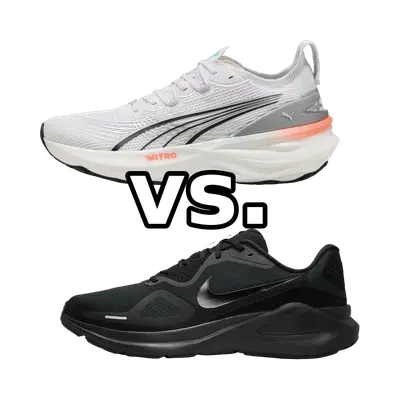
Puma ForeverRun Nitro 2 vs Asics GT-2000 15:
Which to Choose
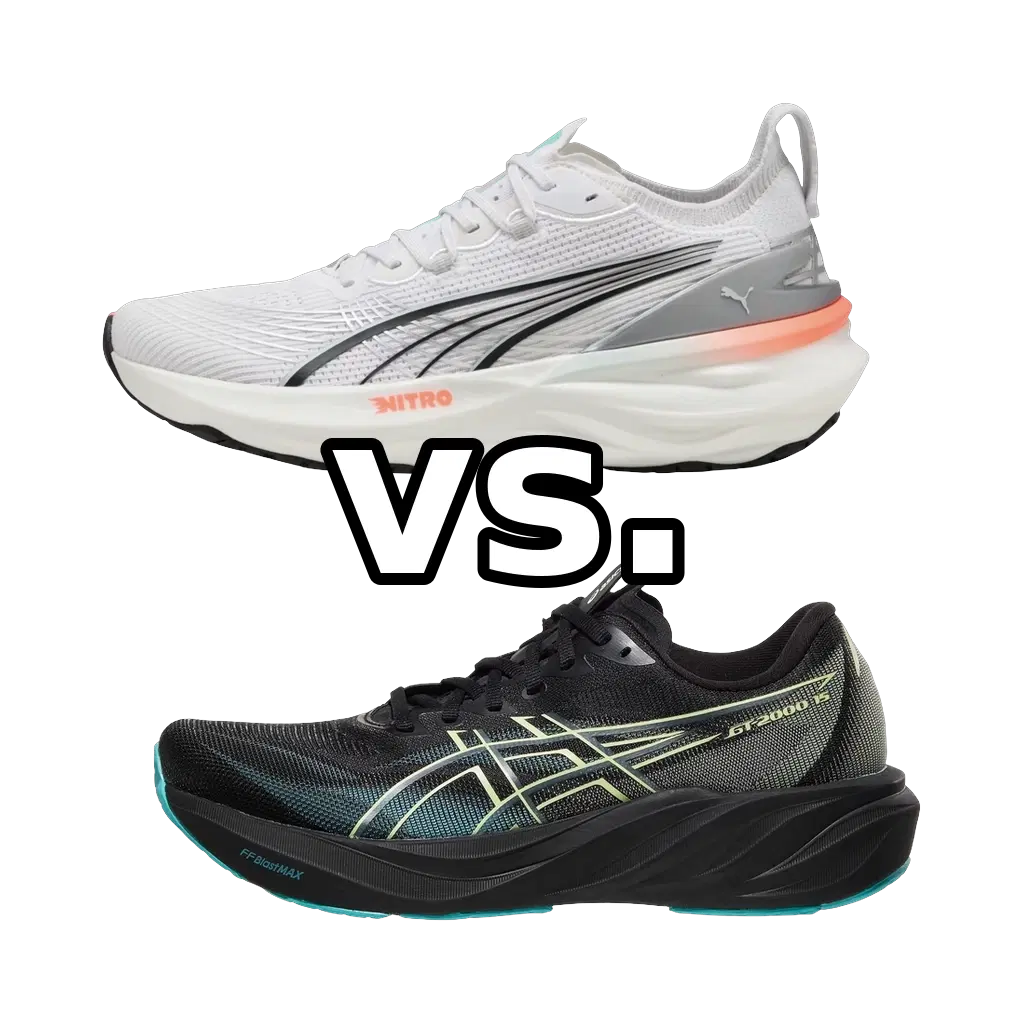
Verdict
These are close relatives doing the same job, so it genuinely comes down to feel: go Asics GT-2000 15 if you want lighter, firmer, lower-drop (8mm) support for easy daily miles, and go Puma ForeverRun Nitro 2 if you want a softer, more cushioned ride, a traditional 10mm drop, and a shoe happy to run a little quicker — accepting that it's the heavier of the two. There's no wrong answer for a mild overpronator here; the Asics wins on weight and ground feel, the Puma on plushness and higher-drop comfort.
Pace
3 of 6
Cushioning
4 of 6
Responsiveness
4 of 6
Stability
5 of 6
Drop
10 mm
Support
Stability
Plate
None
Distances
10KHalfMarathon
Pace
3 of 6
Cushioning
4 of 6
Responsiveness
4 of 6
Stability
5 of 6
Drop
8 mm
Support
Stability
Plate
None
Distances
10KHalfMarathon
At a Glance
Puma ForeverRun Nitro 2Asics GT-2000 15
Who Should Choose Each Shoe
Choose
Puma ForeverRun Nitro 2
Pick the ForeverRun Nitro 2 if you want your stability shoe to feel a touch softer and more cushioned underfoot and you prefer a traditional 10mm drop that eases a heel-led stride. It suits the mild overpronator logging consistent half-to-marathon volume who runs their steady and long efforts a shade quicker (around 4:45–5:45 min/km) and doesn't mind carrying a little more shoe to get a planted, corralled landing. If you're coming from a higher-drop trainer and value guided composure over a firm, direct feel, this is the better match.
Choose
Asics GT-2000 15
Choose the GT-2000 15 if you want the lighter, firmer, more ground-connected of the two and a lower 8mm drop for a flatter, more natural transition. It's the stronger pick for new and intermediate runners building mileage, or experienced runners who want a dependable workhorse for the bulk of an easy-paced week (5:30–6:30 min/km), and who'd rather have composed predictability than a soft, cushioned ride. The weight savings make it the easier shoe to live in for very long runs.
Head-to-Head
Spec for spec these two line up almost exactly: both rate high on stability, moderate on cushioning and responsiveness, run without a plate, and cover 10K through the marathon with the half-to-full range as their sweet spot. The first real split is weight — the Puma lands around 291g in a men's US 9 versus roughly 258g for the GT-2000 15, a noticeable ~33g gap that you feel over long miles, where the Asics simply moves lighter on the foot. The second is drop: the ForeverRun sits at a traditional 10mm heel-to-toe offset that nudges you into a heel-led stride, while the GT-2000 drops to 8mm for a slightly flatter, more neutral transition. Foam character separates them further — Puma's Nitro is cushioned-but-composed, softer underfoot without wobbling at slow paces, whereas the Asics FF BLAST MAX reads firmer and more controlled, trading plush for predictability and ground feel. The Asics also carries the taller midsole stack of the two. Practically, the Puma's tuning favors a marginally quicker, steadier effort (most comfortable around 4:45–5:45 min/km and genuinely happy down to ~4:30), while the GT-2000 is pitched at a true easy-daily zone (5:30–6:30 min/km, with tempo touches around 5:00–5:30). Both lean on structured sidewalls and durable rubber outsoles for high-mileage reliability, so neither is the clear durability winner — the deciding factors are the softer, slightly faster-leaning but heavier Puma versus the firmer, lighter, lower-drop Asics.
© 2026 longrunshoes.ai | All rights reserved.
Use of materials from this site is permitted only with proper attribution and a link to longrunshoes.ai.