
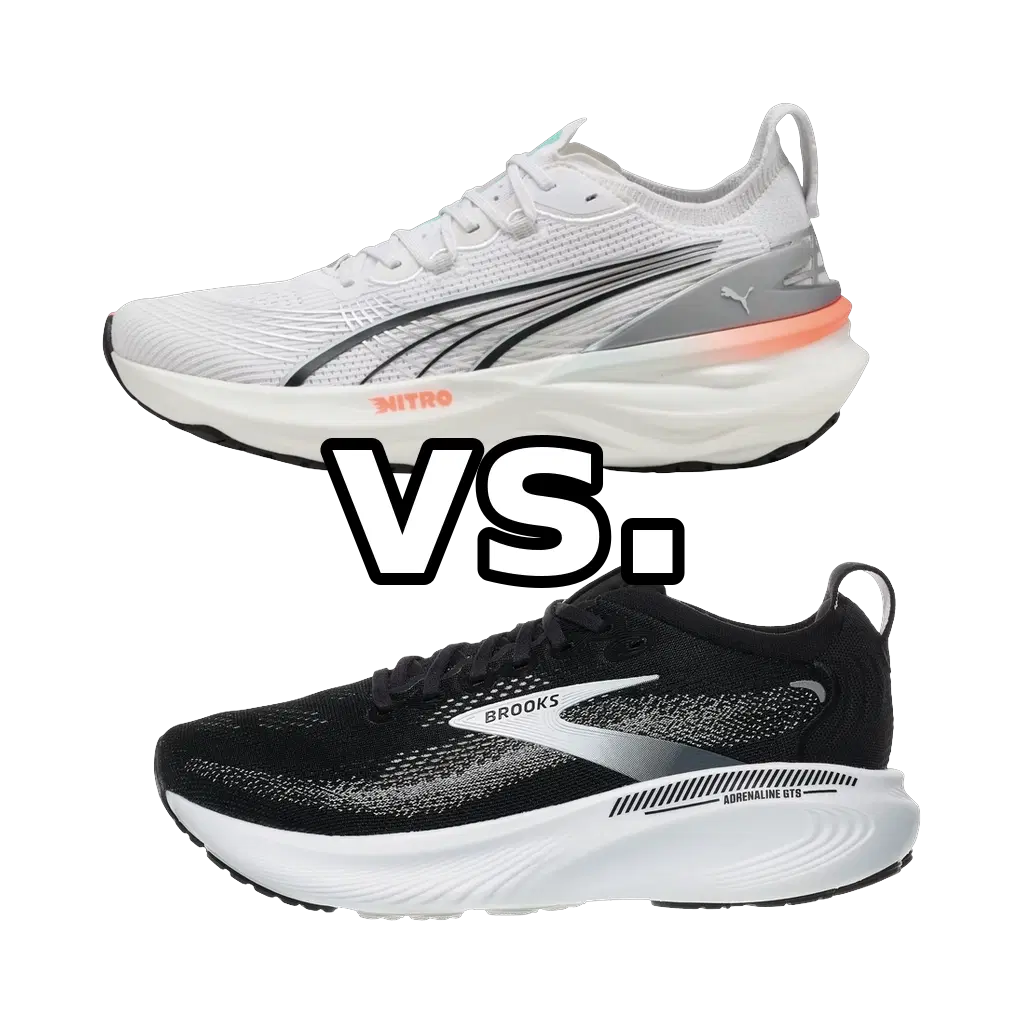
Puma ForeverRun Nitro 2 vs Brooks Adrenaline GTS 25:
Which to Choose
Verdict
These are genuinely close shoes — same drop, nearly identical weight and stack, and the same no-post stability philosophy — so there's no wrong answer, only a right fit. Pick the ForeverRun Nitro 2 if you want a touch more pop and pace range in a more locked-down upper; pick the Adrenaline GTS 25 if you want a softer, more forgiving ride and a roomier, more accommodating fit. It comes down to whether you value a little extra liveliness (Puma) or maximal easygoing comfort and fit flexibility (Brooks).
Pace
3 of 6
Cushioning
4 of 6
Responsiveness
4 of 6
Stability
5 of 6
Drop
10 mm
Support
Stability
Plate
None
Distances
10KHalfMarathon
Pace
3 of 6
Cushioning
4 of 6
Responsiveness
3 of 6
Stability
5 of 6
Drop
10 mm
Support
Stability
Plate
None
Distances
10KHalfMarathon
At a Glance
Puma ForeverRun Nitro 2Brooks Adrenaline GTS 25
Who Should Choose Each Shoe
Choose
Puma ForeverRun Nitro 2
Choose the Puma ForeverRun Nitro 2 if you want a stability trainer that can do more than plod — a runner mixing easy miles with steady efforts and the occasional faster long run, who'll appreciate the Nitro foam's slightly livelier, more composed rebound and a wider usable pace window. It's also the better pick if you prefer a snug, structured upper that holds your midfoot in place rather than a loose, roomy fit.
Choose
Brooks Adrenaline GTS 25
Choose the Brooks Adrenaline GTS 25 if comfort-first predictability is the whole point — a heel-striking everyday runner who wants a soft, forgiving cruiser for daily and long training miles run at a relaxed, controlled pace, with GuideRails quietly keeping the stride honest as fatigue sets in. It's the smarter buy if you have a wider or higher-volume foot or simply want the more accommodating fit and the reassurance of a long-running, well-understood support franchise.
Head-to-Head
On paper these two are almost twins. Both carry a 10mm heel-to-toe drop, nearly identical lab weights (around 291g for the Puma and 295g for the Brooks in a men's US 9), and effectively the same stack — roughly 35–36mm at the heel and about 26mm at the forefoot — so neither is meaningfully lighter or taller than the other, and anyone hoping weight will break the tie won't find it here. Both also deliver stability without a medial post: the ForeverRun leans on a wide base with Puma's RunGuide stabilizing sidewalls, while the Adrenaline uses Brooks' GuideRails, guardrail-like structures at the heel that rein in excess motion as you fatigue. The real split is in the foam and the ride. The Puma's Nitro midsole is the more composed-yet-lively of the two — rated a notch more responsive and tuned to stay planted at slow paces while still having a little life when you lift the effort. The Brooks' full-length DNA Loft v3 is softer and more forgiving but flatter, cushioning impact without much spring back. That difference shows up in usable pace range: the ForeverRun stays comfortable into a steadier zone (down to roughly 4:30 min/km at its quickest) whereas the Adrenaline is happiest at relaxed daily-training and long-run paces and starts to feel heavy and dull if you push much past about 5:00 min/km. Fit rounds it out — the Puma's engineered mesh with PWRTAPE overlays is the more structured, locked-down upper, while the Adrenaline's knit/mesh is the roomier, more accommodating wrap (and Brooks' width options make it the easier shoe to fit a wider or higher-volume foot).
Similar Comparisons

Brooks Adrenaline GTS 24 vs Brooks Adrenaline GTS 25
Puma ForeverRun Nitro 2 vs Asics GT-2000 15

Brooks Ghost 18 vs Brooks Adrenaline GTS 25

Brooks Adrenaline GTS 25 vs Brooks Glycerin GTS 23

Brooks Adrenaline GTS 25 vs Brooks Beast GTS 26

New Balance Fresh Foam X 860v14 vs Brooks Adrenaline GTS 25

Nike Structure 25 vs Brooks Adrenaline GTS 25
© 2026 longrunshoes.ai | All rights reserved.
Use of materials from this site is permitted only with proper attribution and a link to longrunshoes.ai.