
Brooks Adrenaline GTS 24 vs Brooks Adrenaline GTS 25:
Which to Choose
Verdict
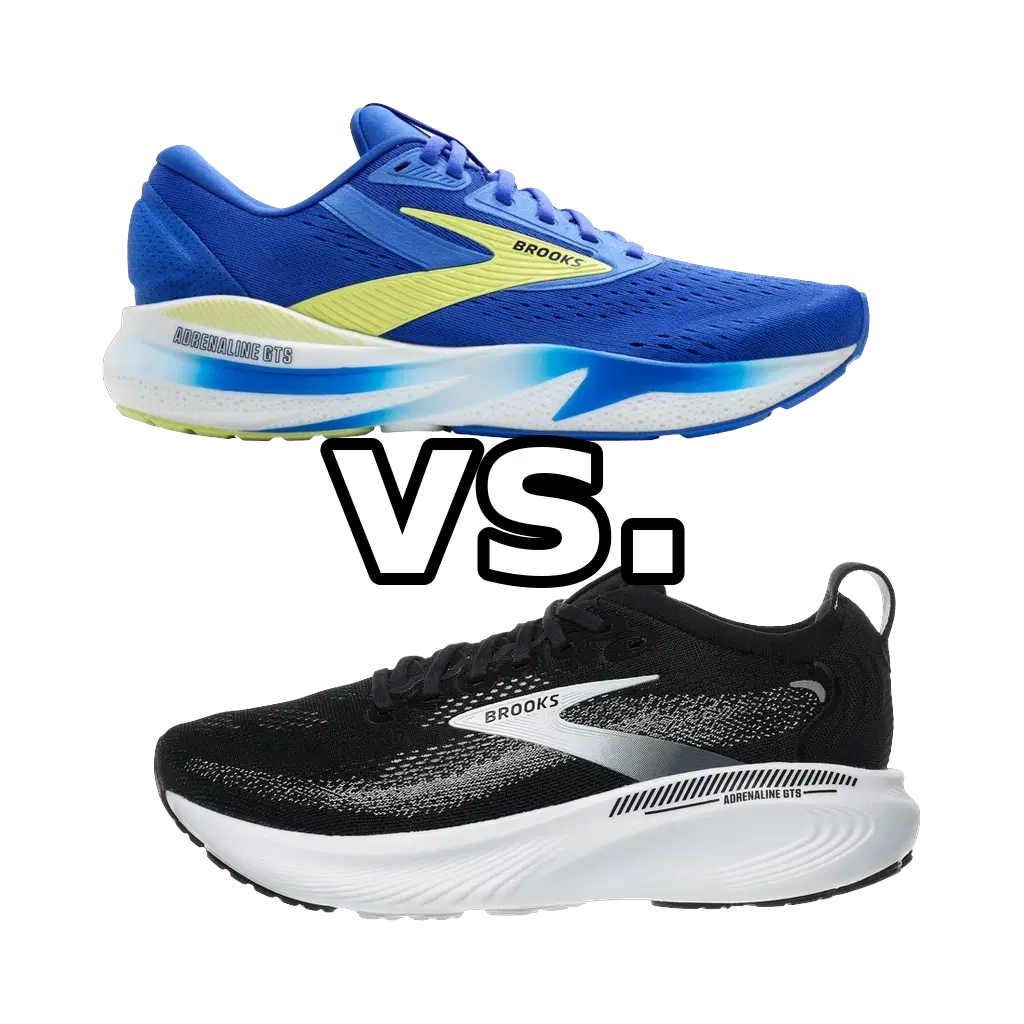
These are close cousins, so the decision hinges on what you value rather than on one clearly outclassing the other. If you're a happy GTS 24 owner who likes a firm, tightly-controlled ride and the 12mm drop, there's no urgent reason to switch — the upgrade is meaningful mainly if you want the softer DNA Loft v3 cushioning, the lower 10mm drop, or the roomier toe box, which are the three things the GTS 25 genuinely does differently. New buyers who want the current, comfort-forward version of this stability workhorse should default to the GTS 25; runners who specifically prefer a firmer, more locked-down feel should seek out the GTS 24.
Pace
3 of 6
Cushioning
4 of 6
Responsiveness
3 of 6
Stability
6 of 6
Drop
12 mm
Support
Stability
Plate
None
Distances
10KHalfMarathon
Pace
3 of 6
Cushioning
4 of 6
Responsiveness
3 of 6
Stability
5 of 6
Drop
10 mm
Support
Stability
Plate
None
Distances
10KHalfMarathon
At a Glance
Brooks Adrenaline GTS 24Brooks Adrenaline GTS 25
Who Should Choose Each Shoe
Choose
Brooks Adrenaline GTS 24
Choose the Adrenaline GTS 24 if you want the most planted, firmly-controlled ride of the two and prefer a traditional 12mm drop — it's an excellent fit for heel strikers, calf-sensitive runners, and anyone who values a slightly firmer, more locked-in stability feel over extra softness. It also makes sense for a GTS 24 owner who is perfectly happy with their current shoe and simply wants to restock a known quantity rather than adapt to a softer foam and lower drop.
Choose
Brooks Adrenaline GTS 25
Choose the Adrenaline GTS 25 if you want the same reliable overpronation support but with a softer, more forgiving DNA Loft v3 ride and a more modern, balanced 10mm drop — it's the better pick for runners who found the GTS 24 a bit firm, or who want more room in the forefoot for wider or higher-volume feet. It's ideal for the everyday runner building steady mileage toward longer races who prioritizes long-haul comfort and smooth, natural-feeling guidance over a firm, planted platform.
Head-to-Head
The two shoes share their entire mission — supportive daily training, GuideRails guidance for overpronation, DNA Loft cushioning, no propulsion plate, and a best-distance range of 10K, half, and full marathon at controlled paces — so the differences are evolutionary rather than dramatic. The clearest change is under the heel: the GTS 24 uses DNA Loft v2, while the GTS 25 moves to a softer, nitrogen-infused DNA Loft v3, giving the newer shoe a more forgiving, cushier impression underfoot even though neither is bouncy or springy. The drop also comes down from 12mm on the GTS 24 to 10mm on the GTS 25, a small shift that makes the 25 feel a touch more balanced front-to-back while still favoring heel strikers. On stability, the GTS 24 is the more locked-down of the pair — the 25's GuideRails are now co-moulded in one piece with the midsole for a smoother, more natural-feeling correction, so it guides rather than firmly braces; both remain genuine overpronation shoes with no intrusive medial post. Fit-wise the GTS 25 opens up slightly, with a roomier toe box that suits wider or higher-volume feet. The trade-off is weight and nimbleness: the GTS 25 comes in around 295g in a men's US 9 and feels sturdy rather than quick, and neither shoe likes being pushed much past a moderate tempo before the flat rebound holds you back.
Similar Comparisons
Brooks Ghost 18 vs Brooks Adrenaline GTS 25

Brooks Adrenaline GTS 25 vs Brooks Glycerin GTS 23

Brooks Adrenaline GTS 25 vs Brooks Beast GTS 26

New Balance Fresh Foam X 860v14 vs Brooks Adrenaline GTS 25

Nike Structure 25 vs Brooks Adrenaline GTS 25

Puma ForeverRun Nitro 2 vs Brooks Adrenaline GTS 25
© 2026 longrunshoes.ai | All rights reserved.
Use of materials from this site is permitted only with proper attribution and a link to longrunshoes.ai.