
Asics Gel-Kayano 33 vs Asics GT-2000 15:
Which to Choose
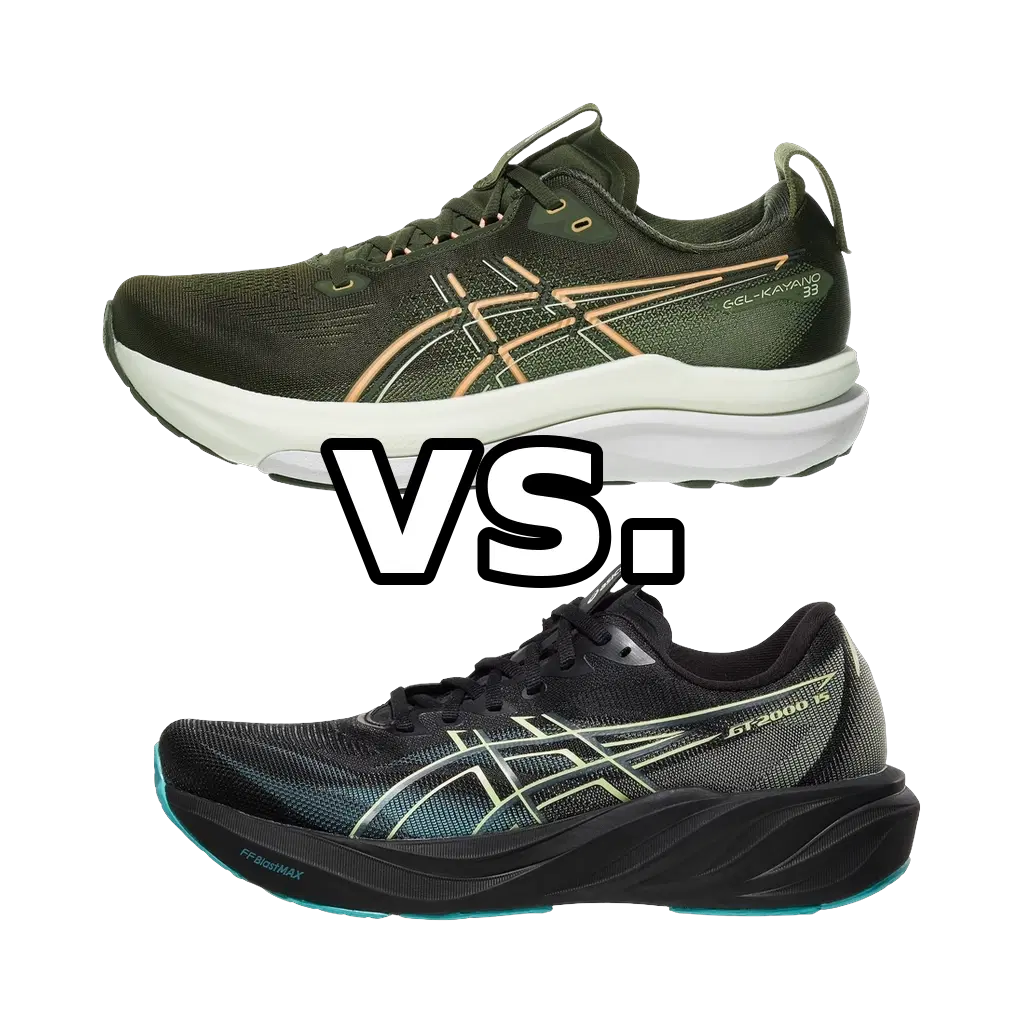
Verdict
These are close cousins with the same mission, so it comes down to support and feel, not category. Go Kayano 33 if you want maximum guided support and a plusher, softer platform and don't mind the extra ~40g; go GT-2000 15 if you want a lighter, firmer, more nimble stability trainer for the bulk of your week. Both are excellent daily trainers and neither is a racer — pick the Kayano when protection and structure lead, the GT-2000 when weight and versatility do.
Pace
3 of 6
Cushioning
5 of 6
Responsiveness
4 of 6
Stability
6 of 6
Drop
8 mm
Support
Stability
Plate
None
Distances
10KHalfMarathon
Pace
3 of 6
Cushioning
4 of 6
Responsiveness
4 of 6
Stability
5 of 6
Drop
8 mm
Support
Stability
Plate
None
Distances
10KHalfMarathon
At a Glance
Asics Gel-Kayano 33Asics GT-2000 15
Who Should Choose Each Shoe
Choose
Asics Gel-Kayano 33
Choose the Gel-Kayano 33 if you want the most support and cushioning Asics offers in a stability shoe — ideal for moderate overpronators, heavier runners, or anyone who prioritizes a plush, well-protected platform for long training runs and steady marathon-pace efforts. It's the better pick if you're willing to carry the extra weight in exchange for that softer top-layer feel and the more actively guided FluidSupport ride, and if past neutral or lighter stability shoes have left your feet wanting more structure.
Choose
Asics GT-2000 15
Choose the GT-2000 15 if you mildly overpronate and want a lighter, more nimble stability trainer that still handles daily volume without feeling like a brick. Its firmer, more grounded FF Blast Max ride suits runners who prefer a composed, connected feel and a bit more pop when they touch tempo pace, and its roughly 40g weight savings makes it the more versatile everyday option for building mileage and picking up the occasional faster stretch.
Head-to-Head
The clearest difference is weight and heft: the Kayano 33 comes in around 298g in a men's US 9, while the GT-2000 15 is roughly 258g — about 40g lighter, which you feel over long runs and when you try to lift the pace. Interestingly, the leaner shoe is not the lower-stack one; the GT-2000 15 measures a touch taller (around 40mm heel / 32mm forefoot, or 38/30 by Asics) than the Kayano's roughly 37mm heel / 28mm forefoot, yet it rides firmer and more grounded because it uses a single full-length FF Blast Max midsole. The Kayano stacks a soft, mildly springy FF Blast Max top layer over firmer FF Blast+ underneath, so its ride reads as plush-but-planted, while the GT-2000 feels composed and predictable rather than pillowy. Support is where the Kayano pulls ahead: it rates a maximal 6/6 with its wide base and FluidSupport geometry for adaptive, guided correction, whereas the GT-2000 sits at a still-high 5/6 — real stability structure, just less of it. Neither is a speed tool: both cap out around tempo efforts (the GT-2000's slightly lighter build gives it marginally more life for a quick stretch), and both are honest mileage shoes, not racers.

© 2026 longrunshoes.ai | All rights reserved.
Use of materials from this site is permitted only with proper attribution and a link to longrunshoes.ai.