
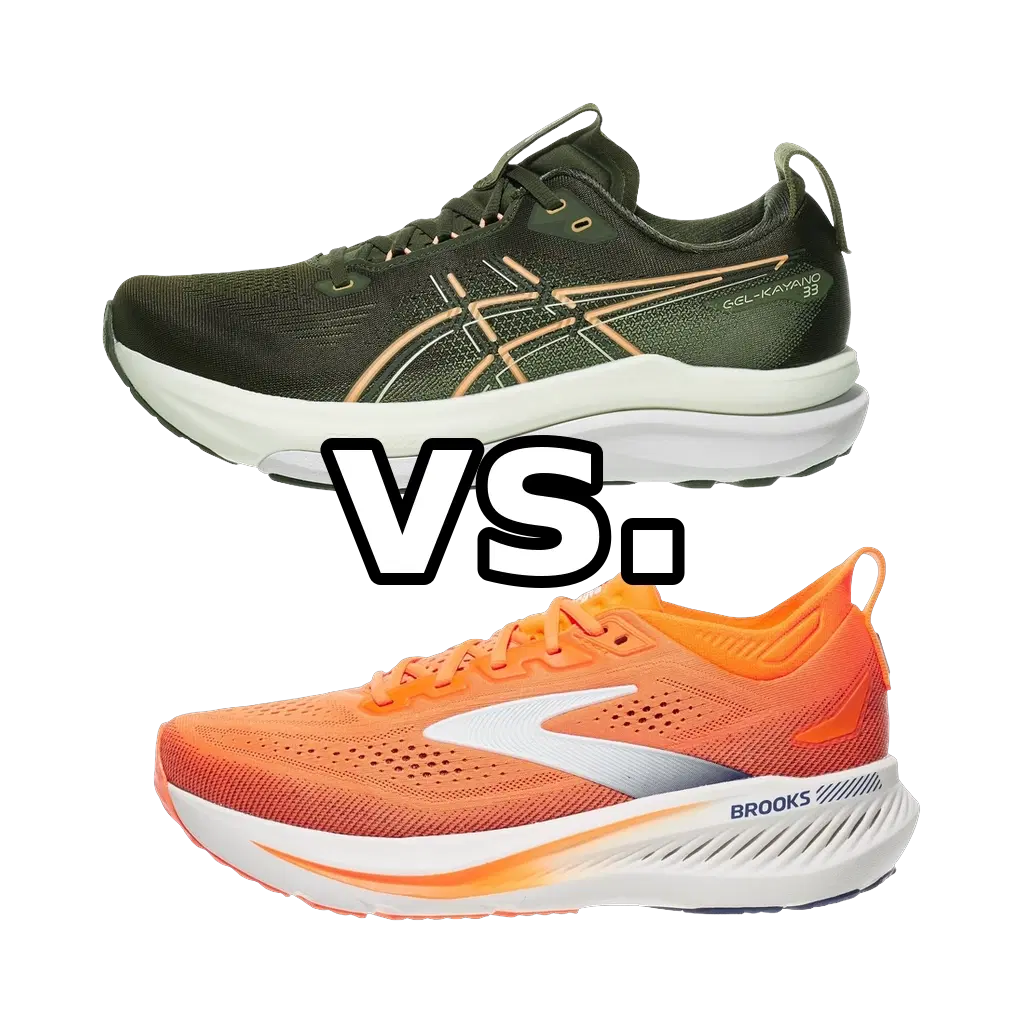
Asics Gel-Kayano 33 vs Brooks Glycerin GTS 23:
Which to Choose
Verdict
These are genuinely close cousins, so it comes down to two things. If you need firmer, more assertive stability or you're training for a marathon, take the Gel-Kayano 33 — it's the more supportive shoe and the one built to go the distance. If your runs cap out at the half and you want the plushest, most protective everyday cushion with a higher drop and a slightly livelier toe-off, the Glycerin GTS 23 is the more comfortable cruiser. Both will serve a mild overpronator well; match the choice to your longest run and how much correction your stride actually wants.
Pace
3 of 6
Cushioning
5 of 6
Responsiveness
4 of 6
Stability
6 of 6
Drop
8 mm
Support
Stability
Plate
None
Distances
10KHalfMarathon
Pace
3 of 6
Cushioning
5 of 6
Responsiveness
4 of 6
Stability
5 of 6
Drop
10 mm
Support
Stability
Plate
None
Distances
10KHalf
At a Glance
Asics Gel-Kayano 33Brooks Glycerin GTS 23
Who Should Choose Each Shoe
Choose
Asics Gel-Kayano 33
Choose the Gel-Kayano 33 if you overpronate mildly to moderately and want the more locked-down, guided platform of the two — its extra stability and controlled ride are the safer bet for runners who need real structure, not just a nudge. It's also the pick if marathon distance is in your plans, since it's the lighter shoe and explicitly built to carry steady long efforts up to 26.2, and its slightly lower 8 mm drop suits those who prefer a touch less heel ramp.
Choose
Brooks Glycerin GTS 23
Choose the Glycerin GTS 23 if you're a mild overpronator who wants soft, joint-protecting comfort with only light guidance underfoot, and your mileage lives in the easy-run to half-marathon range. Its pillowy DNA Tuned landing with a slightly snappier forefoot toe-off will appeal to runners who prioritize plush cushioning for recovery and daily miles, and the higher ~10 mm drop is the friendlier option if you have cranky calves or an Achilles that likes a steeper ramp.
Head-to-Head
On paper these two nearly overlap — cushioning 5/6, responsiveness 4/6, pace 3/6, no plate, stability-category support, and a shared everyday sweet spot around 5:00–6:00 min/km — but the differences are real once you dig in. The Kayano is the more aggressively stabilizing of the pair (6/6 vs 5/6): its wide base plus 4D Guidance and FluidSupport handle mild-to-moderate overpronation, while the Glycerin's GuideRails offer a lighter, guidance-rather-than-correction feel geared to milder pronators. The rides diverge too. The Kayano's dual-layer FF Blast Max over firmer FF Blast+ feels plush but planted and controlled, with smooth guided transitions; the Glycerin's nitrogen-infused DNA Tuned foam lands pillowy-soft but its smaller forefoot cells give a slightly firmer, marginally livelier toe-off. Geometry differs meaningfully: the Kayano sits on a 37 mm heel / 28 mm forefoot stack at an 8 mm drop (lab ~9 mm), while the Glycerin is a hair taller and steeper at 38 mm / 28 mm with a measured ~10 mm drop (Brooks now markets 8 mm) — the higher ramp eases the calves and Achilles. Weight is close, with the Kayano the lighter at ~298 g versus ~306 g for the Glycerin in a men's US 9. The clearest practical split is range: the Kayano is rated for 10K, half, and marathon, while the Glycerin is happiest on easy and long runs and tops out comfortably at the half — both go vague if you push past roughly 4:45 min/km.
Similar Comparisons

Asics Gel-Kayano 32 vs Brooks Glycerin GTS 23
Asics Gel-Kayano 32 vs Asics Gel-Kayano 33

Brooks Glycerin 22 vs Brooks Glycerin GTS 23
Asics Gel-Kayano 33 vs Asics GT-2000 15

Brooks Glycerin 23 vs Brooks Glycerin GTS 23
Asics Gel-Kayano 33 vs Hoka Arahi 8
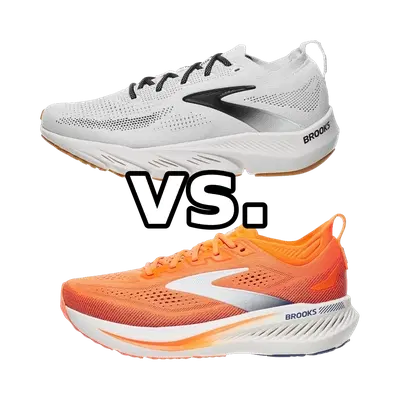
Brooks Glycerin Flex vs Brooks Glycerin GTS 23

Asics Gel-Kayano 33 vs Brooks Ariel GTS 26
© 2026 longrunshoes.ai | All rights reserved.
Use of materials from this site is permitted only with proper attribution and a link to longrunshoes.ai.