
Adidas Supernova Rise 2 vs Mizuno Wave Revolt 3:
Which to Choose
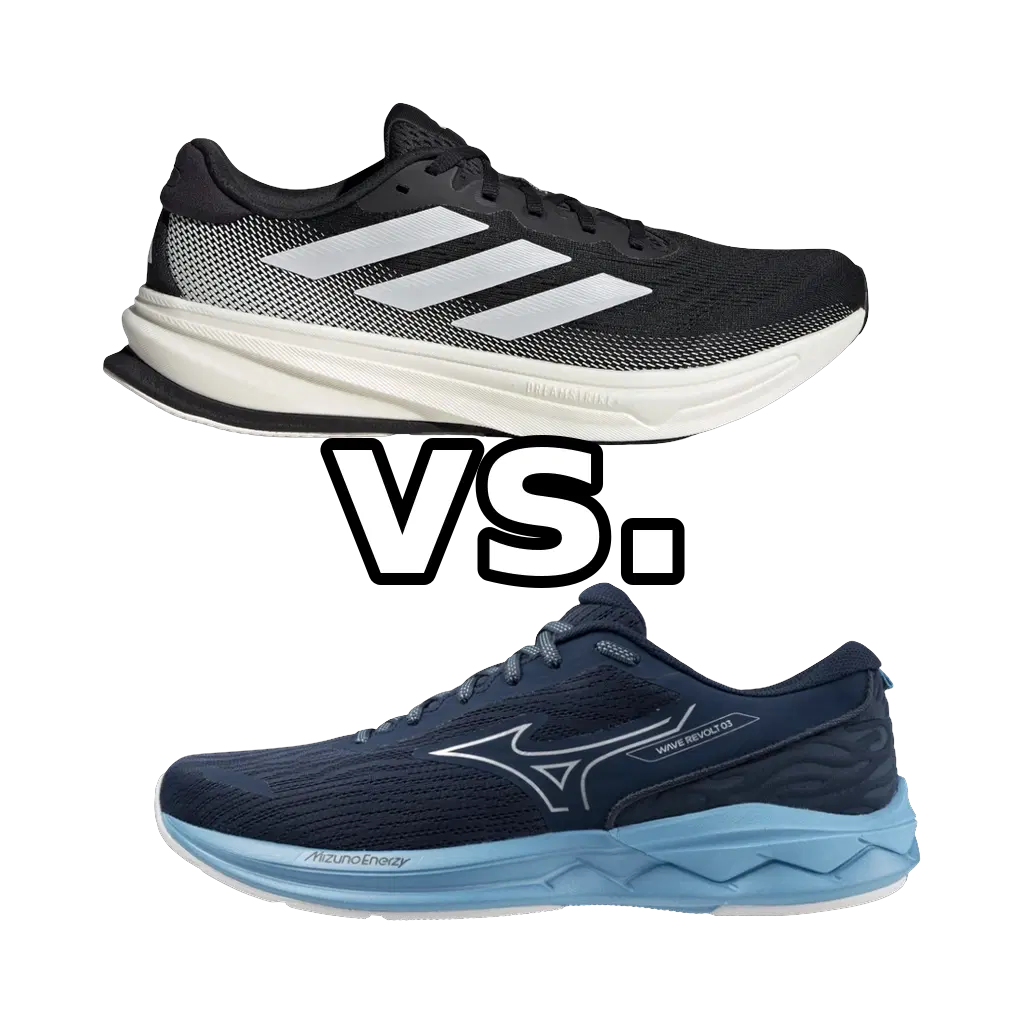
Verdict
These are two very close daily workhorses, so it comes down to feel and geometry rather than capability. Go Supernova Rise 2 for a higher 10mm drop, a slightly livelier ride, and light stable-neutral guidance; go Wave Revolt 3 for a lower 8mm drop, a firmer and more grounded neutral ride, and a build geared toward durability. If you're torn and can't test both, let drop preference and whether you want mild bounce (Adidas) or a planted, structured feel (Mizuno) be the tiebreaker.
Pace
3 of 6
Cushioning
4 of 6
Responsiveness
4 of 6
Stability
4 of 6
Drop
10 mm
Support
Stable Neutral
Plate
Composite
Distances
10KHalfMarathon
Pace
3 of 6
Cushioning
4 of 6
Responsiveness
3 of 6
Stability
4 of 6
Drop
8 mm
Support
Neutral
Plate
Composite
Distances
10KHalfMarathon
At a Glance
Adidas Supernova Rise 2Mizuno Wave Revolt 3
Who Should Choose Each Shoe
Choose
Adidas Supernova Rise 2
Pick the Supernova Rise 2 if you're a heel striker or simply prefer a higher 10mm drop, and you want your daily trainer to have a bit more life underfoot when you decide to push the pace. It's the better call for neutral-to-mildly-overpronating runners who want that subtle guidance from the Support Rods, and for anyone who finds a grounded, firm ride dull and wants mild bounce on long runs and marathon training.
Choose
Mizuno Wave Revolt 3
Choose the Wave Revolt 3 if you're a neutral runner who values a firm, planted, predictable ride over any sense of bounce, and you want a shoe built to grind out high-mileage weeks. It's especially well suited to beginners and intermediates logging controlled 10K-to-marathon training who prioritize durability and a composed, structured transition at steady long-run efforts, and who prefer a lower 8mm drop that keeps footstrike flexible.
Head-to-Head
On paper these two are close: both sit at cushioning 4/6, stability 4/6, and pace 3/6, both run best at 10K, half, and marathon distances, and both use a composite structural element rather than a springy superfoam plate. The stack numbers underline how similar they are — the Supernova Rise 2 measures 36mm in the heel and 26mm in the forefoot, the Wave Revolt 3 measures 34mm heel and 26mm forefoot — so forefoot protection is effectively identical and the heel is only marginally taller on the Adidas. The clearest hardware difference is drop: 10mm on the Supernova versus 8mm on the Mizuno, giving the Adidas a more traditional heel-biased geometry that tends to suit heel strikers, while the Mizuno's 8mm offset keeps footstrike a touch more versatile. Ride character is where they genuinely diverge. The Supernova's Dreamstrike+ foam is mildly bouncy and a little livelier (responsiveness 4/6), with Support Rods adding gentle guidance, so it's a shade more willing when you lift the effort — its sweet spot runs to roughly 4:45–5:00 min/km. The Wave Revolt 3 feels firmer and more grounded (responsiveness 3/6): its Enerzy foam is soft-but-composed and the molded Wave plate delivers a structured, planted transition that rewards smooth cadence over aggressive push-off, with its fastest comfortable zone a notch slower at about 5:00–5:15 min/km. On support, the Adidas is tuned stable-neutral — a moderately wide platform with light guidance that tolerates mild overpronation — whereas the Mizuno is a true neutral shoe whose Wave plate broadens the base for a planted feel without steering the foot. Both ride in similar daily-trainer weight territory, with the Mizuno's durable rubber outsole and build clearly engineered for high-mileage longevity.
Similar Comparisons
Salomon Spectur 2 vs Mizuno Wave Revolt 3

Adidas Supernova Rise 2 vs Adidas Supernova Solution 2.0

Adidas Supernova Rise 2 vs Adidas Supernova Stride 2

Adidas Supernova Rise 2 vs Adidas Supernova Rise 3

Adidas Supernova Rise 2 vs Mizuno Wave Prodigy 6

Adidas Supernova Rise 2 vs Mizuno Wave Ultima 16
© 2026 longrunshoes.ai | All rights reserved.
Use of materials from this site is permitted only with proper attribution and a link to longrunshoes.ai.