
Puma Deviate Nitro 3 vs Puma Deviate Nitro 4:
Which to Choose
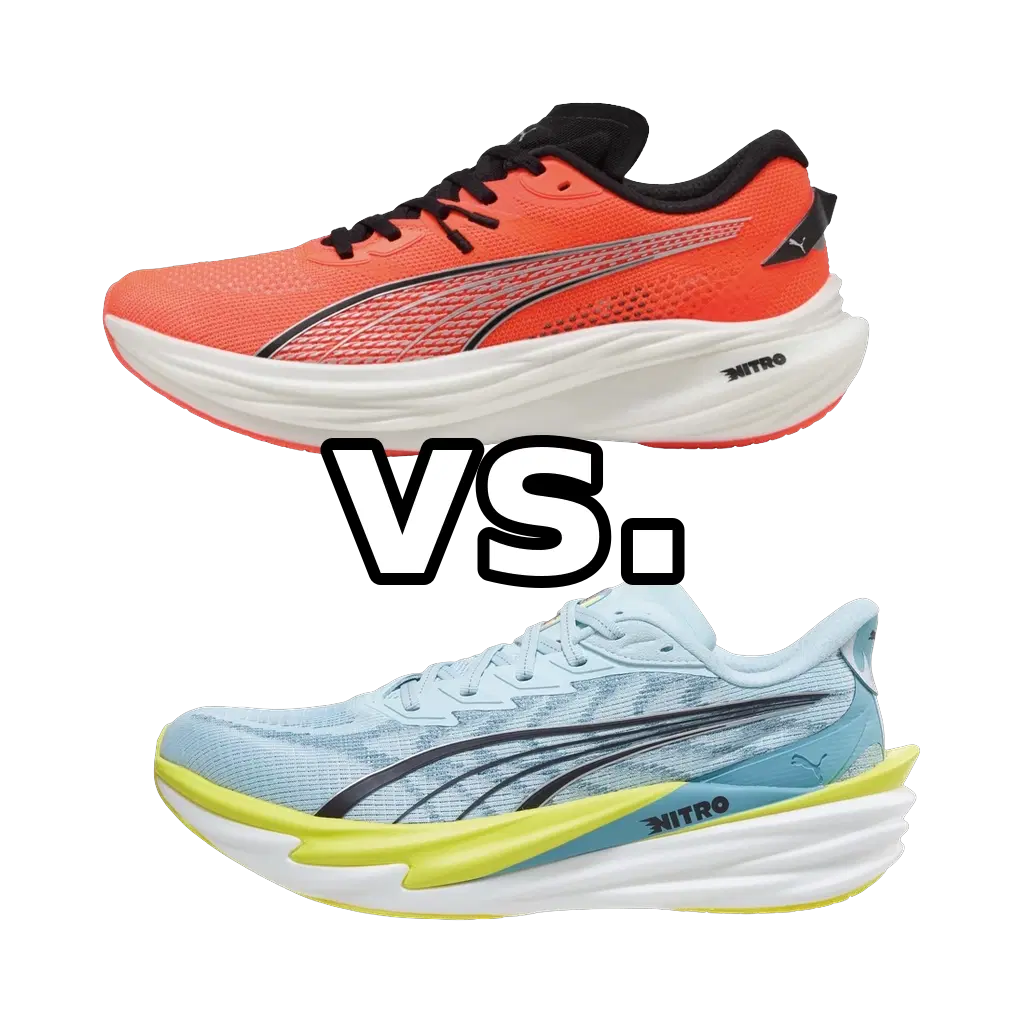
Verdict
This is a genuine, if incremental, upgrade rather than a redesign. If you love your Nitro 3 for its cushioning and comfort, there's no urgency to switch — the core identity is unchanged. But if you want the same shoe made lighter, lower, and snappier, the Nitro 4 is the clear pick, and it's the model to buy if you're coming in fresh. It comes down to whether you weight plush protection (Nitro 3) or quick, responsive agility (Nitro 4).
Pace
4 of 6
Cushioning
5 of 6
Responsiveness
5 of 6
Stability
4 of 6
Drop
8 mm
Support
Neutral
Plate
Carbon
Distances
10KHalfMarathon
Pace
4 of 6
Cushioning
4 of 6
Responsiveness
5 of 6
Stability
4 of 6
Drop
7 mm
Support
Neutral
Plate
Carbon
Distances
10KHalfMarathon
At a Glance
Puma Deviate Nitro 3Puma Deviate Nitro 4
Who Should Choose Each Shoe
Choose
Puma Deviate Nitro 3
Choose the Deviate Nitro 3 if you prioritize cushioning and heel comfort over outright quickness — its taller stack and higher offset give a touch more protection underfoot on long steady efforts, and the slightly more ramped 8mm-ish geometry suits heel-leaning runners who want a smoother landing. It's a strong pick for the recreational marathoner or half-marathoner who values a composed, planted, well-cushioned ride and isn't chasing the last bit of forefoot snap.
Choose
Puma Deviate Nitro 4
Choose the Deviate Nitro 4 if you want the same versatile do-everything trainer but lighter, lower, and more responsive — its ~21g weight saving, lower-profile 7mm ride, and PEBA-based foam make it feel more alive when you push toward faster tempo and workout paces. It's the better fit for the runner who does more uptempo and progression work, prefers a closer-to-the-ground and more agile feel, or wants a fit with a bit more room up front from the wider upper. For a current Nitro 3 owner, it's a worthwhile upgrade specifically if you found the 3 a little heavy or wished it came alive more readily at speed.
Head-to-Head
These two share a skeleton: a full-length carbon PWRPLATE, PUMAGRIP outsole, breathable engineered-mesh upper, a neutral platform, and identical high responsiveness — both are fast trainers that reward a committed midfoot roll and feel slightly businesslike at very easy jogging paces. The differences are refinements rather than a reinvention, but they add up. The Nitro 4 is meaningfully lighter, at 247g versus the Nitro 3's 268g (men's US 9), and it sits lower and closer to the ground — a 34mm heel and 27mm forefoot against the Nitro 3's 37.4mm heel and 27.3mm forefoot. That drops the effective ride from a taller ~10mm offset on the Nitro 3 to a flatter ~7mm on the Nitro 4, which the metrics reflect as a small step down in cushioning (from high to above-average). The other substantive upgrade is the foam itself: the Nitro 3 uses Puma's nitrogen-infused Nitro compound, while the Nitro 4 moves to a PEBA-based NITROFOAM — the same family of material Puma uses in its race-day shoes — for a springier, more energetic rebound. The Nitro 4 also gets a newly wider engineered-mesh upper for a more accommodating fit. The net effect is that the Nitro 4 feels quicker and more agile as you lean into pace, trading a sliver of the Nitro 3's underfoot plushness and heel comfort for a nimbler, more propulsive ride. Both still peak as half-marathon shoes and both handle 10K through the marathon, so the use case hasn't changed — the Nitro 4 just executes it with a lighter, snappier character.
Similar Comparisons

Puma Deviate Nitro 4 vs Hoka Mach 7
© 2026 longrunshoes.ai | All rights reserved.
Use of materials from this site is permitted only with proper attribution and a link to longrunshoes.ai.