
Adidas Adizero Boston 13 vs Puma Deviate Nitro 4:
Which to Choose

Verdict
These two overlap enough that you won't be disappointed either way, so the choice comes down to how you actually run. If you spend real time at tempo and marathon pace and want a shoe that can also race, the Boston 13's higher cushioning, faster tuning, and snappy EnergyRods make it the pick. If you want a single, forgiving all-rounder for mostly steady training with the occasional faster day, the Deviate Nitro 4's smoother, more versatile carbon-plated ride fits better. Match the shoe to your paces, not the other way around.
Pace
5 of 6
Cushioning
5 of 6
Responsiveness
5 of 6
Stability
4 of 6
Drop
6 mm
Support
Neutral
Plate
Composite
Distances
10KHalfMarathon
Pace
4 of 6
Cushioning
4 of 6
Responsiveness
5 of 6
Stability
4 of 6
Drop
7 mm
Support
Neutral
Plate
Carbon
Distances
10KHalfMarathon
At a Glance
Adidas Adizero Boston 13Puma Deviate Nitro 4
Who Should Choose Each Shoe
Choose
Adidas Adizero Boston 13
Choose the Boston 13 if you train with intent and want one shoe that can handle tempo runs, marathon-pace work, and the occasional race without resorting to a fragile carbon racer. It's the better pick for intermediate-to-experienced runners who genuinely spend time in the quicker zones (sub-4:30 min/km), want a bit more underfoot protection for fast long runs, and prefer the flexible, snappy feel of EnergyRods to a stiff full plate. If your hard days are actually hard, this is the sharper tool.
Choose
Puma Deviate Nitro 4
Choose the Deviate Nitro 4 if you're a recreational or developing runner who wants one pair to cover most of the week — steady daily miles plus the occasional tempo or progression run — rather than a dedicated race-day weapon. Its carbon plate is tuned to be forgiving and durable for repeated training use, and its optimal pace window is a more accessible, moderate range, so it suits runners who aren't routinely hammering sub-4:30 kilometers. Pick it for training versatility over outright speed.
Head-to-Head
On paper they're close cousins. Both are neutral (no medial post), both score above-average for stability off a moderately wide, plate-stiffened platform, and both deliver high responsiveness from a lively PEBA-class foam. Their drops are effectively the same — 6mm on the Boston, 7mm on the Deviate — and they weigh within a few grams of each other, so neither carries a meaningful weight penalty. The ride character rhymes too: both feel a touch stiff and businesslike at a true easy jog and only come alive when you lean into the pace. The decisive differences are in tuning and intent. The Boston is the racier of the two: it rates higher for both pace and cushioning, runs on a dual-density Lightstrike Pro-over-Lightstrike 2.0 midsole, and its glass-fiber EnergyRods give a snappy, flexible, quick-rolling transition that rewards a fast cadence — its sweet spot sits in the roughly 3:50–4:30 min/km tempo-to-marathon-pace zone. The Deviate takes a different route to a similar place: its full-length carbon PWRPLATE over nitrogen-injected NITROFOAM produces a smoother, more rolling push, but it's tuned as an uptempo trainer rather than a racer, happiest around 4:15–5:15 min/km. Counterintuitively, the carbon-plated Puma is the more everyday-friendly, slightly less cushioned shoe, while the rod-based adidas is the more protective and more aggressive one. Both handle 10K, half, and marathon distances; the Boston's center of gravity is the half-to-marathon fast long run and race day, while the Deviate's is versatile half-marathon training and steady racing.
Similar Comparisons
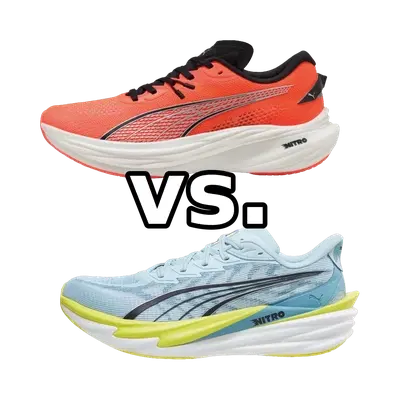
Puma Deviate Nitro 3 vs Puma Deviate Nitro 4

Adidas Adizero Boston 13 vs Nike Vomero Plus
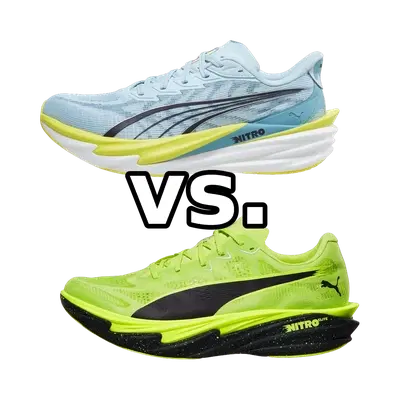
Puma Deviate Nitro 4 vs Puma Deviate Nitro Elite 4

Adidas Adizero Boston 13 vs Saucony Endorphin Speed 5

Puma Deviate Nitro 4 vs Hoka Mach 7

Adidas Adizero Boston 13 vs Hoka Mach X 3
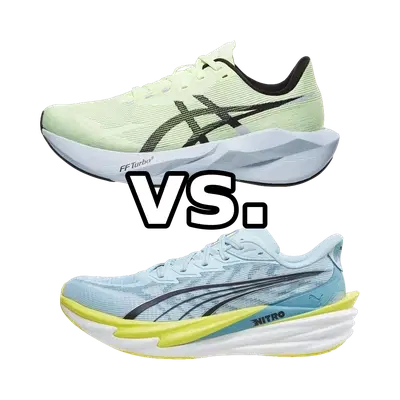
Asics Novablast 6 vs Puma Deviate Nitro 4
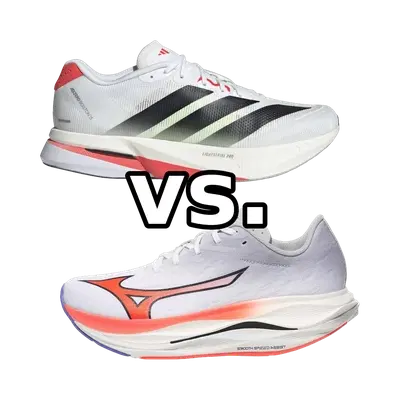
Adidas Adizero Boston 13 vs Mizuno Wave Rebellion Flash 3
© 2026 longrunshoes.ai | All rights reserved.
Use of materials from this site is permitted only with proper attribution and a link to longrunshoes.ai.