
Puma Deviate Nitro 4 vs Hoka Mach 7:
Which to Choose
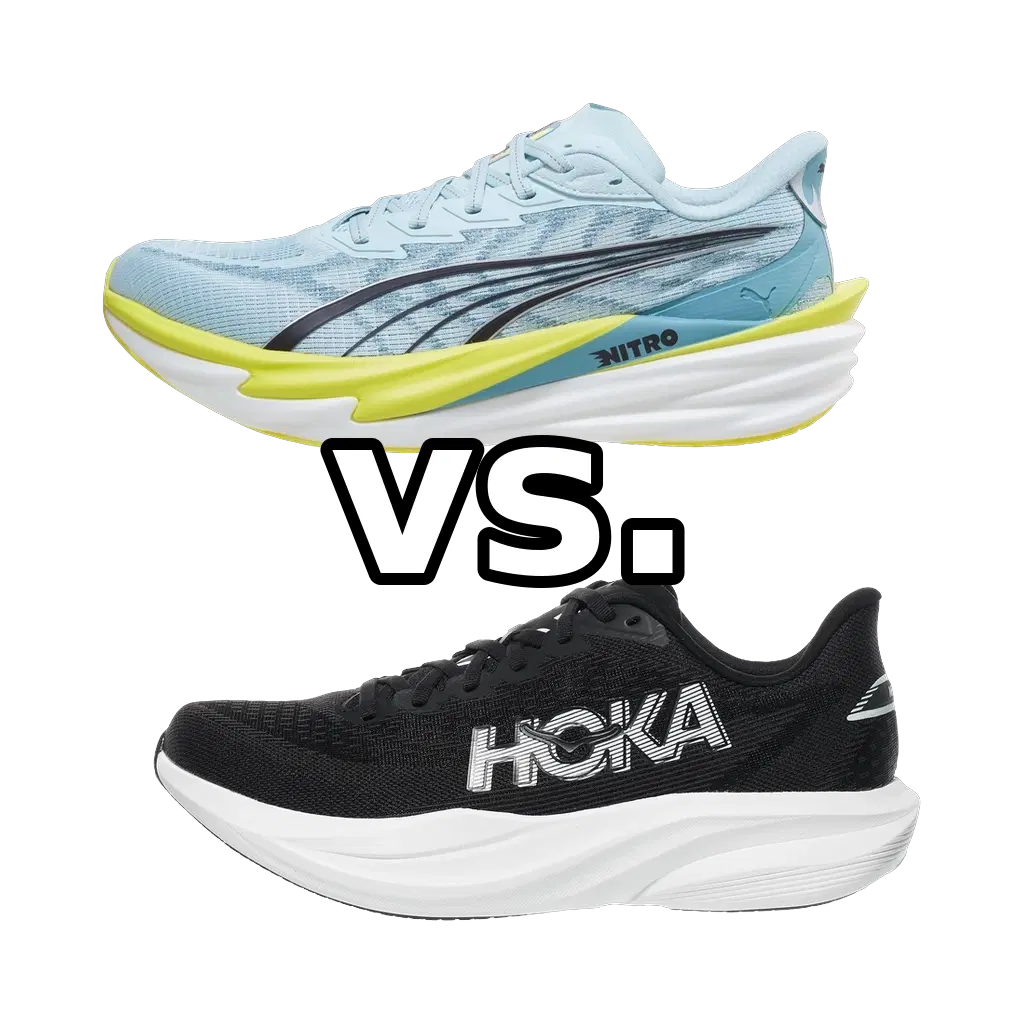
Verdict
Both are excellent, closely matched neutral daily trainers, so the decision hinges on what you want underfoot rather than which is "better." Go with the newer Deviate Nitro 4 for a heavier but more propulsive, stable, plated ride that leans toward uptempo and race-day training; go with the Mach 7 for a lighter, lower, plateless trainer with more ground feel and a higher drop for everyday steady miles.
Pace
4 of 6
Cushioning
4 of 6
Responsiveness
5 of 6
Stability
4 of 6
Drop
7 mm
Support
Neutral
Plate
Carbon
Distances
10KHalfMarathon
Pace
4 of 6
Cushioning
4 of 6
Responsiveness
4 of 6
Stability
3 of 6
Drop
10 mm
Support
Neutral
Plate
None
Distances
10KHalfMarathon
At a Glance
Puma Deviate Nitro 4Hoka Mach 7
Who Should Choose Each Shoe
Choose
Puma Deviate Nitro 4
Choose the Deviate Nitro 4 if you want the most propulsive, race-adjacent ride of the two and are willing to carry a little extra weight for it — the carbon plate and PEBA foam reward runners who regularly push into tempo and progression efforts and want that rolling forward assist on longer half and marathon workouts. It's also the better pick if you value a planted, stable platform and a moderate 7 mm drop, or if you're stepping up from a plateless trainer and want a taste of super-shoe mechanics in an everyday package.
Choose
Hoka Mach 7
Choose the Mach 7 if you prize a light, low, connected ride and prefer natural spring over a plated push — at 224 g with good ground feel, it's the more agile everyday trainer for runners who want to feel the road and rack up steady daily miles. It also suits heel strikers who get on better with a higher (roughly 10 mm) drop, and anyone who'd rather not have a stiff plate dictating their footstrike on easy and steady runs.
Head-to-Head
The clearest fork is the plate. The Deviate Nitro 4 runs a full-length PWRPLATE carbon plate under nitrogen-injected NITROFOAM (a PEBA-based foam), which gives it a smooth, rolling toe-off and the snappier rebound reflected in its higher responsiveness — it genuinely comes alive when you lean into pace. The Mach 7 is plateless, relying on springy supercritical EVA and a mild rocker; it's lively and quick but the propulsion is softer and more natural, driven by geometry rather than a stiff lever. Weight favors the Hoka, at 224 g (men's US 9) versus 247 g for the Puma — a real gap you'll notice, and part of why the Mach feels nimble despite having no plate. Stack heights are close overall (Puma 34/27 mm, Hoka 36/26 mm), but the measured drops diverge: the Deviate sits at a moderate 7 mm while the Mach 7 measures around 10 mm, a steeper heel-to-toe ramp that heel strikers may prefer. The Puma is the more planted, stable platform of the two (its plate stiffens and steadies the ride), whereas the Mach 7 is lower to the ground with better road feel but a slightly less locked-in feel underfoot. Both share the same honest weakness — a firm, businesslike character at very slow recovery paces — and both are happiest in the steady-to-tempo zone rather than at flat-out racing speed.
Similar Comparisons

Hoka Mach 6 vs Hoka Mach 7
Puma Deviate Nitro 4 vs Puma Deviate Nitro Elite 4
Hoka Mach 7 vs Hoka Mach X 3

Saucony Endorphin Speed 5 vs Hoka Mach 7

Adidas Adizero Evo SL vs Hoka Mach 7

Brooks Hyperion 3 vs Hoka Mach 7
Asics Dynablast 5 vs Hoka Mach 7

On Cloudsurfer 2 vs Hoka Mach 7
© 2026 longrunshoes.ai | All rights reserved.
Use of materials from this site is permitted only with proper attribution and a link to longrunshoes.ai.