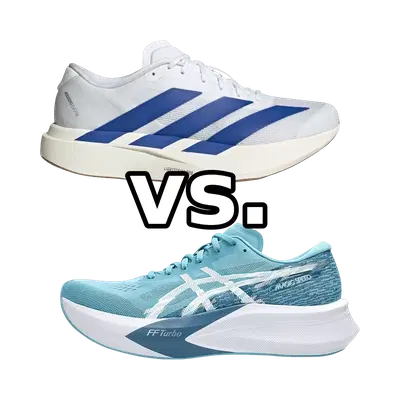
Adidas Adizero Evo SL vs Hoka Mach 7:
Which to Choose
Verdict
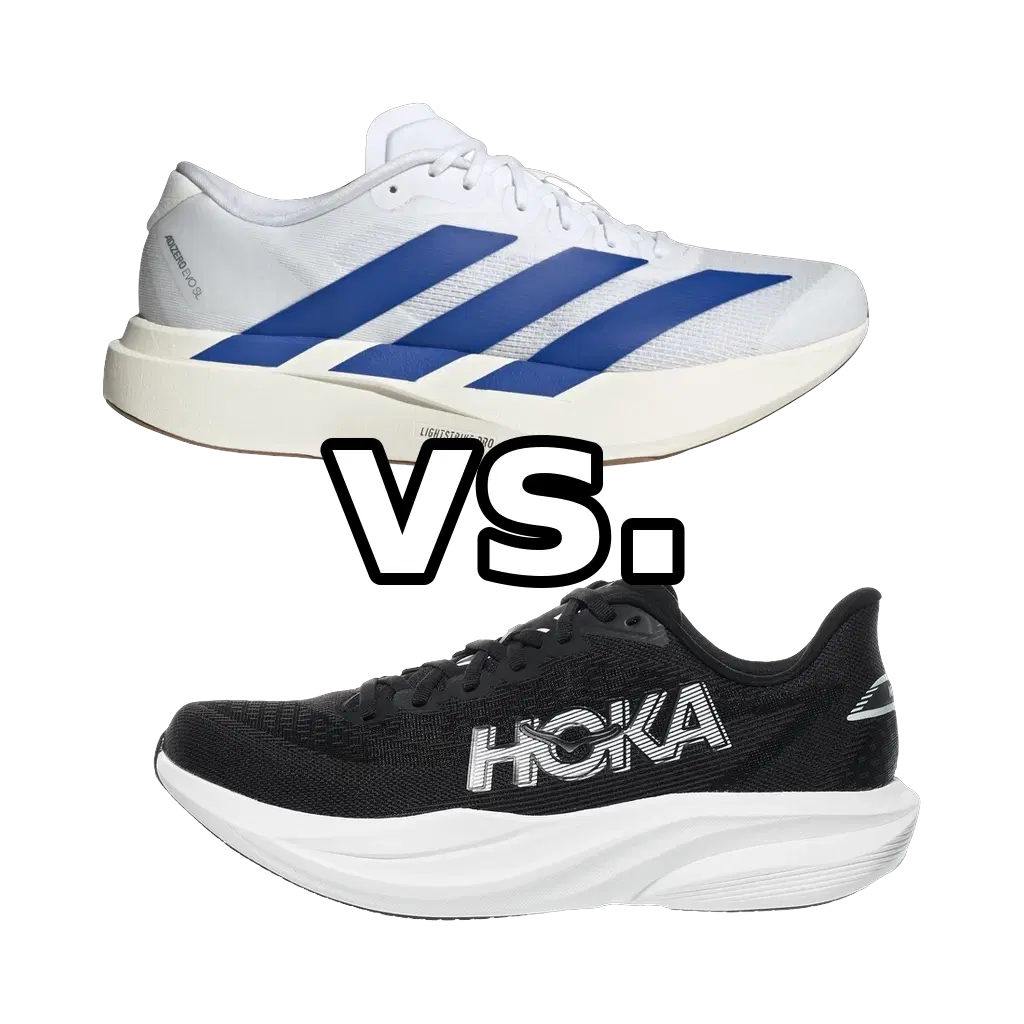
These aren't really rivals so much as specialists for different halves of your training. It comes down to what dominates your week: if it's speed and shorter racing, the Evo SL's softer, springier PEBA-class foam and taller forefoot make it the more thrilling and effective fast shoe. If it's mileage and versatility — one trainer that goes from easy days to the marathon — the firmer, lower, rocker-driven Mach 7 is the more sensible everyday choice. Same weight, different missions; pick the mission that matches your calendar.
Pace
5 of 6
Cushioning
5 of 6
Responsiveness
5 of 6
Stability
3 of 6
Drop
6 mm
Support
Neutral
Plate
None
Distances
5K10KHalf
Pace
4 of 6
Cushioning
4 of 6
Responsiveness
4 of 6
Stability
3 of 6
Drop
10 mm
Support
Neutral
Plate
None
Distances
10KHalfMarathon
At a Glance
Adidas Adizero Evo SLHoka Mach 7
Who Should Choose Each Shoe
Choose
Adidas Adizero Evo SL
Choose the Evo SL if the exciting part of your week is the fast part — tempo runs, intervals, and racing 5K through the half — and you want that soft-yet-springy PEBA-class rebound underfoot without committing to a rigid carbon racer. It rewards experienced and improving runners who spend real time at 3:45–4:30 min/km and want a lively trainer that comes alive when they engage it. It's the pick if you already have an easy-day shoe and want something that snaps at the 10K sweet spot rather than something that plods.
Choose
Hoka Mach 7
Choose the Mach 7 if you want one shoe to handle most of your week — easy miles, steady runs, the occasional tempo, and long efforts up to the marathon — and you value a firm, connected, no-nonsense ride over maximum bounce. Its lower forefoot and mild rocker suit runners who want reliable ground feel and don't mind a firmer platform on recovery days, and its comfort range extends to distances the Evo SL isn't built for. It's the safer single-shoe rotation for the versatility-first runner logging steady mileage rather than chasing pace.
Head-to-Head
Start with the midsole, because that's where these two part ways. The Evo SL runs a full-length PEBA-class Lightstrike Pro foam — the same energetic, race-derived material that feels soft yet springy and rewards a quick, purposeful footstrike; the Mach 7 uses supercritical EVA, which is livelier than standard foam but distinctly firmer and more "businesslike," relying on a mild rocker to smooth transitions. Neither has a plate, so both let the foam do the work, but the Evo SL's foam is the more explosive of the two. Geometry reinforces that: the Evo SL stacks 39mm heel / 33mm forefoot on a 6mm drop, while the Mach 7 sits lower with a more sloped feel — 36mm heel / 26mm forefoot, with a measured drop closer to 10mm despite Hoka's 5mm listing. That taller, more level forefoot on the Evo SL is a big part of why it feels bouncy and protective when you push, whereas the Mach 7's lower-slung forefoot gives noticeably more ground feel and connection to the road. Their pace windows tell the rest of the story: the Evo SL is optimized for roughly 3:45–4:30 min/km with a 10K sweet spot and a genuine fast zone down near 3:45–4:00, while the Mach 7 lives at 4:30–5:30 min/km, covering steady-to-tempo work and stretching from easy miles all the way to the marathon. On stability they're a wash — both are neutral, unposted, and rated the same, though the Evo SL's tall soft platform can feel slightly unsettled at true jogging speeds, exactly where the firmer Mach 7 stays composed. In short: same weight, similar overall footprint, but the Evo SL is the sharper race-day-adjacent tool and the Mach 7 is the more versatile everyday workhorse.
Similar Comparisons
Hoka Mach 6 vs Hoka Mach 7

Adidas Adizero Evo SL vs Nike Structure 26
Hoka Mach 7 vs Hoka Mach X 3

Adidas Adizero Evo SL vs Saucony Endorphin Speed 5
Saucony Endorphin Speed 5 vs Hoka Mach 7

Adidas Adizero Evo SL vs Saucony Endorphin Azura
Puma Deviate Nitro 4 vs Hoka Mach 7

Adidas Adizero Evo SL vs Puma Deviate Pure Nitro
© 2026 longrunshoes.ai | All rights reserved.
Use of materials from this site is permitted only with proper attribution and a link to longrunshoes.ai.