
Adidas Adizero Evo SL vs Puma Deviate Pure Nitro:
Which to Choose

Verdict
It depends on the distance and role you're buying for. If you want a dedicated speed and short-to-half racing tool with a soft, low-drop, snappy ride, take the Adizero Evo SL; if you want one grounded, higher-drop trainer that spans easy days through the marathon, take the Deviate Pure Nitro. Both are excellent plateless PEBA super-trainers — the deciding factor is whether you're optimizing for fast, focused sessions (Adidas) or all-purpose versatility and longer distance (Puma).
Pace
5 of 6
Cushioning
5 of 6
Responsiveness
5 of 6
Stability
3 of 6
Drop
6 mm
Support
Neutral
Plate
None
Distances
5K10KHalf
Pace
4 of 6
Cushioning
4 of 6
Responsiveness
5 of 6
Stability
3 of 6
Drop
9 mm
Support
Neutral
Plate
Composite
Distances
10KHalfMarathon
At a Glance
Adidas Adizero Evo SLPuma Deviate Pure Nitro
Who Should Choose Each Shoe
Choose
Adidas Adizero Evo SL
Choose the Adizero Evo SL if your week revolves around tempo runs, intervals, and racing 5K to half marathon, and you want a lively, soft-but-springy ride that comes alive when you push the pace. It's the better pick for experienced and improving recreational runners who like a low 6mm drop and a bouncy foam-only feel, and who don't need a shoe that doubles as a slow recovery cruiser — this one prefers to move.
Choose
Puma Deviate Pure Nitro
Choose the Deviate Pure Nitro if you want one versatile trainer that can log easy miles, handle steady tempo work, and go the full marathon distance without swapping shoes. Its higher 9mm drop, firmer and more grounded ride, and midfoot shank suit intermediates who value a connected, do-it-all feel over maximum softness — and who prioritize range from 10K up to the marathon rather than sharpening pure short-distance speed.
Head-to-Head
On paper these shoes look like cousins — both neutral, both rated the same for responsiveness and stability, both driven by bouncy PEBA-based foam (Lightstrike Pro in the Adidas, NITROFOAM in the Puma) rather than a stiff plate. Weight is close too: the Evo SL comes in around 224g and the Deviate Pure Nitro around 215g in a men's sample, so both feel genuinely light underfoot with the Puma just a hair lighter. The real separation is in geometry and character. The Evo SL runs a lower 6mm drop on a taller, softer platform (roughly 39mm heel / 33mm forefoot) and carries more cushioning, giving it a plush, springy ride that rewards a quick footstrike but can feel slightly tippy and unsettled when you're just jogging. The Deviate Pure Nitro sits at a higher ~9mm drop on a slightly lower, firmer stack (about 37mm heel / 28mm forefoot) with a small composite midfoot shank for structure, so it feels more connected and grounded — firm and eager at a shuffle, smooth and rolling once the pace lifts. That translates into different sweet spots: the Evo SL is happiest at faster paces (roughly 3:45–4:30 min/km) with the 10K as its bullseye, while the Deviate is optimized for a more moderate range (about 4:30–5:30 min/km) with the half marathon as its home and enough cushioning to genuinely handle marathon distance. In short, the Adidas is the sharper, softer, speed-biased tool; the Puma is the firmer, more even-tempered shoe that covers a wider range of paces and distances.
Similar Comparisons
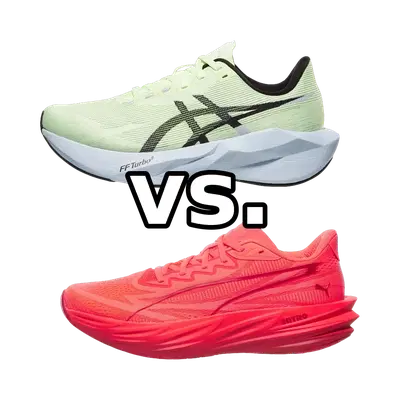
Asics Novablast 6 vs Puma Deviate Pure Nitro

Adidas Adizero Evo SL vs Nike Structure 26

Saucony Endorphin Speed 5 vs Puma Deviate Pure Nitro

Adidas Adizero Evo SL vs Saucony Endorphin Speed 5
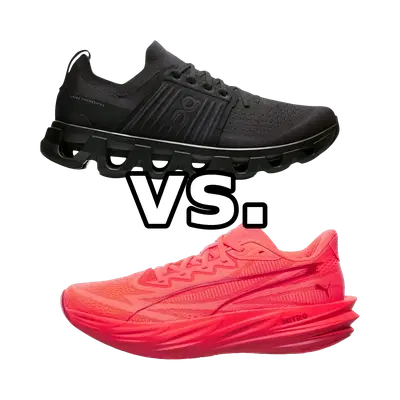
On Cloudswift 4 vs Puma Deviate Pure Nitro

Adidas Adizero Evo SL vs Saucony Endorphin Azura
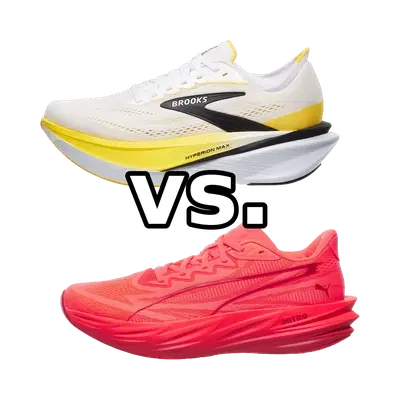
Brooks Hyperion Max 4 vs Puma Deviate Pure Nitro

Adidas Adizero Evo SL vs Hoka Mach 7
© 2026 longrunshoes.ai | All rights reserved.
Use of materials from this site is permitted only with proper attribution and a link to longrunshoes.ai.