
Adidas Adizero Boston 13 vs Hoka Mach X 3:
Which to Choose
Verdict
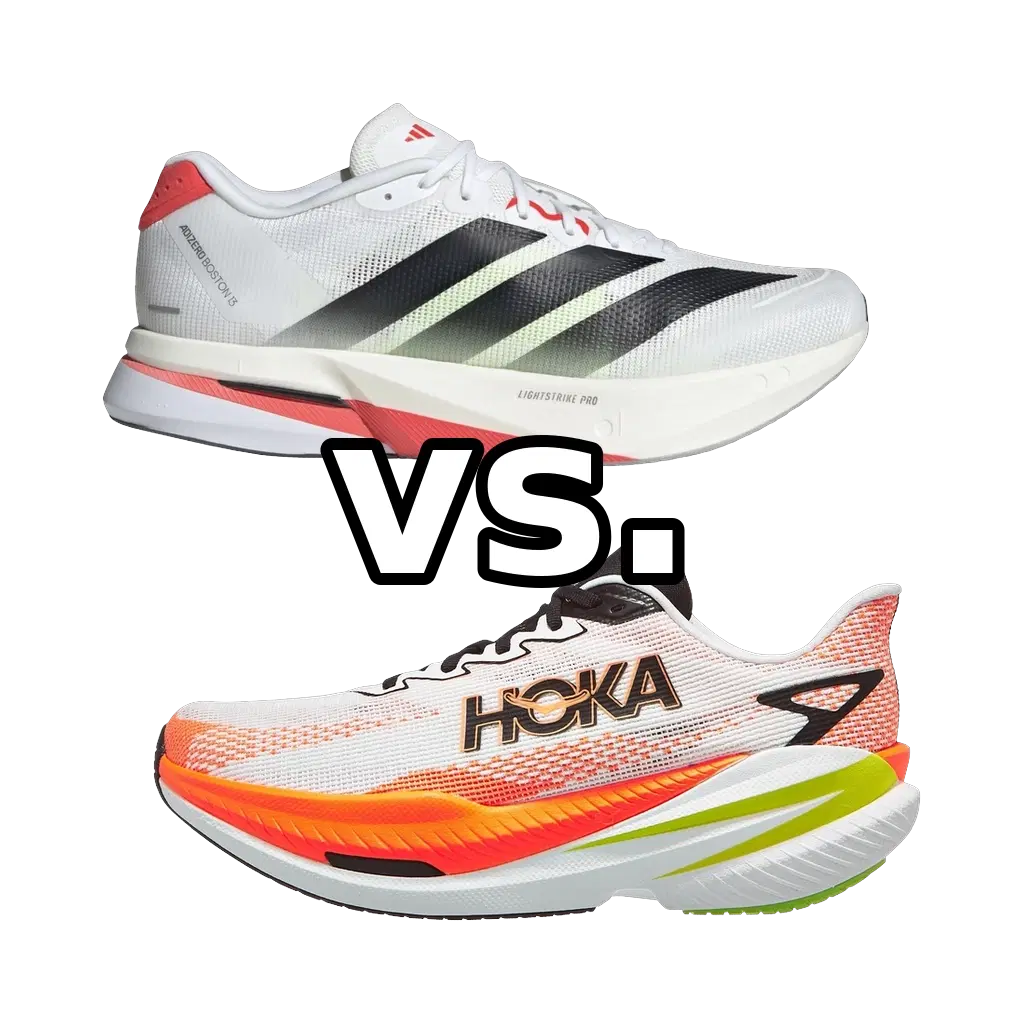
There's no wrong answer here — these are two takes on the same super-trainer brief, and the choice hinges on ride geometry and fit rather than capability. Go Boston 13 for a lower, firmer, snappier, quick-cadence ride in a more standard width; go Mach X 3 for a taller, softer, higher-drop platform that's easier on the calves over long miles, provided your foot fits its narrow last.
Pace
5 of 6
Cushioning
5 of 6
Responsiveness
5 of 6
Stability
4 of 6
Drop
6 mm
Support
Neutral
Plate
Composite
Distances
10KHalfMarathon
Pace
5 of 6
Cushioning
5 of 6
Responsiveness
5 of 6
Stability
4 of 6
Drop
10 mm
Support
Neutral
Plate
Composite
Distances
10KHalfMarathon
At a Glance
Adidas Adizero Boston 13Hoka Mach X 3
Who Should Choose Each Shoe
Choose
Adidas Adizero Boston 13
Choose the Boston 13 if you want the lower, firmer, more connected-to-the-road feel — an intermediate-to-experienced runner doing tempo and marathon-pace work who likes an engaged, snappy transition and doesn't mind their legs contributing to the ride. Its 6 mm drop, rod-driven pop, and grippy Continental outsole make it the pick for anyone who values agility and precision at pace, or who simply prefers a lower-drop shoe. The more accommodating width also makes it the safer bet if you don't have a narrow foot.
Choose
Hoka Mach X 3
Choose the Mach X 3 if you want the taller, more cushioned, more forgiving version of the same idea — a runner logging high-volume fast long runs who wants the extra heel stack and steeper ~10 mm drop to spare the calves and Achilles over sustained honest efforts. It's the better fit for someone who prioritizes smooth, rockered comfort and a plush landing at sub-race paces. Just be sure your foot suits its narrow last before committing.
Head-to-Head
The clearest fork is geometry. The Boston 13 is the lower, more ground-connected shoe: roughly a 36 mm heel / 30 mm forefoot stack with a 6 mm drop, layering Lightstrike Pro over a firmer Lightstrike 2.0 carrier and threading it with glass-fiber EnergyRods rather than a full plate. The Mach X 3 sits taller and more heel-biased — a 43 mm heel / 33 mm forefoot platform with a measured ~10 mm drop (well above Hoka's listed 5 mm spec) — pairing a soft PEBA top over a supercritical-EVA base split by a Pebax plate. That extra heel stack and steeper drop make the Mach X 3 the easier shoe on the calves over long miles, with a smooth, gently rockered roll, while the Boston's rods give a snappier, more purposeful transition that rewards a quick cadence and a bit more work from your own legs. Weight is close: at a US men's 9 the Boston comes in around 255 g and the Mach X 3 around 264 g, so the Boston is marginally lighter but neither is heavy for the category. Both stiffen up and feel busy at a true easy shuffle and both come alive as you approach tempo pace, but their pace windows differ slightly — the Boston is happiest around 3:50–4:30 /km and the Mach X 3 around 4:00–4:45 /km, making the Boston the sharper-edged, slightly faster-leaning of the two. Fit is a practical tiebreaker: the Mach X 3 runs distinctly narrow and suits narrow-to-medium feet, while the Boston's engineered mesh is a more forgiving, standard width. The Boston also brings Continental rubber underfoot for grippy, durable coverage.
Similar Comparisons

Hoka Mach X 2 vs Hoka Mach X 3

Adidas Adizero Boston 13 vs Nike Vomero Plus
Hoka Mach 7 vs Hoka Mach X 3

Adidas Adizero Boston 13 vs Saucony Endorphin Speed 5

Saucony Endorphin Speed 5 vs Hoka Mach X 3

Adidas Adizero Boston 13 vs Mizuno Wave Rebellion Flash 3

Hoka Mach 6 vs Hoka Mach X 3
Hoka Mach X 3 vs Mizuno Wave Rebellion Flash 3
© 2026 longrunshoes.ai | All rights reserved.
Use of materials from this site is permitted only with proper attribution and a link to longrunshoes.ai.