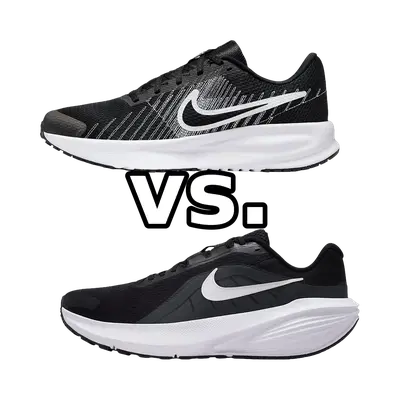
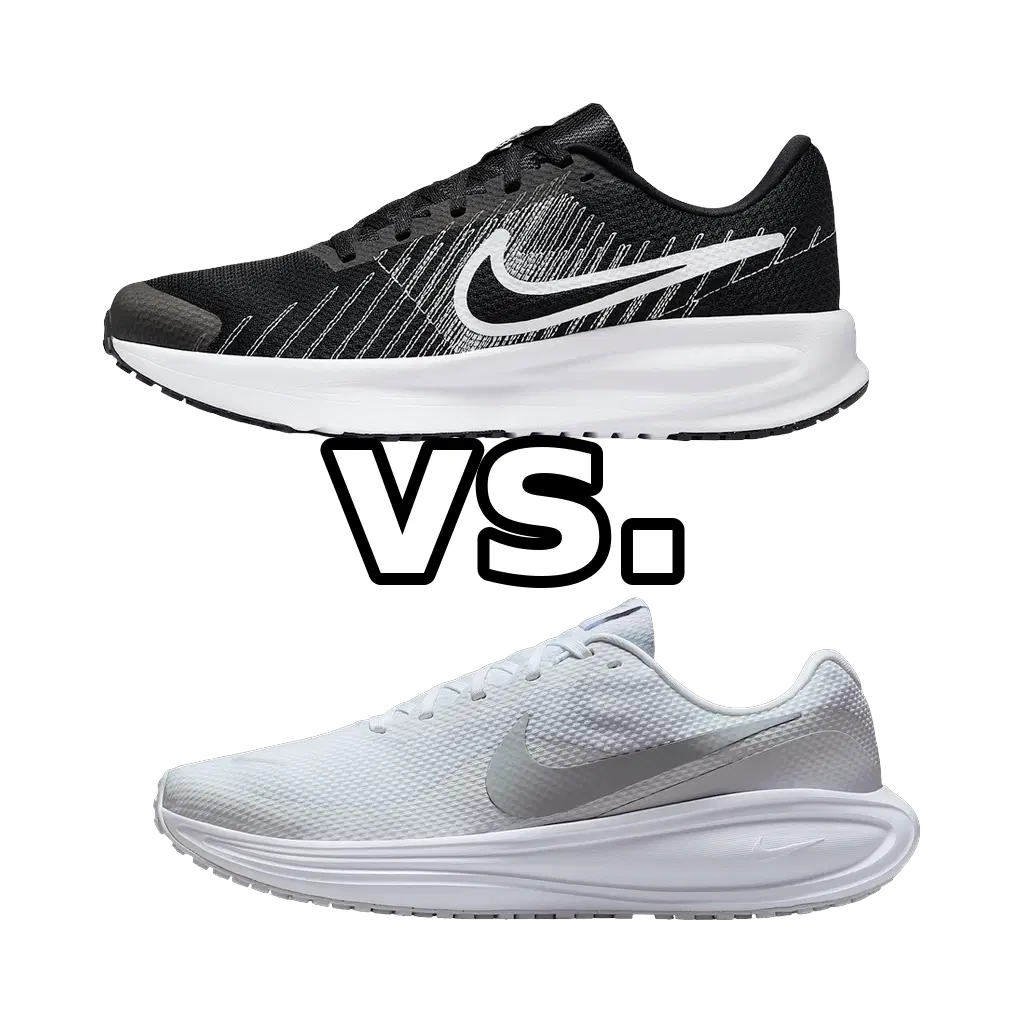
Nike Run Defy vs Nike Revolution 8:
Which to Choose
Verdict
These two are close enough that you won't be disappointed either way — both are calm, protective, neutral beginner trainers for easy 5Ks and 10Ks, not fast running. The tiebreaker is durability and pace range: the Run Defy's denser foam lasts longer and stays usable a touch faster, so it's the smarter buy if you're genuinely building a running habit. Reach for the Revolution 8 only if your running is firmly first-steps-and-gentle-jogs, where its soft, simple EVA is all you need.
Pace
2 of 6
Cushioning
3 of 6
Responsiveness
2 of 6
Stability
3 of 6
Drop
10 mm
Support
Neutral
Plate
None
Distances
5K10K
Pace
1 of 6
Cushioning
3 of 6
Responsiveness
2 of 6
Stability
3 of 6
Drop
9 mm
Support
Neutral
Plate
None
Distances
5K10K
At a Glance
Nike Run DefyNike Revolution 8
Who Should Choose Each Shoe
Choose
Nike Run Defy
Choose the Nike Run Defy if you're a beginner or everyday runner who wants the better-wearing of the two for regular easy mileage, and who occasionally nudges into the faster end of "easy" — its denser foam stays composed down toward 6:00 min/km where the Revolution 8 runs out of road. It's also the pick if you prefer a slightly taller, more clearly heel-led 10mm ride and want a trainer that holds up over a full build-up rather than a few months of casual jogs.
Choose
Nike Revolution 8
Choose the Nike Revolution 8 if you're taking your very first steps into running or logging gentle, short neighborhood loops where a soft, calm, unfussy ride matters more than pace or lifespan. It's the shoe for the runner who simply wants comfortable padding for relaxed 5K–10K jogs at a true conversational effort and isn't going to push the tempo — exactly the zone where its plain EVA feels pleasant and its limitations never show up.
Head-to-Head
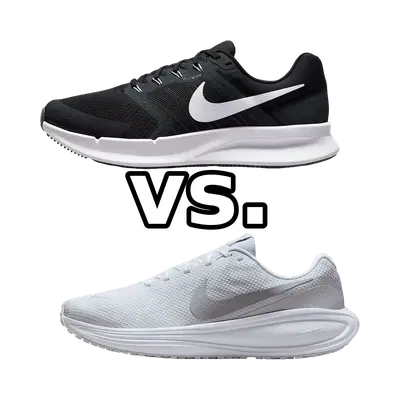
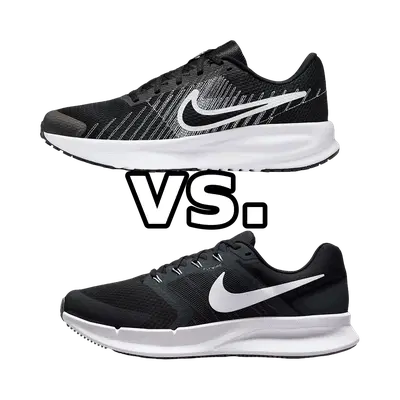
Start with what's genuinely the same, because most of it is. Both run neutral with no pronation support, both skip a plate, both pair a breathable mesh upper with a single-density foam midsole, and both land soft-on-contact but "dead" underfoot — protective, damped rides that cushion the step without handing energy back. Their stack numbers are a hair apart (the Run Defy sits at 33mm heel / 23mm forefoot, the Revolution 8 at 32mm / 23mm), which is close enough to feel equivalent underfoot, and their weights are effectively level — 259g for the Run Defy versus roughly 264g for the Revolution 8 in a men's US 9. The differences that matter are subtle. The Run Defy runs a 10mm drop against the Revolution 8's 9mm, so the Defy's ramp feels marginally more heel-led, though both are built for heel-strikers. The foams differ in character: the Defy uses an unnamed, dense Nike foam and the Revolution 8 a straightforward EVA (which replaced the older Phylon), and while both are low-rebound, the Defy's pace score (2/6) edges out the Revolution 8's (1/6) — the Defy stays usable down to about 6:00–6:30 min/km, where the Revolution 8 taps out closer to 6:30 min/km. The other real separator is longevity: the Revolution 8's EVA and build are its flagged weak point for durability, whereas the Run Defy's dense foam is more forgiving of repeated miles. So: a dead heat on cushioning, stability and weight, with the Run Defy holding slight edges in usable pace range and expected lifespan.
© 2026 longrunshoes.ai | All rights reserved.
Use of materials from this site is permitted only with proper attribution and a link to longrunshoes.ai.