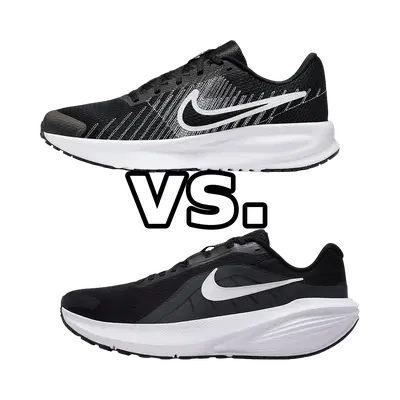
Nike Downshifter 14 vs Nike Revolution 8:
Which to Choose
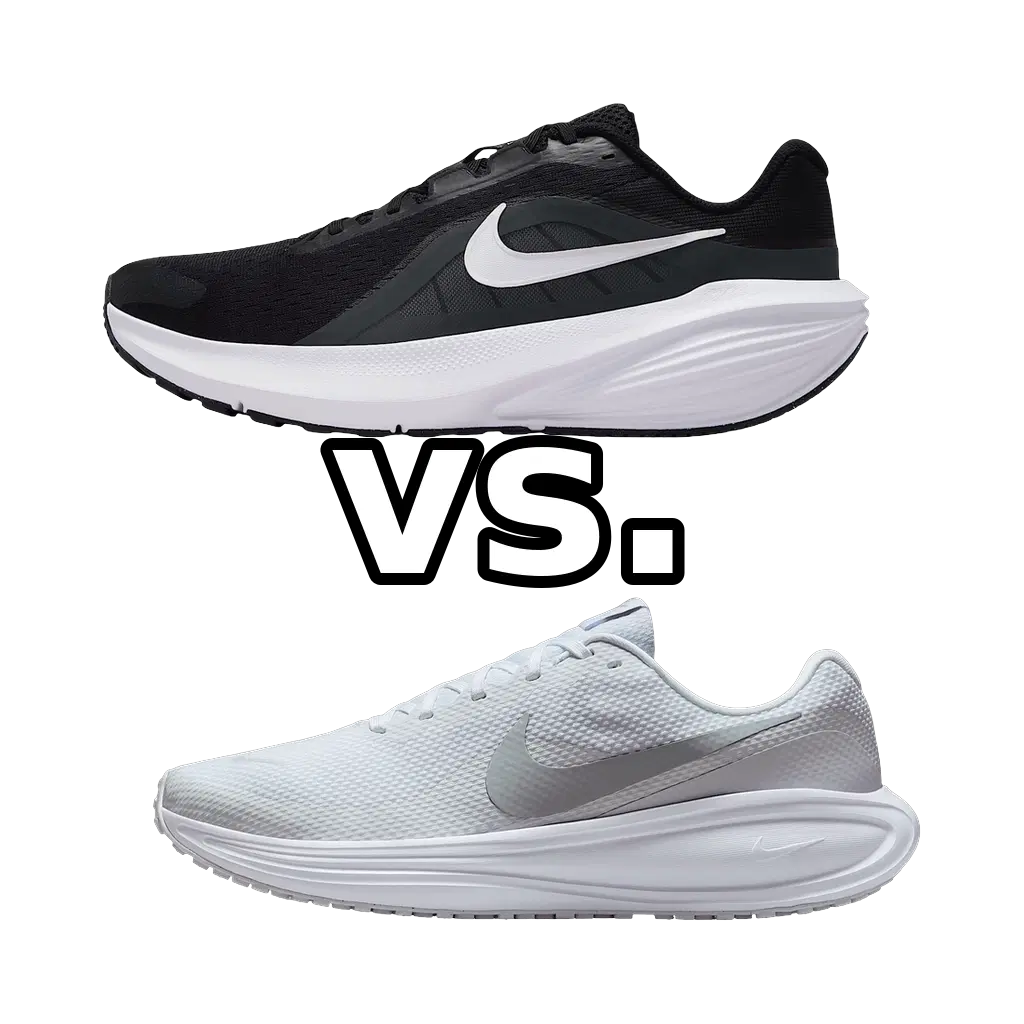
Verdict
It genuinely depends, but on a clear axis rather than a coin flip: go Downshifter 14 if you prioritize a firm, stable, grounded ride and don't mind the heavier build, or Revolution 8 if you want the lightest, softest, higher-drop option for purely easy jogging. Neither is a tempo or race shoe — both are easy-day, beginner-friendly trainers — so let ride firmness and weight, not performance ambitions, make the call.
Pace
2 of 6
Cushioning
3 of 6
Responsiveness
2 of 6
Stability
4 of 6
Drop
7 mm
Support
Neutral
Plate
None
Distances
5K10K
Pace
1 of 6
Cushioning
3 of 6
Responsiveness
2 of 6
Stability
3 of 6
Drop
9 mm
Support
Neutral
Plate
None
Distances
5K10K
At a Glance
Nike Downshifter 14Nike Revolution 8
Who Should Choose Each Shoe
Choose
Nike Downshifter 14
Pick the Downshifter 14 if you want the steadier, more grounded ride and value stability over softness — its firm foam and 4/6 stability platform stay level and predictable, which reassures newer runners who feel wobbly in plush shoes. It's also the better bet if your easy pace occasionally drifts a little quicker (down toward 5:30 min/km), since the firmer foam transitions better when you open up. The extra weight is the trade-off you accept for that planted, dependable feel.
Choose
Nike Revolution 8
Choose the Revolution 8 if keeping weight off your feet matters most — at around 264g it's the lighter of the two by a clear margin, which helps on longer easy loops where fatigue creeps in. Its softer EVA and taller ~9–10mm drop suit heel-strikers and anyone who prefers a cushier, calmer landing over a firm one, as long as you're content to keep things at a genuinely relaxed jogging pace. It's the more forgiving, comfort-first pick for first-time runners building base mileage.
Head-to-Head
The single biggest gap is weight: the Downshifter 14 comes in at 315g for a men's US 9 versus roughly 264g for the Revolution 8, making the Revolution about 50g lighter on foot — a real, noticeable difference that reduces leg fatigue over a jog. Cushioning volume, by contrast, is essentially a wash: the Downshifter stacks 31mm heel / 24mm forefoot and the Revolution 32mm heel / 23mm forefoot, so neither is meaningfully more protective than the other. Where they diverge is in character. The Downshifter's foam is firm and grounded, which pairs with its higher 4/6 stability score for a steady, level, planted platform, and its lower 7mm drop keeps the stride more neutral underfoot. The Revolution runs on softer EVA with a plusher landing but a slightly less locked-down 3/6 stability rating, and its taller ~9mm drop (Nike lists 10mm) ramps weight onto the midfoot in a way heel-strikers tend to like. Both foams are low-rebound and go flat the moment you push, but the firmer Downshifter actually stretches a touch quicker, holding an easy pace down to about 5:30 min/km, whereas the Revolution tops out around 6:30 min/km and is really tuned for a relaxed jogging cadence. In short: the Downshifter is the heavier, firmer, more stable and slightly quicker option; the Revolution is the lighter, softer, higher-drop cruiser.
Similar Comparisons
Asics Gel-Excite 10 vs Nike Downshifter 14
© 2026 longrunshoes.ai | All rights reserved.
Use of materials from this site is permitted only with proper attribution and a link to longrunshoes.ai.