
Nike Pegasus 42 vs Mizuno Wave Rider 30:
Which to Choose

Verdict
It comes down to firm-and-lively versus soft-and-protective. If you heel strike, like a high-drop ride, and want a bit of Air Zoom pop from your daily miles, the Pegasus 42 is your shoe; if you want more cushioning, a lower drop, and less weight for long, comfortable efforts — and you're happy to trade responsiveness for plushness — the newer Wave Rider 30 is the stronger daily trainer. Both nail the same use case, so let stack height, drop, and how much feedback you want underfoot make the call.
Pace
4 of 6
Cushioning
4 of 6
Responsiveness
4 of 6
Stability
4 of 6
Drop
14 mm
Support
Neutral
Plate
None
Distances
10KHalfMarathon
Pace
3 of 6
Cushioning
6 of 6
Responsiveness
3 of 6
Stability
4 of 6
Drop
9 mm
Support
Neutral
Plate
Composite
Distances
10KHalfMarathon
At a Glance
Nike Pegasus 42Mizuno Wave Rider 30
Who Should Choose Each Shoe
Choose
Nike Pegasus 42
Choose the Pegasus 42 if you're a heel striker who likes to feel the ground firm up and pop back as you find a rhythm, and you want a businesslike trainer that rewards settling into a moderate tempo rather than plodding. The tall 14mm drop and firmer ReactX-plus-Air-Zoom ride favor runners who like a heel-biased, connected feel and don't mind carrying a little more weight for that durable, springy character. It's the better pick for someone who found max-soft shoes vague or mushy and wants more feedback from a daily workhorse.
Choose
Mizuno Wave Rider 30
Choose the Wave Rider 30 if your priority is protection over pop — a deep, plush platform for long time on feet, easy days, and marathon-block mileage where comfort matters more than snap. Its lower 9mm drop, taller stack, and lighter weight suit heel and midfoot strikers who want a soft but stable landing and a smooth, no-drama transition, and it's an especially easy shoe to recommend to beginners building a base. Just go in knowing the rebound is honest-to-modest: it cushions beautifully but won't hand energy back the way its stack height might suggest.
Head-to-Head
On paper these two overlap heavily — both neutral, both rated 4/6 for stability, both happiest on steady long runs and moderate efforts at the same paces — but underfoot they feel meaningfully different. The Wave Rider 30 is the more cushioned shoe by a clear margin: 43mm heel / 34mm forefoot of nitrogen-infused ENERZY NXT versus the Pegasus 42's lower, firmer 36mm / 22mm ReactX platform, which is why it scores 6/6 for cushioning against the Pegasus's 4/6. It's also the lighter of the two at 265g (men's US 9) to the Pegasus's 286g, an uncommon combination — more stack and less weight at once. The trade-off is in the ride: the Pegasus uses a full-length Air Zoom unit to deliver a distinct pop that wakes up as you speed up, earning it the higher responsiveness rating (4/6 vs 3/6), whereas the Wave Rider's composite Wave Plate is there to firm up and structure the tall foam rather than to spring you forward, so its energy return stays modest and its ride reads as smooth and predictable rather than lively. Geometry is the other big divider: the Pegasus runs a steep 14mm drop with an unmistakably heel-biased feel that suits committed heel strikers, while the Wave Rider's moderate 9mm drop sits closer to level and eases the landing for heel and midfoot strikers alike. Neither shoe has a carbon plate or wants to run fast — push either past roughly 4:45 min/km and it starts to feel like more shoe than the job needs.
Similar Comparisons

Mizuno Wave Rider 29 vs Mizuno Wave Rider 30

Brooks Ghost 17 vs Nike Pegasus 42
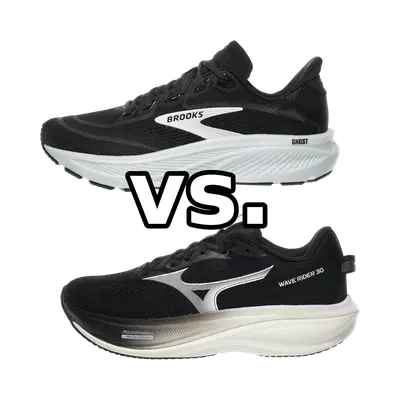
Brooks Ghost 18 vs Mizuno Wave Rider 30

Hoka Clifton 10 vs Nike Pegasus 42
Asics Novablast 6 vs Nike Pegasus 42

Nike Pegasus Premium vs Nike Pegasus 42

Nike Pegasus Plus vs Nike Pegasus 42

Nike Pegasus 42 vs Brooks Ghost 18
© 2026 longrunshoes.ai | All rights reserved.
Use of materials from this site is permitted only with proper attribution and a link to longrunshoes.ai.