
Nike Pegasus 41 vs Nike Pegasus 42:
Which to Choose

Verdict
There's no clear winner here — it depends on what you want from a daily trainer, not on which is "newer and therefore better." If you already own and enjoy the Pegasus 41, an upgrade to the 42 is optional rather than obvious: expect a firmer, taller, more heel-biased ride with a single full-length Air Zoom unit that skews toward long runs and marathon training. Go to the 42 if you want that firmer, longer-range character; stick with (or buy) the 41 if you prefer a softer, lower 10mm drop and more short-to-mid-distance versatility.
Pace
4 of 6
Cushioning
4 of 6
Responsiveness
4 of 6
Stability
4 of 6
Drop
10 mm
Support
Neutral
Plate
None
Distances
5K10KHalf
Pace
4 of 6
Cushioning
4 of 6
Responsiveness
4 of 6
Stability
4 of 6
Drop
14 mm
Support
Neutral
Plate
None
Distances
10KHalfMarathon
At a Glance
Nike Pegasus 41Nike Pegasus 42
Who Should Choose Each Shoe
Choose
Nike Pegasus 41
Choose the Pegasus 41 if you want the more versatile end of the Pegasus line — a neutral trainer that's comfortable dropping down to 5K and uptempo 10K work while still covering steady long runs. Its lower 10mm drop, slightly softer ReactX feel, and dual Air Zoom units suit heel and midfoot strikers who prefer a more planted, lower-to-the-ground ride and don't want to feel a tall heel on every footstrike. Runners finding their rhythm as beginners, or anyone happy with a 41 they already own, have little reason to move on — the core experience is one they already like.
Choose
Nike Pegasus 42
Choose the Pegasus 42 if your weekly staple is steady long runs and moderate efforts stretching up toward the marathon, and you want a firmer, more connected ride with the continuous pop of a full-length Air Zoom unit. The tall 14mm drop strongly favors committed heel strikers who like a high, heel-forward platform and log honest mileage over chasing short-distance speed. It's the better pick for a 41 owner specifically after a firmer, longer-range feel — but if you value a softer, lower, more uptempo-friendly shoe, the change won't feel like an upgrade.
Head-to-Head
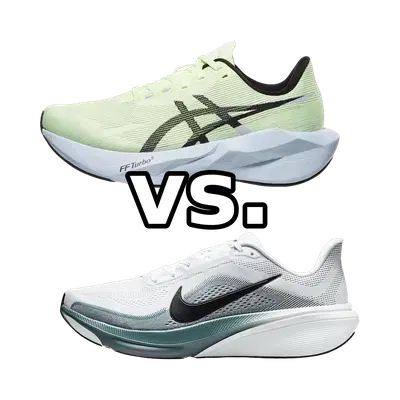
The headline difference is geometry and Air Zoom layout. The 41 runs a traditional 10mm drop and uses two separate Air Zoom units — one in the heel, one in the forefoot — paired with moderately soft ReactX for a planted, predictable landing with a subtle lift once you push the pace. The 42 moves to a single curved, full-length Air Zoom unit running the whole length of the midsole, which gives a more continuous, distinct pop through the whole footstrike, but Nike also went firmer and much more heel-biased: the 42 carries a tall 14mm offset versus the 41's 10mm, so you feel the heel on every stride and the ride is clearly businesslike at truly slow paces, warming up once you settle into a rhythm. That firmness and the higher heel make the 42 lean toward longer, steadier efforts — its best distances shift up to 10K, half, and full marathon, where the 41 is pitched at 5K, 10K, and half, making the older shoe the slightly more lively, versatile one at shorter, uptempo work. Both share the same neutral, wide, well-planted platform with no pronation support, the same breathable engineered mesh upper, durable rubber outsole, and the same optimal everyday training window of roughly 5:00–6:00 min/km, with a fastest effective zone around 4:45–5:15 min/km for each — neither is a speed tool, and the 42's extra weight and tall heel reinforce that it's a trainer, not a racer. Net: this is an evolution in ride character, not a leap in capability; the 42 trades a touch of the 41's softer, lower-slung versatility for a firmer, taller, more long-run-oriented platform.




© 2026 longrunshoes.ai | All rights reserved.
Use of materials from this site is permitted only with proper attribution and a link to longrunshoes.ai.