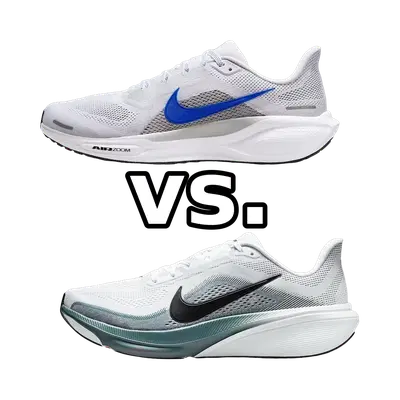
Nike Pegasus 41 vs Hoka Mach 7:
Which to Choose
Verdict
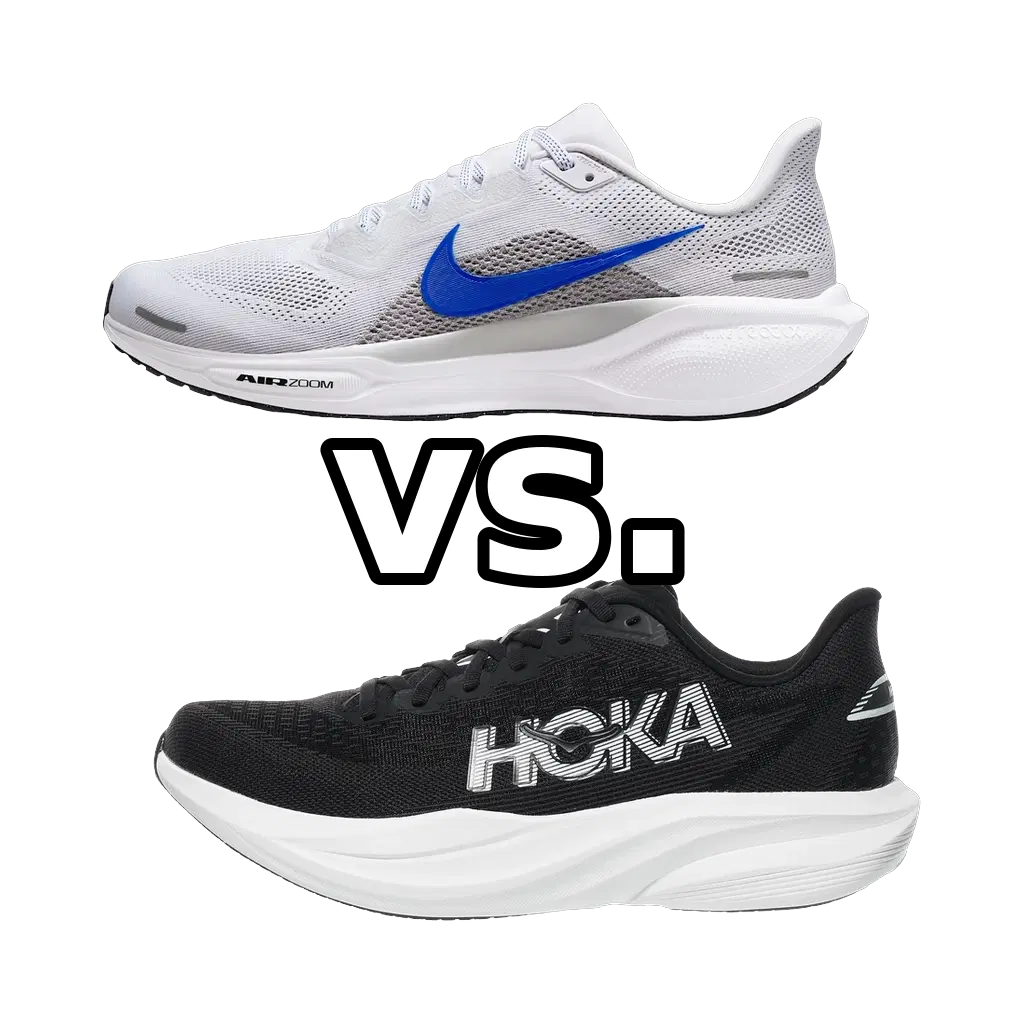
These are close cousins — same drop, near-identical stack, both plateless neutral daily trainers — so the decision comes down to ride character rather than capability. Pick the Pegasus 41 if you prioritize a planted, stable, cushioned workhorse for mostly easy-to-steady miles up to the half; pick the Mach 7 if you want a lighter, firmer, springier shoe that rewards tempo work and can carry you all the way to a marathon. If your running is fast-leaning and you like feeling the road snap back, go Mach; if you want dependable security underfoot day after day, go Pegasus.
Pace
4 of 6
Cushioning
4 of 6
Responsiveness
4 of 6
Stability
4 of 6
Drop
10 mm
Support
Neutral
Plate
None
Distances
5K10KHalf
Pace
4 of 6
Cushioning
4 of 6
Responsiveness
4 of 6
Stability
3 of 6
Drop
10 mm
Support
Neutral
Plate
None
Distances
10KHalfMarathon
At a Glance
Nike Pegasus 41Hoka Mach 7
Who Should Choose Each Shoe
Choose
Nike Pegasus 41
Choose the Pegasus 41 if you want the most dependable, planted, no-surprises daily trainer — a beginner finding a rhythm or an experienced runner logging honest volume who values a broad, secure, forgiving platform over outright speed. Its slightly more cushioned, more stable feel and softer landing make it the better pick for someone whose week is mostly easy-to-steady miles topped off with the occasional pickup, and whose racing rarely stretches past the half marathon. If you've run past Pegasus models and liked their planted, jack-of-all-trades security, the 41 is the natural continuation.
Choose
Hoka Mach 7
Choose the Mach 7 if you want that same one-shoe versatility but skewed faster and lighter — a neutral runner who does regular tempo and steady work and wants a springy, rockered ride that comes alive when the pace drops. Its lower weight and firmer supercritical foam make it the stronger choice for anyone whose sweet spot is uptempo daily running and who races anywhere from 10K up to the marathon. Just know it can feel a touch firm and businesslike on genuine recovery-day jogs, so it's best for runners who'd rather have snap than plush softness.
Head-to-Head
Start with what's genuinely the same: both run a 10mm drop, both are neutral with no plate, and their platforms are within a millimeter of each other — the Pegasus 41 sits at 37mm heel / 27mm forefoot, the Mach 7 at 36mm heel / 26mm forefoot — so neither is a max-stack pillow and both favor heel and midfoot strikers. The differences show up in weight, ride character, and stability. The Mach 7 is markedly lighter, at 224g versus 281g for the Pegasus in a men's US9 — a 57g gap you feel every time you lift the pace. That weight difference tracks with two different midsole philosophies: the Pegasus pairs moderately soft ReactX foam with dual Air Zoom units for a planted, smooth, predictable landing that adds a subtle liveliness only once you push, while the Mach 7's supercritical EVA is firmer and more overtly bouncy, with a mild rocker that snaps you through transitions and rewards picking up the tempo. On stability our metrics split them 4/6 for the Pegasus against 3/6 for the Mach: the Pegasus rides on a broader, more grounded platform that feels more secure and forgiving underfoot, whereas the low-slung Mach trades some of that planted stability for ground feel and speed. Use cases overlap but tilt differently — the Pegasus is happiest at 5K, 10K, and half-marathon efforts with a sweet spot in uptempo 10K work, while the Mach stretches further, shining from 10K through the marathon and leaning more toward steady-to-tempo running. The Mach's firmer, businesslike ride is the weak spot on truly slow plod days; the Pegasus's extra weight is what holds it back when you want to fly.
Similar Comparisons
Hoka Mach 6 vs Hoka Mach 7
Nike Pegasus 41 vs Salomon Aero Blaze 4
Hoka Mach 7 vs Hoka Mach X 3
Nike Pegasus 41 vs Puma Velocity Nitro 3
Saucony Endorphin Speed 5 vs Hoka Mach 7
Puma Deviate Nitro 4 vs Hoka Mach 7

Adidas Adizero Evo SL vs Hoka Mach 7
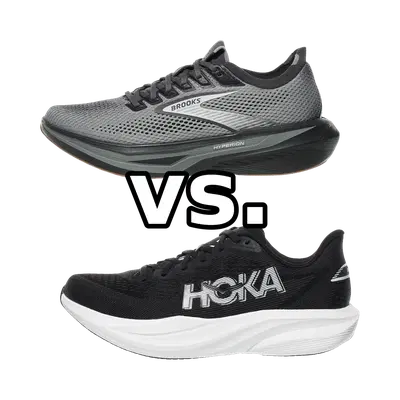
Brooks Hyperion 3 vs Hoka Mach 7
© 2026 longrunshoes.ai | All rights reserved.
Use of materials from this site is permitted only with proper attribution and a link to longrunshoes.ai.