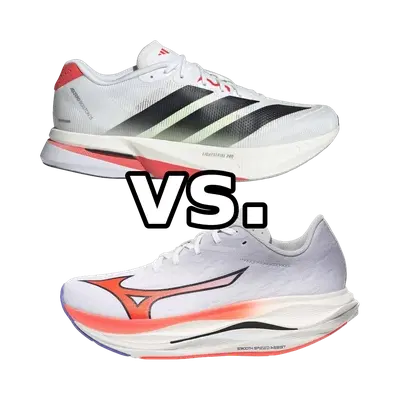
Mizuno Wave Rebellion Flash 2 vs Mizuno Wave Rebellion Flash 3:
Which to Choose
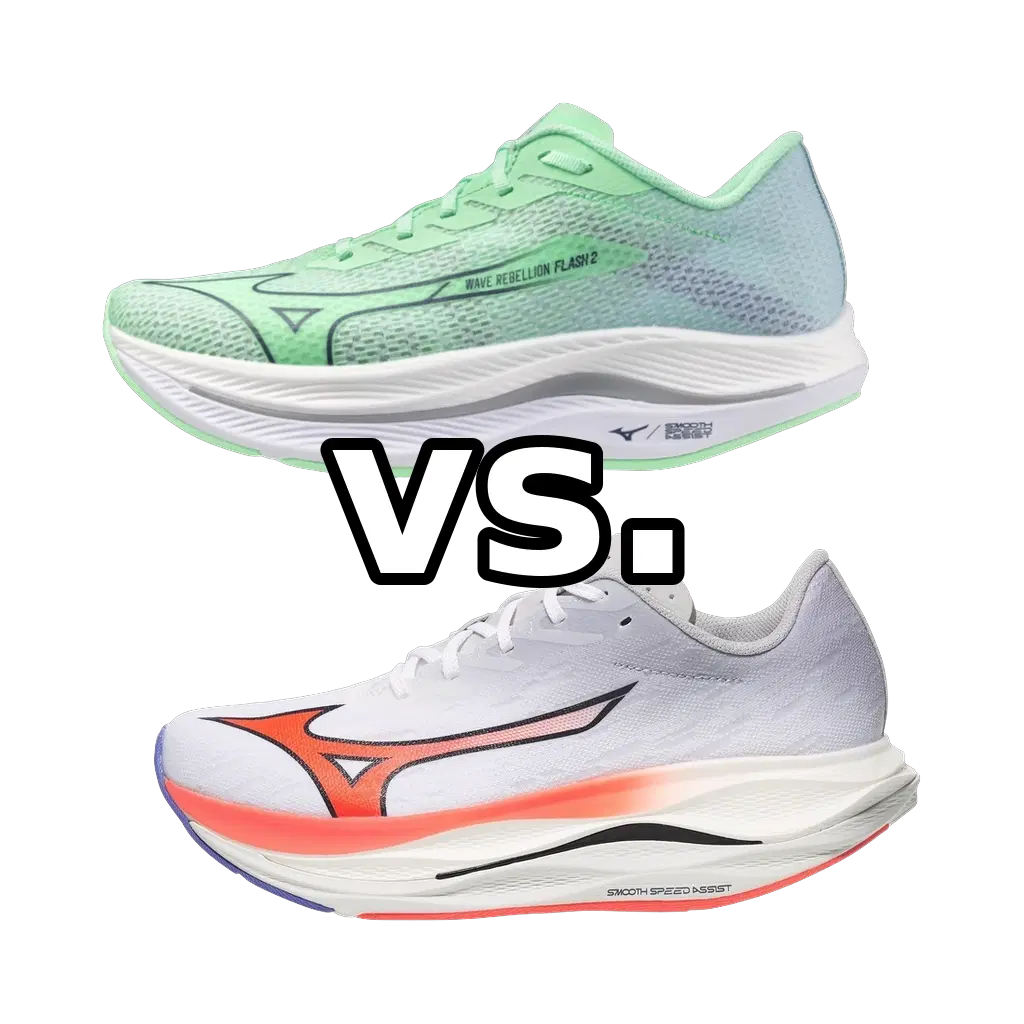
Verdict
It comes down to distance focus and how you feel about drop, not weight — the two are nearly identical on the scale. If you mainly race 5K and 10K and love a near-flat, firm, ground-hugging ride, the Flash 2 is still the sharper instrument and there's no urgent reason to upgrade. If your priority is the half marathon and tempo volume, the Flash 3's taller heel, ~7 mm drop, and cushier dual-layer midsole make it a meaningful step up in protection and long-run comfort — that's the upgrade worth paying for.
Pace
5 of 6
Cushioning
4 of 6
Responsiveness
5 of 6
Stability
3 of 6
Drop
1 mm
Support
Neutral
Plate
Composite
Distances
5K10KHalf
Pace
5 of 6
Cushioning
5 of 6
Responsiveness
5 of 6
Stability
3 of 6
Drop
7 mm
Support
Neutral
Plate
Composite
Distances
10KHalf
At a Glance
Mizuno Wave Rebellion Flash 2Mizuno Wave Rebellion Flash 3
Who Should Choose Each Shoe
Choose
Mizuno Wave Rebellion Flash 2
Choose the Flash 2 if you prize a low, firm, close-to-the-ground ride and sharpen your speed over 5K and 10K, where its near-flat drop and snappy Enerzy Lite platform feel most connected and aggressive. It's the pick for the runner who wants maximum ground feel and pop at genuinely quick paces (roughly 3:45–4:30 min/km) and doesn't want the heel built up underneath them. Existing Flash 2 owners who love it for short, fast racing have little reason to feel they've been left behind — it remains the sharper tool for the 5K.
Choose
Mizuno Wave Rebellion Flash 3
Choose the Flash 3 if your focus is the half marathon and higher-volume tempo work, and you'd welcome a touch more heel cushioning and a more conventional ~7 mm drop to soak up the distance without going mushy. Its softer, springier Enerzy XP-over-NXT stack and rolling rocker suit runners who want one plated shoe to cover workouts and the occasional race, and who don't need the absolute lowest, firmest ride. It's the better call if you found the Flash 2 slightly too flat or too firm for the longer efforts.
Head-to-Head
Weight is essentially a wash: the Flash 2 comes in around 239 g and the Flash 3 around 244 g in a men's US 9, so nobody is upgrading for a lighter shoe. Up front they're nearly identical too, both sitting near 32 mm of forefoot stack. The meaningful change is at the back. The Flash 2's heel measures about 35 mm, giving a near-flat ride (Mizuno lists roughly a 1 mm drop, and it feels low and firm underfoot), while the Flash 3 builds the heel up to a full 40 mm and lands around a 7 mm drop — a genuinely different geometry that keeps you leaning forward without demanding the same low, aggressive foot strike. That extra height comes with more foam: the Flash 2 runs a single Enerzy Lite midsole that's moderate and quick with good ground feel, whereas the Flash 3 layers softer, springier Enerzy XP (TPEE) over an Enerzy NXT (EVA) base for a higher, more protective, slightly bouncier ride. Both use a composite plate, though Mizuno swapped the Flash 2's Pebax Wave plate for a glass-fiber-reinforced nylon plate in the Flash 3. Both remain neutral with no pronation support, and both carry the same quirk — that exaggerated cut-away heel makes them feel tippy and unsettled at jogging pace, so each rewards a committed, purposeful stride. Where they diverge is intended use: the Flash 2 genuinely excels across 5K, 10K, and the half with the 10K as its sweet spot and a fast optimal window around 3:45–4:30 min/km, while the taller, cushier Flash 3 shines over 10K and the half — the half being its sweet spot — and settles into a marginally more forgiving 4:00–4:45 min/km zone.
© 2026 longrunshoes.ai | All rights reserved.
Use of materials from this site is permitted only with proper attribution and a link to longrunshoes.ai.