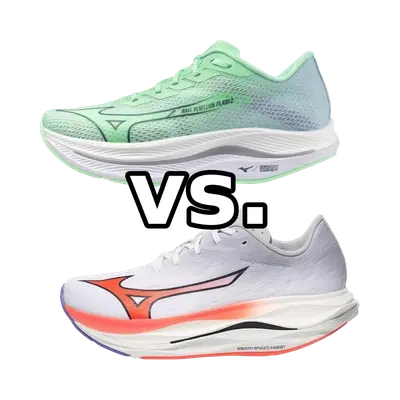
Mizuno Wave Rebellion Flash 2 vs Mizuno Wave Rebellion Pro 3:
Which to Choose
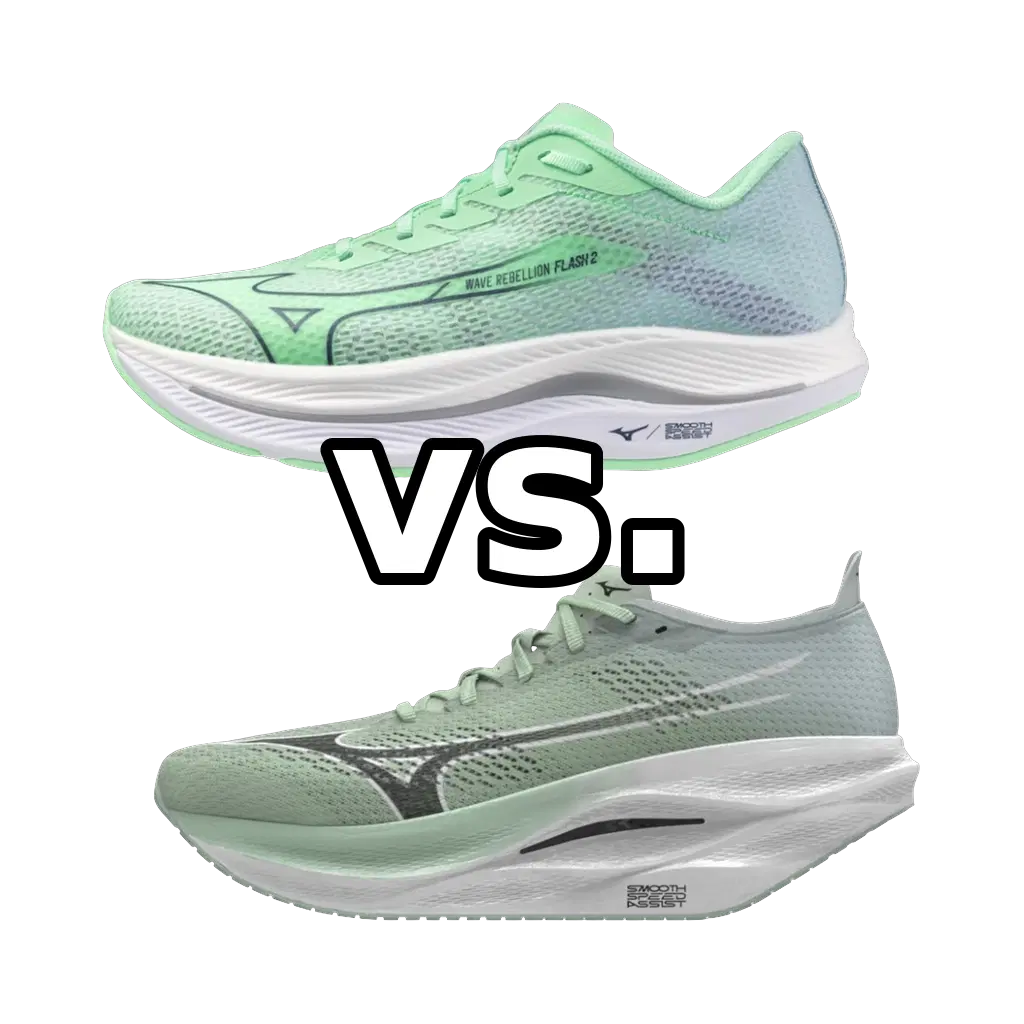
Verdict
This comes down to distance and intent, not which is 'better.' Go Flash 2 for 5K-to-half speed and a plate that's forgiving enough to train in; go Pro 3 for half-and-marathon racing where you can commit to fast, form-dependent efforts and want the taller, lighter, carbon-plated platform. At the half marathon — the one distance they share — let your pace decide: if you're not reliably running in the Pro 3's sub-3:20 min/km zone, the more versatile Flash 2 will serve you better.
Pace
5 of 6
Cushioning
4 of 6
Responsiveness
5 of 6
Stability
3 of 6
Drop
1 mm
Support
Neutral
Plate
Composite
Distances
5K10KHalf
Pace
6 of 6
Cushioning
5 of 6
Responsiveness
6 of 6
Stability
1 of 6
Drop
4 mm
Support
Neutral
Plate
Carbon
Distances
HalfMarathon
At a Glance
Mizuno Wave Rebellion Flash 2Mizuno Wave Rebellion Pro 3
Who Should Choose Each Shoe
Choose
Mizuno Wave Rebellion Flash 2
Choose the Flash 2 if your racing tops out around the half and you want one shoe that doubles for tempo days and intervals rather than a single-purpose marathon weapon. It suits intermediate-to-experienced runners who like a lively, forward ride but still want a plate that behaves at a range of paces and a platform that isn't white-knuckle unstable. If the 5K and 10K are your focus — the 10K is its sweet spot — this is the pick.
Choose
Mizuno Wave Rebellion Pro 3
Choose the Pro 3 if you're an experienced, efficient forefoot runner targeting the half and especially the marathon, and you're genuinely racing sub-3:20 min/km where the carbon plate and tall rocker fully engage. It rewards strong form with more cushioning for late-race leg protection, a lighter overall package, and maximum energy return. If you want a dedicated PB machine and have no intention of using it for easy miles, this is the one.
Head-to-Head
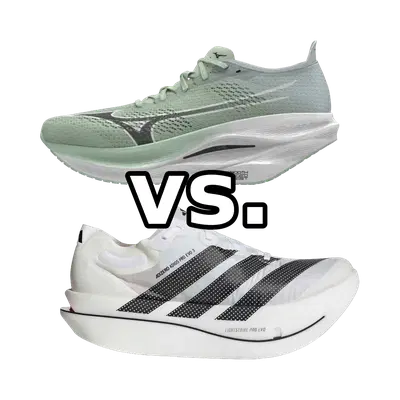
The clearest fork is the plate and what it's tuned for. The Flash 2 uses a Pebax-based composite Wave plate over Enerzy Lite foam — snappy and propulsive, but with enough give to feel natural across tempo and interval paces (its zone is roughly 3:45–4:30 min/km). The Pro 3 goes all-in with a full-length carbon plate over Enerzy Lite+ superfoam and only truly comes alive deep in its 3:00–3:30 min/km racing window; below that it can feel like a lot of shoe. Cushioning follows suit: the Flash 2 sits around a modest 35mm of stack — moderate protection that keeps ground feel and quickness — while the Pro 3 is a dramatically taller, max-stack platform with a generous forefoot designed to keep legs fresh late in a marathon. Drop is low on both (1mm on the Flash 2, 4mm on the Pro 3), and both use the aggressive beveled 'smart heel' that forces a midfoot-to-forefoot landing and feels tippy at jogging speed. Stability is the sharpest contrast in degree — the Flash 2 is neutral but manageable, whereas the Pro 3's tall, narrow platform is genuinely demanding and punishes anything less than strong form. One counterintuitive note: despite being the bigger shoe, the Pro 3 is actually the lighter of the two (about 7.7 oz / 218g versus roughly 8.6 oz / 244g for the Flash 2), because it's a stripped-down racer with a thin, breathable mesh upper where the Flash 2 carries a slightly more substantial racing upper. That thin Pro 3 upper is worth checking in person — pure race mesh tends to wear faster than a more built-up trainer upper.
© 2026 longrunshoes.ai | All rights reserved.
Use of materials from this site is permitted only with proper attribution and a link to longrunshoes.ai.