
Hoka Skyward X vs Asics Superblast 3:
Which to Choose
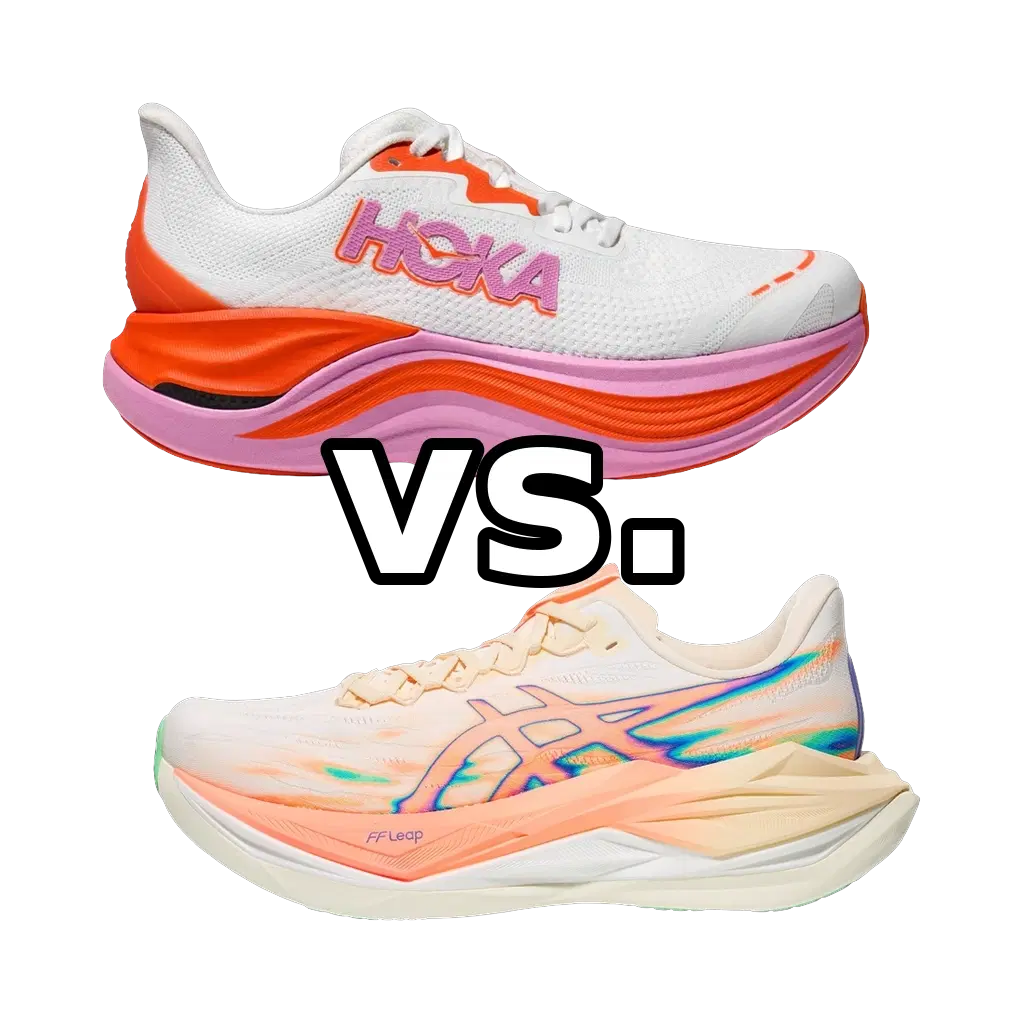
Verdict
It comes down to how you'll use the shoe. If you want a plated, maximally protective long-run and half/marathon cruiser and don't mind the extra ~85g, the Skyward X is the more cushioned, more guided ride. If you want a lighter, faster, one-quiver shoe that handles everything from tempo 10Ks to the marathon and prefer bounce from foam rather than a plate, the Superblast 3 is the more versatile choice — and for most runners deciding between the two, its lightness and range make it the easier everyday recommendation.
Pace
4 of 6
Cushioning
6 of 6
Responsiveness
5 of 6
Stability
4 of 6
Drop
5 mm
Support
Stable Neutral
Plate
Carbon
Distances
HalfMarathon
Pace
5 of 6
Cushioning
6 of 6
Responsiveness
5 of 6
Stability
3 of 6
Drop
8 mm
Support
Neutral
Plate
None
Distances
10KHalfMarathon
At a Glance
Hoka Skyward XAsics Superblast 3
Who Should Choose Each Shoe
Choose
Hoka Skyward X
Choose the Skyward X if you're a neutral to mildly efficient runner building marathon volume and you want the most protective, forgiving ride you can get for steady long efforts and uptempo daily miles. The winged carbon plate and its wider, stable-neutral base suit runners who like a guided, momentum-driven roll-through and are happy cruising in the 4:30–5:30 min/km range rather than chasing sharp turnover. It's the better pick if leg preservation over big weekly mileage matters more to you than gram-counting or top-end speed.
Choose
Asics Superblast 3
Choose the Superblast 3 if you want one lightweight pair that covers almost everything — easy miles, steady runs, and honest tempo work from the 10K up to the marathon — without swapping between a soft trainer and a race shoe. Its 235g weight and plateless, springy foam make it feel far quicker than its tall stack suggests, ideal for neutral runners who value versatility and lightness and can handle the slightly less planted feel at slow paces. It's the smarter buy if you don't want a plate dictating your stride and you'd rather have a shoe that stretches faster than the Skyward X comfortably goes.
Head-to-Head
Both shoes carry maximum cushioning (6/6) and score identically for responsiveness (5/6), and both sit on wide, tall platforms — 48/43mm on the Skyward X and 46/38mm on the Superblast 3 — so neither is remotely low-profile. From there they split hard. The biggest gap is weight: the Superblast 3 comes in at roughly 235g in a men's US 9, while the Skyward X is around 320g — an 85g difference you feel with every stride, and the reason the Asics changes direction and picks up pace so much more willingly. The propulsion philosophy differs too: the Skyward X uses a winged carbon plate over dual-density PEBA for a smooth, guided roll-through that rewards holding one steady tempo, whereas the Superblast 3 runs entirely plateless, generating its bounce from FF Leap A-TPU superfoam over an FF Blast+ base and its midsole geometry alone — a softer, springier, less "railed" feel. Drop also separates them: the Skyward X's 5mm keeps you balanced and low over its tall stack, while the Superblast 3's 8mm suits both heel and midfoot strikers. On stability they're close but not equal — the Skyward X's wider base earns a stable-neutral 4/6, while the Superblast 3 is a moderate neutral 3/6 that can feel slightly tippy at very slow paces until you settle into a rhythm. That feeds into pace and range: the Skyward X is happiest as an uptempo daily and long-run tool (optimal around 4:45–5:30 min/km, coming alive near 4:30–4:45), best at the half and marathon; the Superblast 3 stretches faster and wider, optimal from 4:00–4:45 and genuinely useful from the 10K through the marathon, making it the more all-purpose of the two.


© 2026 longrunshoes.ai | All rights reserved.
Use of materials from this site is permitted only with proper attribution and a link to longrunshoes.ai.