
Hoka Bondi 9 vs Hoka Skyward X:
Which to Choose
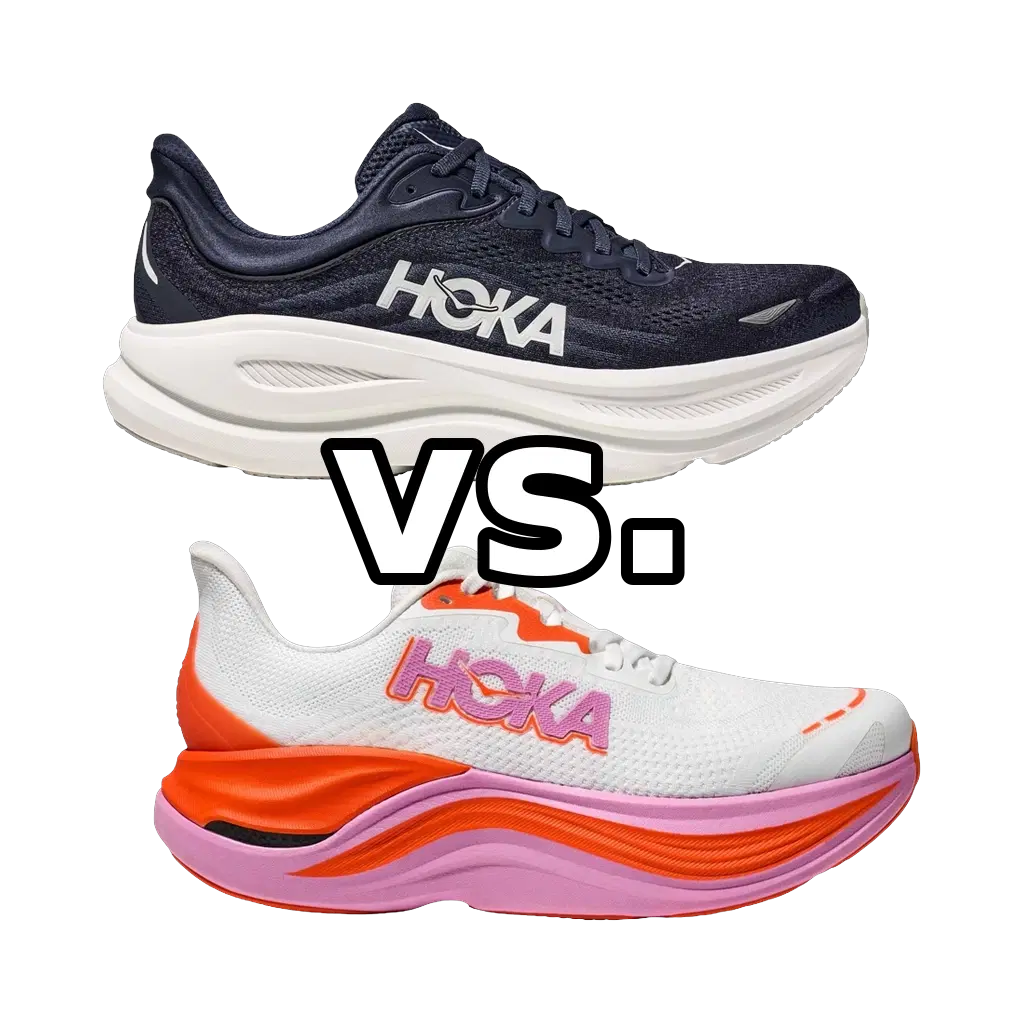
Verdict
It genuinely depends on your pace, not your preference for a brand — because these are two Hokas built around the same cushioning idea but tuned for opposite speeds. If your week is mostly easy and recovery mileage and you want the softest, most stable landing, take the Bondi 9; if you run uptempo and are logging long half- and marathon-distance training where you want the plate to drive you forward, take the Skyward X. Runners who straddle both — plenty of easy miles but regular faster long runs — will get more range out of the Skyward X, accepting that it's the duller of the two when you slow right down.
Pace
2 of 6
Cushioning
6 of 6
Responsiveness
3 of 6
Stability
5 of 6
Drop
5 mm
Support
Stable Neutral
Plate
None
Distances
10KHalf
Pace
4 of 6
Cushioning
6 of 6
Responsiveness
5 of 6
Stability
4 of 6
Drop
5 mm
Support
Stable Neutral
Plate
Carbon
Distances
HalfMarathon
At a Glance
Hoka Bondi 9Hoka Skyward X
Who Should Choose Each Shoe
Choose
Hoka Bondi 9
Choose the Bondi 9 if most of your running is easy — recovery days, long slow aerobic miles, and relaxed 10K-to-half efforts — and you want a forgiving landing rather than any snap. It's the better pick for beginners building volume, heavier runners, and anyone whose legs just need the softest, most stable platform they can get without worrying about turning over quickly. If you rarely run faster than about 5:30 min/km and value planted comfort over propulsion, this is the one.
Choose
Hoka Skyward X
Choose the Skyward X if you want that same deep cushioning but spend real time at steady, uptempo efforts and are building half-marathon or marathon volume. The PEBA foam and winged carbon plate reward a consistent, lengthening stride in the 4:45–5:30 min/km range, making it the better long-training and tempo-day tool for neutral runners who find the Bondi too muted when they press the pace. It's the pick if you want one plush shoe that can both cushion long efforts and still give something back when you lift the effort.
Head-to-Head
Start with what they share: both run a 5mm heel-to-toe drop, both top out the cushioning scale, and both use a very wide base to steady a tall stack rather than any medial posting. From there they diverge sharply. The Bondi 9 sits lower — a 42mm heel / 37mm forefoot stack versus the Skyward X's taller 48mm / 43mm — and comes in lighter at roughly 297g against the Skyward X's roughly 320g in a men's US 9, so it feels the more manageable shoe at slow speeds. Underfoot, though, they feel nothing alike: the Bondi's supercritical-EVA midsole has no plate and prioritizes a soft, impact-absorbing landing over rebound, which is why it can feel muted and even a little dead when you try to push, while the Skyward X pairs dual-density PEBA foam with a winged carbon plate that delivers a genuine snap and a guided roll-through once you press into it. That shows up in their working ranges: the Bondi is happiest around 5:45–6:45 min/km and runs out of life past about 5:30, whereas the Skyward X only really comes alive from 4:45–5:30 min/km and feels ponderous below that. The trade-off is at the slow end — the Bondi is the more planted, stable, no-fuss easy-day shoe (and the more sure-footed of the two on recovery days), while the Skyward X asks for momentum to justify its height and weight, and its stack is actually too tall to be race-legal, so neither is a true racer. In short: same cushioning category, opposite ride personalities.
Similar Comparisons

Hoka Skyward X vs Asics Superblast 3

Hoka Bondi 9 vs Asics Gel-Nimbus 28

Hoka Skyward X vs Brooks Hyperion Max 3

Hoka Bondi 9 vs Saucony Paramount Max
Hoka Skyward X vs Hoka Skyward X 2

Hoka Bondi 9 vs Brooks Ghost Max 3
Hoka Skyward X vs Asics Superblast 2

Hoka Bondi 9 vs Brooks Glycerin Max 2
© 2026 longrunshoes.ai | All rights reserved.
Use of materials from this site is permitted only with proper attribution and a link to longrunshoes.ai.