
Hoka Bondi 9 vs Nike Vomero Plus:
Which to Choose

Verdict
Both are excellent max-cushion cruisers for the same easy-mile, 10K-to-half job, so it comes down to feel and geometry, not capability. Go Bondi 9 for the flatter, most protective, most planted-and-stable ride; go Vomero Plus for a livelier, springier ZoomX ride with a higher 9 mm drop and a hair less weight. Neither will make you faster — pick the one whose landing matches how you like your easy days to feel.
Pace
2 of 6
Cushioning
6 of 6
Responsiveness
3 of 6
Stability
5 of 6
Drop
5 mm
Support
Stable Neutral
Plate
None
Distances
10KHalf
Pace
3 of 6
Cushioning
6 of 6
Responsiveness
5 of 6
Stability
4 of 6
Drop
9 mm
Support
Neutral
Plate
None
Distances
10KHalf
At a Glance
Hoka Bondi 9Nike Vomero Plus
Who Should Choose Each Shoe
Choose
Hoka Bondi 9
Choose the Bondi 9 if your priority is the most protective, forgiving landing you can get and you value a planted, stable ride over rebound. It's the better pick for heavier runners, beginners building volume, and anyone whose legs need to be shielded on easy and recovery miles, and its low 5 mm drop and wide sidewalls suit runners who want stability without a dedicated support shoe. If you tend to run purely aerobic and never expect the foam to give anything back, the Bondi delivers that cushioned-cocoon feel best.
Choose
Nike Vomero Plus
Choose the Vomero Plus if you want maximum cushioning that still feels alive underfoot — its ZoomX foam adds a bounce the Bondi deliberately doesn't have, making it the more engaging companion for long, steady miles. Its higher 9 mm drop suits heel strikers and runners who like a traditional forward roll, and the slightly lighter build appeals to neutral runners who want plush protection without the deadest possible ride. It's the stronger option for someone who logs high mileage but still wants a little life in the step.
Head-to-Head
On paper these two are close: both rate a full 6/6 for cushioning, both run plateless, and both peak at relaxed 10K-to-half efforts. The stacks are nearly matched — 43/38 mm on the Bondi 9 versus 42/33 mm on the Vomero Plus — but the geometry diverges. The Bondi sits at a low 5 mm drop with a thick 38 mm forefoot, giving a flatter, more evenly planted platform, while the Vomero's 9 mm drop and thinner 33 mm forefoot create a more pronounced heel-to-toe slope that rolls you forward off the heel. The bigger split is the foam. The Bondi's supercritical EVA is the more protective, dead-quiet landing — it absorbs impact rather than returning it, which is exactly why its ride feels muted and heavy the moment you try to press (responsiveness 3/6). The Vomero's full-length ZoomX is the livelier compound, adding a gentle springy bounce that keeps long runs from feeling flat (responsiveness 5/6), though it's still tuned for cruising, not surging. Stability tips the other way: the Bondi's wide base and sidewalls earn a stable-neutral 5/6 planted feel, whereas the Vomero is a straightforwardly neutral 4/6 with no extra guidance. Weight is close, with the Vomero Plus at 285 g slightly lighter than the Bondi 9 at 297 g (men's US 9) — but both admit they feel heavy when the pace drops below roughly 5:15–5:30 min/km.
Similar Comparisons

Nike Invincible 3 vs Nike Vomero Plus

Hoka Bondi 9 vs Saucony Paramount Max
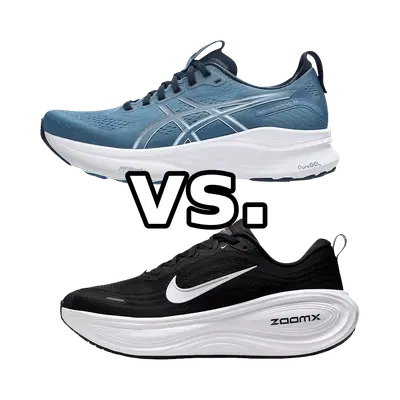
Asics Gel-Kayano 32 vs Nike Vomero Plus

Hoka Bondi 9 vs Brooks Ghost Max 3
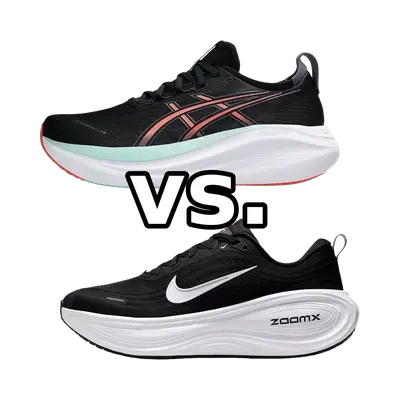
Asics Gel-Nimbus 27 vs Nike Vomero Plus

Hoka Bondi 9 vs Brooks Glycerin Max 2

Adidas Adizero Boston 13 vs Nike Vomero Plus

Nike Vomero 18 vs Nike Vomero Plus
© 2026 longrunshoes.ai | All rights reserved.
Use of materials from this site is permitted only with proper attribution and a link to longrunshoes.ai.