
Brooks Hyperion GTS 2 vs Brooks Hyperion 3:
Which to Choose
Verdict
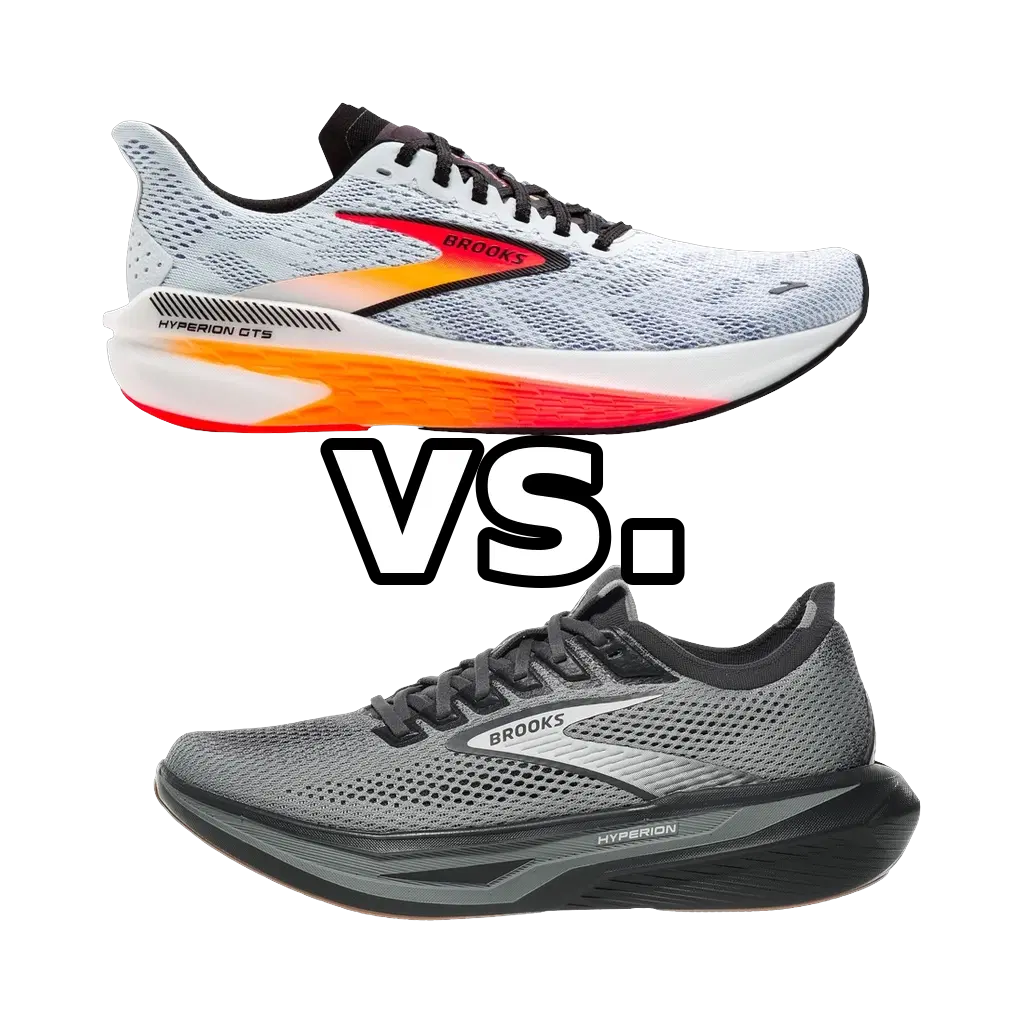
It comes down to guidance and purpose, not quality — both are fast, plateless DNA Flash v2 shoes that excel at 5K through the half. Pick the GTS 2 for the lighter, firmer, more guided ride if you want a focused tempo-and-race tool or like a steadier platform; pick the Hyperion 3 for the slightly softer, more durable neutral ride if you want a do-everything trainer that can still run fast.
Pace
5 of 6
Cushioning
3 of 6
Responsiveness
4 of 6
Stability
4 of 6
Drop
8 mm
Support
Stable Neutral
Plate
None
Distances
5K10KHalf
Pace
4 of 6
Cushioning
4 of 6
Responsiveness
4 of 6
Stability
3 of 6
Drop
8 mm
Support
Neutral
Plate
None
Distances
5K10KHalf
At a Glance
Brooks Hyperion GTS 2Brooks Hyperion 3
Who Should Choose Each Shoe
Choose
Brooks Hyperion GTS 2
Choose the Hyperion GTS 2 if you mildly overpronate or simply prefer a steadier, more guided platform under speed, and you want the lightest, firmest, most race-ready feel of the two for tempo runs, intervals, and short races. It's the pick for an intermediate-to-experienced runner whose top priority is turning over fast — pushing toward the 3:50-4:10 min/km end — and who is happy to accept a thinner, less durable build in exchange for that quickness.
Choose
Brooks Hyperion 3
Choose the Hyperion 3 if you're a neutral runner who wants one shoe to handle daily mileage and still sharpen up on tempo days, rather than a dedicated racer. Its extra few millimeters of stack and more durable outsole make it the more forgiving, longer-lasting everyday option, ideal for recreational and improving runners chasing quicker 5K-to-half efforts at slightly more moderate paces who don't need — or want — any pronation guidance.
Head-to-Head
Start with what they share: the same DNA Flash v2 midsole, no plate, and the same Brooks-stated 8mm drop, so both deliver a lively, springy-but-moderately-firm rebound rather than deep plush softness, and both come alive when you lean into a quicker rhythm. The core split is guidance versus neutrality. The GTS 2 adds Brooks' GuideRails — a medial rail running heel-to-midfoot plus a lateral heel rail — giving it a stable-neutral character with gentle pronation support, while the Hyperion 3 is a straight neutral shoe with no corrective structure. Weight and geometry reinforce this: the GTS 2 is the lighter, lower, racier of the two at around 220g in a men's US 9 with roughly a 33mm heel / 22mm forefoot stack, versus the Hyperion 3 at about 241-244g with a taller ~36mm heel / 25mm forefoot platform. That makes the GTS 2 feel firmer, snappier, and more impatient to run fast — its optimal zone sits around 3:50-4:30 min/km — whereas the Hyperion 3 carries a touch more cushion underfoot and is happiest a little more moderate, around 4:30-5:30 min/km, which lets it double as a legitimate daily trainer. The trade-off is durability: the Hyperion 3's outsole holds up better over honest mileage, while the GTS 2's thinner, more race-focused build prioritizes speed over longevity. Both are genuinely quick; neither is a long-slow-recovery shoe.
Similar Comparisons

Brooks Hyperion 2 vs Brooks Hyperion 3
Brooks Hyperion 2 vs Brooks Hyperion GTS 2

Brooks Hyperion 3 vs Brooks Hyperion Max 3

Asics Dynablast 5 vs Brooks Hyperion 3

Brooks Hyperion 3 vs Hoka Mach 7

On Cloudsurfer 2 vs Brooks Hyperion 3

New Balance FuelCell Propel v5 vs Brooks Hyperion 3

Hoka Mach 6 vs Brooks Hyperion 3
© 2026 longrunshoes.ai | All rights reserved.
Use of materials from this site is permitted only with proper attribution and a link to longrunshoes.ai.