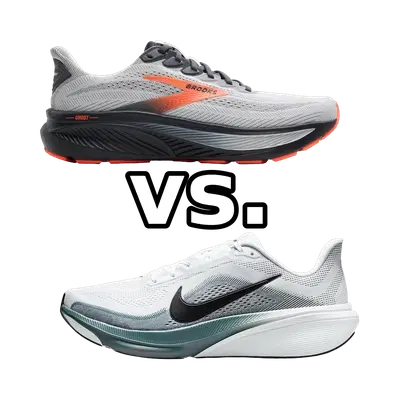
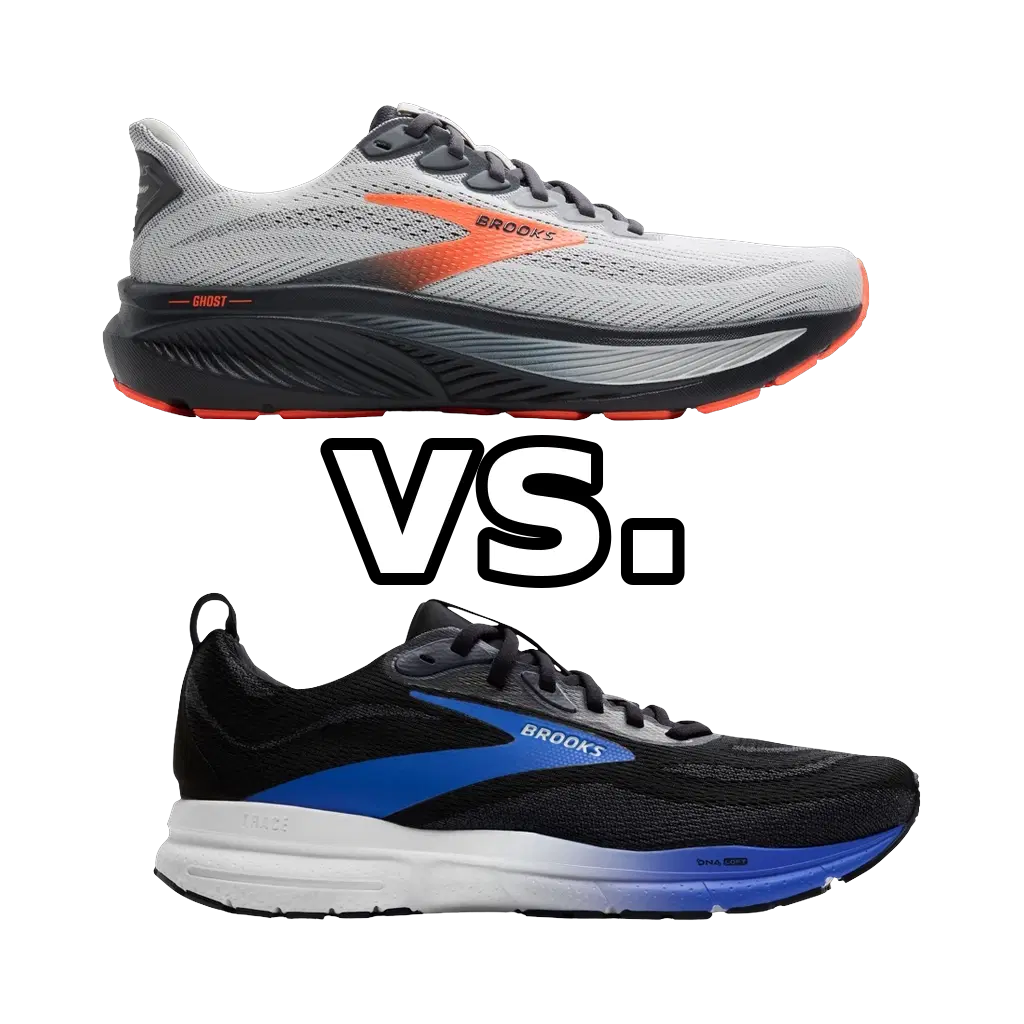
Brooks Ghost 17 vs Brooks Trace 4:
Which to Choose
Verdict
It comes down to distance and how much cushioning you want. If your runs regularly stretch past the 10K mark and you prize plush, stable long-run comfort, the Ghost 17 is the more capable shoe and the one that carries you further. If your running is mostly shorter, easy, everyday miles and you'd rather have a lighter, simpler, firmer trainer, the Trace 4 covers that ground without the extra stack. Both are honest, durable neutral trainers with no racing pretensions — pick the Ghost for range and softness, the Trace for simplicity.
Pace
3 of 6
Cushioning
4 of 6
Responsiveness
3 of 6
Stability
4 of 6
Drop
12 mm
Support
Neutral
Plate
None
Distances
10KHalfMarathon
Pace
3 of 6
Cushioning
3 of 6
Responsiveness
2 of 6
Stability
3 of 6
Drop
12 mm
Support
Neutral
Plate
None
Distances
5K10KHalf
At a Glance
Brooks Ghost 17Brooks Trace 4
Who Should Choose Each Shoe
Choose
Brooks Ghost 17
Choose the Ghost 17 if your weekly mileage leans long — regular half marathons, marathon training, or simply hour-plus easy runs where you want maximum underfoot comfort and a taller, plusher platform to protect your legs. It's the better call for runners who value a soft, smooth, stable ride and are willing to carry a little more shoe to get it, and for heel-strikers who want that cushioned landing on longer days.
Choose
Brooks Trace 4
Choose the Trace 4 if you're a beginner or casual runner logging a few shorter, easy sessions a week — 5Ks and 10Ks, the odd relaxed half — and you want an uncomplicated, lighter, lower-to-the-ground trainer without overthinking the gear. Its firmer, denser ride suits runners who prefer a more connected, planted feel over maximum plush, and who don't need the extra long-run cushioning the Ghost provides.
Head-to-Head
These are siblings, not rivals from opposite ends of the spectrum, so expect a lot of shared DNA: both are neutral, both skip a propulsion plate, both ride on a planted segmented-rubber outsole under a breathable engineered mesh, and both are tuned for durability and predictability over spring. The clearest split is cushioning. The Ghost 17 uses the newer nitrogen-infused DNA Loft v3 foam and stacks taller — roughly 36mm at the heel and 26mm up front — for a plush-but-controlled ride that takes the edge off pavement on long efforts. The Trace 4 runs on standard, denser DNA Loft and a lower platform, around 34mm heel and 22mm forefoot, so it feels firmer and more ground-connected, with protection that's adequate for daily miles rather than cosseting. That shows up in the ratings: the Ghost grades higher on cushioning (4/6 vs 3/6) and stability (4/6 vs 3/6), thanks to a wider, more supportive base. Interestingly, the extra foam makes the Ghost the heavier shoe at about 289g versus roughly 266g for the Trace (men's), so the Trace's appeal is a lighter, simpler package rather than a livelier one — neither is bouncy, and both feel a touch flat when you push the pace. Both carry a traditional, relatively high heel-to-toe drop that favors heel-strikers and eases the calves. On range, the Ghost genuinely extends to the marathon and is happiest on steady long runs (optimal around 5:00–6:00 min/km), while the Trace is centered on 5K to 10K with the occasional relaxed half, and settles best at easy, conversational paces (5:30–6:30 min/km).
Similar Comparisons
Brooks Trace 4 vs Nike Quest 6
Brooks Ghost 17 vs Brooks Ghost 18
Brooks Ghost 17 vs Brooks Ghost AMP

Brooks Ghost 17 vs Brooks Hyperion Elite 5
Brooks Ghost 17 vs Mizuno Wave Rider 29
Adidas Ultraboost 5X vs Brooks Ghost 17
Brooks Ghost 17 vs Asics Gel-Pulse 17
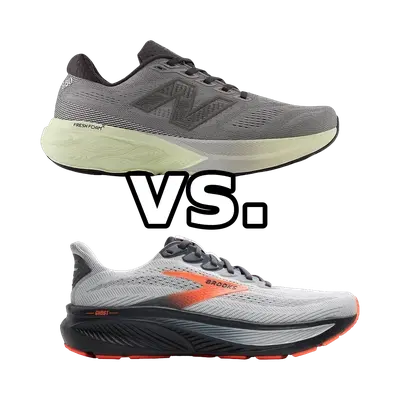
New Balance Fresh Foam X 880v15 vs Brooks Ghost 17
© 2026 longrunshoes.ai | All rights reserved.
Use of materials from this site is permitted only with proper attribution and a link to longrunshoes.ai.