
Puma Velocity Nitro 3 vs Puma Velocity Nitro 4:
Which to Choose
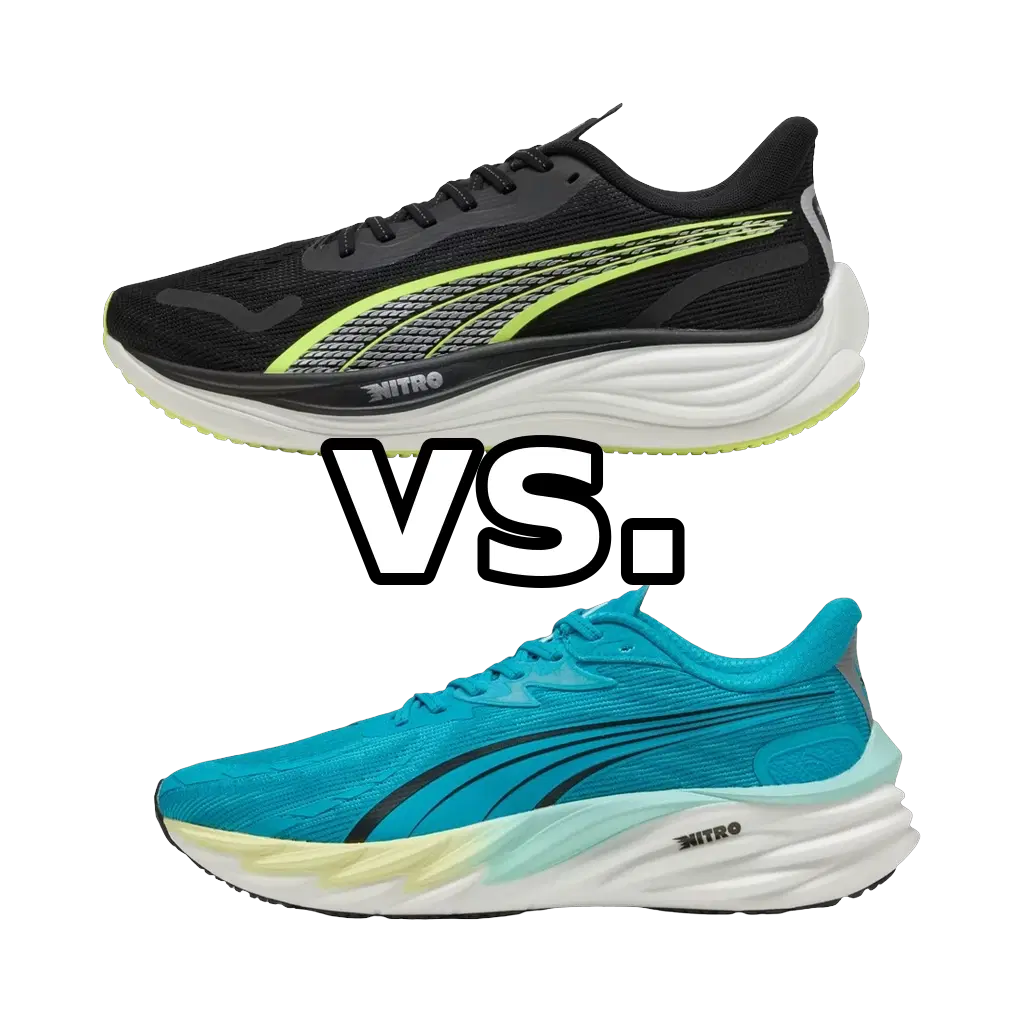
Verdict
For most existing Nitro 3 owners, the Nitro 4 is a real upgrade rather than a cosmetic refresh: same proven geometry and use case, but about 50g lighter and noticeably springier thanks to the move to a single full-length NITROFOAM midsole. The main reason to stay with the 3 — or to hold off — is if you actively prefer its firmer, more grounded ride, in which case the change in character may not be the direction you want.
Pace
4 of 6
Cushioning
4 of 6
Responsiveness
4 of 6
Stability
4 of 6
Drop
10 mm
Support
Neutral
Plate
None
Distances
10KHalfMarathon
Pace
3 of 6
Cushioning
4 of 6
Responsiveness
4 of 6
Stability
4 of 6
Drop
10 mm
Support
Neutral
Plate
None
Distances
10KHalfMarathon
At a Glance
Puma Velocity Nitro 3Puma Velocity Nitro 4
Who Should Choose Each Shoe
Choose
Puma Velocity Nitro 3
The Velocity Nitro 3 still makes sense for the neutral runner who specifically likes a grounded, connected, slightly firmer ride and the extra road feel that the dual-density midsole delivers, especially for shorter steady efforts where the modest weight penalty barely registers. It's a sensible pick for an improving beginner or anyone who wants one durable trainer for most of the week and doesn't feel the pull to chase the lightest, springiest version available.
Choose
Puma Velocity Nitro 4
Choose the Velocity Nitro 4 if you're a neutral runner logging real weekly volume — long easy days, steady runs, and the occasional faster effort — where shedding roughly 50g and gaining a smoother, mildly springier roll genuinely changes how fresh your legs feel late in a run or a marathon. It's the better call for anyone who found the Nitro 3 a bit firm or leaden and wants the same geometry and use case in a lighter, more modern-feeling package, as long as you can live with a knit upper that holds a little heat in summer.
Head-to-Head
The headline difference is weight and what drives it. The Velocity Nitro 3 comes in at around 275g in a men's US 9; the Nitro 4 drops to roughly 224g — a reduction of about 50g, which is a lot to shed in one generation and is immediately noticeable at pickup and over a long run. That weight saving is not a trick of thinner cushioning — stack height and the 10mm drop are unchanged — but a change in how the midsole is built. The Nitro 3 uses a dual-density setup, pairing the lively nitrogen-infused Nitro foam with a firmer EVA-based carrier underneath, which is why it reads as lively-but-grounded with a fair amount of ground feel that some runners find a touch firm on long days. The Nitro 4 ditches the carrier layer for a single full-length slab of nitrogen-infused NITROFOAM, which is both the reason it's lighter and the reason it rides a little springier and rolls through the gait more smoothly, while still firming up honestly when you push the pace. Everything else is close to a wash: both are neutral platforms with a moderately stable, wide base and no pronation correction, both top out around a similar tempo ceiling (roughly 4:45 vs 4:40 min/km) and are happiest at steady daily paces, and neither is a plush recovery shoe or a plated 5K racer. The uppers differ in detail more than in feel — the Nitro 3 uses a plain engineered mesh, while the Nitro 4 moves to an engineered knit reinforced with PWRTAPE for lockdown, which does run slightly warm in peak summer heat.
Similar Comparisons
Puma Velocity Nitro 5 vs Puma Velocity Nitro 4

Nike Pegasus 41 vs Puma Velocity Nitro 3
New Balance Fresh Foam X 1080v15 vs Puma Velocity Nitro 4

Puma Velocity Nitro 3 vs Salomon Aero Blaze 4

Adidas Ultraboost 5X vs Puma Velocity Nitro 4

Brooks Glycerin 22 vs Puma Velocity Nitro 4
© 2026 longrunshoes.ai | All rights reserved.
Use of materials from this site is permitted only with proper attribution and a link to longrunshoes.ai.