
Puma Velocity Nitro 3 vs Salomon Aero Blaze 4:
Which to Choose
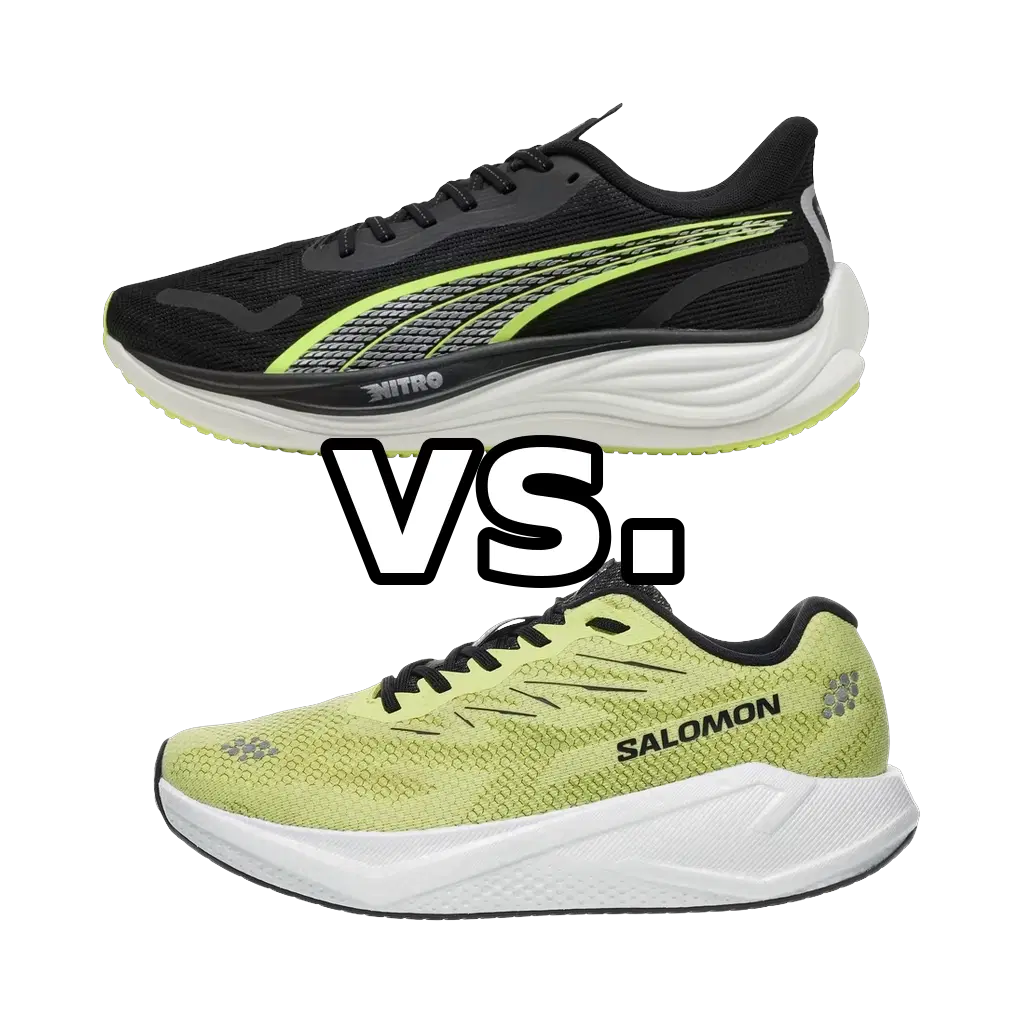
Verdict
There's no wrong answer here — these are two closely matched neutral, plateless daily trainers with the same core mission — so it genuinely depends on ride preference and foot shape. Pick the Aero Blaze 4 if you want lighter weight, a bit more stack, a springier TPU bounce, and a lower 8mm drop, and your foot fits its snug upper; pick the Velocity Nitro 3 if you prefer a more grounded, firmer ride, a traditional 10mm drop, and a roomier, more accommodating fit. Try both if you can, but let fit be the deciding factor when the ride feels close.
Pace
4 of 6
Cushioning
4 of 6
Responsiveness
4 of 6
Stability
4 of 6
Drop
10 mm
Support
Neutral
Plate
None
Distances
10KHalfMarathon
Pace
4 of 6
Cushioning
4 of 6
Responsiveness
4 of 6
Stability
4 of 6
Drop
8 mm
Support
Neutral
Plate
None
Distances
10KHalfMarathon
At a Glance
Puma Velocity Nitro 3Salomon Aero Blaze 4
Who Should Choose Each Shoe
Choose
Puma Velocity Nitro 3
Choose the Velocity Nitro 3 if you want a grounded, dependable one-shoe quiver and value a traditional 10mm drop — it favors heel and midfoot strikers and rewards runners who like a firmer, connected ride with real ground feel over a bouncy one. It's a particularly sensible pick for improving beginners and higher-mileage neutral runners who want durability and a roomier, no-surprises fit, and who prioritize a planted feel on steady miles over shaving grams. If you're building base and don't mind a bit more shoe underfoot, this is the reassuring workhorse.
Choose
Salomon Aero Blaze 4
Choose the Aero Blaze 4 if you want the lighter, livelier of the two and enjoy a springier, more resilient bounce when you press into an uptempo daily run — the ~226g weight and taller optiFOAM² stack make it the better tool for a runner with efficient form who wants one trainer that can flex from easy miles to pickups. Its lower 8mm drop and forefoot engagement suit runners who want a slightly more modern, energetic ride. Just confirm the fit first: the snug, somewhat narrow version-4 upper rewards medium-to-narrow feet and may frustrate wide-footed runners.
Head-to-Head
These two overlap heavily in intent but diverge in feel. The biggest split is weight: the Aero Blaze 4 comes in at about 226g in a men's US 9 versus roughly 275g for the Velocity Nitro 3, and that ~49g gap is felt underfoot — the Salomon plays lighter and quicker on pickups, while the Puma sits more planted and trainer-like. Notably the Salomon achieves that lower weight on the taller platform: it runs a 36/28mm stack against the Puma's 34/24mm, so it's marginally more protective yet lighter, a testament to its beaded optiFOAM² TPU midsole versus Puma's nitrogen-infused Nitro EVA. The foams behave differently too — the TPU-based optiFOAM² reads soft-but-firm with a resilient, springier bounce when you lean on it, whereas the Nitro EVA feels lively but more grounded and firm, giving up a bit of pop for a clean, predictable roll-through. Geometry differs as well: the Puma's 10mm drop is a traditional heel-and-midfoot-friendly slope, while the Salomon's 8mm sits a touch more balanced toward forefoot engagement. Both are neutral with a wide-enough, moderately stable base and neither has a plate, so both top out around 4:45 min/km before a dedicated racer makes more sense. Fit is the practical tiebreaker: the version-4 Aero Blaze upper hugs securely but runs somewhat narrow, so wide-footed runners will want to try it on, whereas the Velocity Nitro 3's more conventional daily-trainer fit is the safer bet for higher-volume feet.





© 2026 longrunshoes.ai | All rights reserved.
Use of materials from this site is permitted only with proper attribution and a link to longrunshoes.ai.