
Nike Pegasus Plus vs Saucony Endorphin Speed 5:
Which to Choose

Verdict
These are close cousins in weight and superfoam bounce, so it comes down to plate and range rather than which is "faster." Take the Pegasus Plus for a natural, plateless ride tuned to 5K–half tempo work; take the Endorphin Speed 5 if you want a more planted, plated all-rounder that can carry you from daily miles to the marathon start line. The longer and more race-oriented your ambitions, the more the Endorphin justifies itself.
Pace
4 of 6
Cushioning
4 of 6
Responsiveness
5 of 6
Stability
3 of 6
Drop
10 mm
Support
Neutral
Plate
None
Distances
5K10KHalf
Pace
5 of 6
Cushioning
5 of 6
Responsiveness
5 of 6
Stability
3 of 6
Drop
8 mm
Support
Neutral
Plate
Composite
Distances
10KHalfMarathon
At a Glance
Nike Pegasus PlusSaucony Endorphin Speed 5
Who Should Choose Each Shoe
Choose
Nike Pegasus Plus
Choose the Pegasus Plus if your fast running lives in the 5K-to-half range and you want a soft, springy, plateless ride that feels natural rather than mechanical — tempo runs, uptempo long runs, and shorter road races where you like to feel the foam do the work. Its 10mm drop and energetic ZoomX suit heel and midfoot strikers who prefer a shoe that comes alive when they push the pace, not one that dictates the roll. It's the better pick if you don't need a plate and don't plan to race beyond the half.
Choose
Saucony Endorphin Speed 5
Choose the Endorphin Speed 5 if you're an intermediate-to-experienced runner who wants a single shoe for tempo sessions, marathon-training long runs, and race day without buying a separate carbon racer. The nylon plate and wider 37mm platform give it propulsion and a more planted, forgiving roll at speed, and its comfort zone stretches all the way to the marathon, with the half as its sweet spot. It's the smarter buy if your longest hard efforts run past the half or you want a little more structure guiding your stride.
Head-to-Head
On paper these two are close: both are neutral (stability 3/6), both ride on a PEBA superfoam, and both weigh essentially the same — roughly 238g for the Pegasus Plus in a men's 9 versus 241g for the Endorphin Speed 5 — so weight isn't a deciding factor. The real split is the plate. The Pegasus Plus is full-length Nike ZoomX with no plate, which gives it a soft, lively, unforced rebound that rewards a quick cadence but leaves the ride feeling a touch tippy and less grounded at easy paces, especially on its tall, fairly narrow base. The Endorphin Speed 5 pairs beaded PWRRUN PB with a semi-rigid winged nylon plate (not carbon) that guides rather than snaps, adding propulsion and a rolling toe-off while a wide 37mm-heel platform keeps it more planted underfoot. That plate and geometry are also why it reaches further: the Endorphin sits a little taller (about 37/27mm versus roughly 34/24mm for the Pegasus) and is happiest from 10K through the marathon, with the half as its sweet spot, whereas the Pegasus tops out at the half and truly shines at 5K–10K tempo efforts. Drop is close but not identical — 10mm on the Pegasus for a more traditional heel bias, 8mm stated on the Endorphin (it measures nearer 10mm in practice). In short: the Pegasus is the simpler, more natural short-to-middle-distance flyer, while the Endorphin is the more structured, longer-legged all-rounder that can genuinely double as a racer up to 26.2.
Similar Comparisons

Saucony Endorphin Speed 4 vs Saucony Endorphin Speed 5

Nike Pegasus Plus vs Nike Vomero Plus

Adidas Adizero Evo SL vs Saucony Endorphin Speed 5

Adidas Adizero Boston 13 vs Saucony Endorphin Speed 5
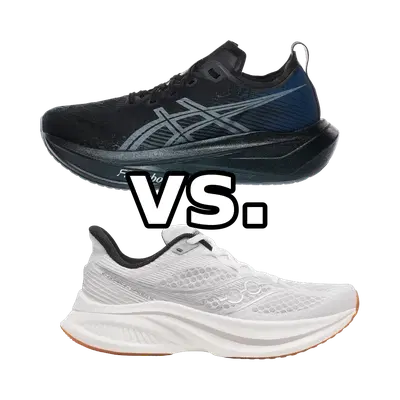
Asics Megablast vs Saucony Endorphin Speed 5

Saucony Endorphin Speed 5 vs Saucony Endorphin Azura

Saucony Endorphin Trainer vs Saucony Endorphin Speed 5

Saucony Endorphin Speed 5 vs Brooks Hyperion Max 4
© 2026 longrunshoes.ai | All rights reserved.
Use of materials from this site is permitted only with proper attribution and a link to longrunshoes.ai.