
New Balance FuelCell SuperComp Elite v5 vs Puma Deviate Nitro Elite 4:
Which to Choose
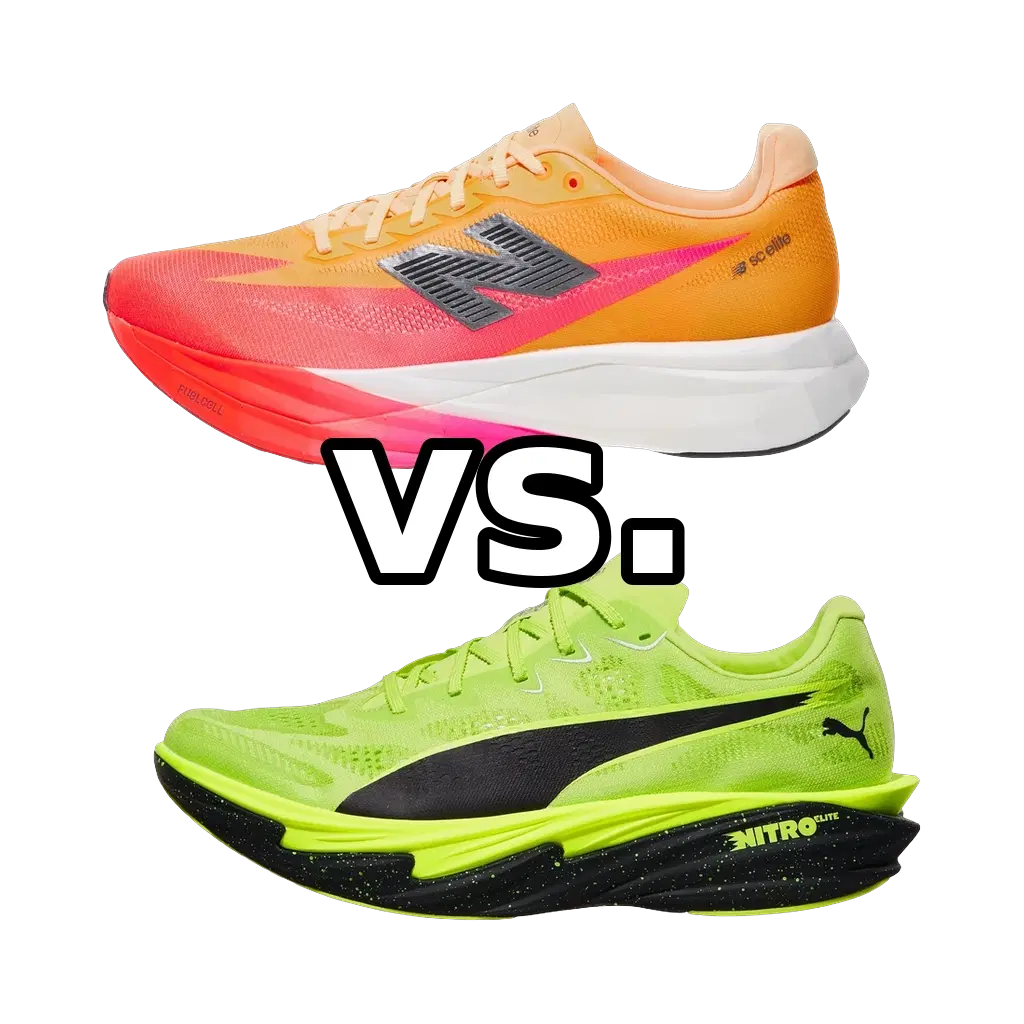
Verdict
These are two excellent, closely matched race-day super shoes, and for most runners either will deliver a fast day — so the decision comes down to fit and distance rather than any gap in quality. Go New Balance if your priority is the marathon, a roomier toebox, and a slightly more cushioned, forgiving ride; go Puma if you want the lighter, firmer, more versatile racer that spans 10K to marathon and feels sharpest at the half. Match the shoe to your foot shape and your main race distance and you can't really go wrong.
Pace
6 of 6
Cushioning
5 of 6
Responsiveness
6 of 6
Stability
2 of 6
Drop
10 mm
Support
Neutral
Plate
Carbon
Distances
HalfMarathon
Pace
6 of 6
Cushioning
5 of 6
Responsiveness
6 of 6
Stability
2 of 6
Drop
9 mm
Support
Neutral
Plate
Carbon
Distances
10KHalfMarathon
At a Glance
New Balance FuelCell SuperComp Elite v5Puma Deviate Nitro Elite 4
Who Should Choose Each Shoe
Choose
New Balance FuelCell SuperComp Elite v5
Choose the SuperComp Elite v5 if the marathon is your target and you want a super shoe that stays comfortable deep into the race — the extra cushion and the roomier toebox make it the friendlier pick for longer time on feet or for runners who find paper-thin racers cramped and harsh. It's also the better match if you have a wider foot or simply prefer a bit more forgiveness and a less twitchy, more planted feel underfoot. Experienced marathoners holding a fast, even effort will get the most out of it.
Choose
Puma Deviate Nitro Elite 4
Choose the Deviate Nitro Elite 4 if you want the lighter, snappier, more aggressive tool and you race across a wider range of distances — it's at home from 10K to the marathon and peaks at the half, so it's the stronger choice if your calendar mixes shorter, faster races with longer ones. Its minimal, locked-down upper and firm, direct ride suit a confident midfoot striker who likes to feel the ground and drive off the plate. If outright low weight and a sharp, race-ready feel matter more to you than extra plushness, this is the one.
Head-to-Head
On paper these are near-twins: both score 6/6 for pace and responsiveness, 5/6 for cushioning, and just 2/6 for stability, and both rely on a full-length carbon plate (the Elite's Energy Arc system with midsole voids, the Deviate's PWRPLATE) under a lively, bouncy — not plush — supercritical foam. The clearest hard difference is weight: the Deviate Nitro Elite 4 is a featherweight 173g in men's US 9, while the SuperComp Elite v5 comes in at 198g. That ~25g gap is real and you feel it late in a race. Stack and drop are close enough to be a wash — the Elite sits at 39mm heel / 29mm forefoot, the Deviate at 37mm / 28mm, and both run a moderate heel bias (the Deviate a measured 9mm, the Elite roughly 8–10mm depending on how it's measured) that flatters heel and midfoot strikers alike. The more decisive split is fit and ride character. The New Balance pairs a woven mesh upper with a semi-gusseted tongue and a notably roomier, more accommodating toebox and a touch more underfoot cushion, giving it a slightly softer, more forgiving feel that holds up well over the full marathon. The Puma's ULTRAWEAVE upper is minimal and race-snug, and its ride is firmer and more direct — it rewards precise foot placement and an aggressive forward tumble more than it coddles you. Both platforms are tall, soft, and admittedly tippy at easy jog paces; neither is a shoe you want to slow down in. On range, the Deviate is the more versatile racer, genuinely happy from 10K through the marathon with the half as its sweet spot, whereas the Elite is tuned longer, with the marathon as its true home and the half as its shorter end.
Similar Comparisons

Puma Deviate Nitro Elite 3 vs Puma Deviate Nitro Elite 4

New Balance FuelCell SuperComp Elite v4 vs New Balance FuelCell SuperComp Elite v5

Nike Vaporfly 4 vs Puma Deviate Nitro Elite 4

Puma Deviate Nitro Elite 3 vs New Balance FuelCell SuperComp Elite v5

Saucony Endorphin Pro 5 vs Puma Deviate Nitro Elite 4

Saucony Endorphin Pro 4 vs New Balance FuelCell SuperComp Elite v5

Puma Deviate Nitro 4 vs Puma Deviate Nitro Elite 4

Brooks Hyperion Elite 5 vs New Balance FuelCell SuperComp Elite v5
© 2026 longrunshoes.ai | All rights reserved.
Use of materials from this site is permitted only with proper attribution and a link to longrunshoes.ai.