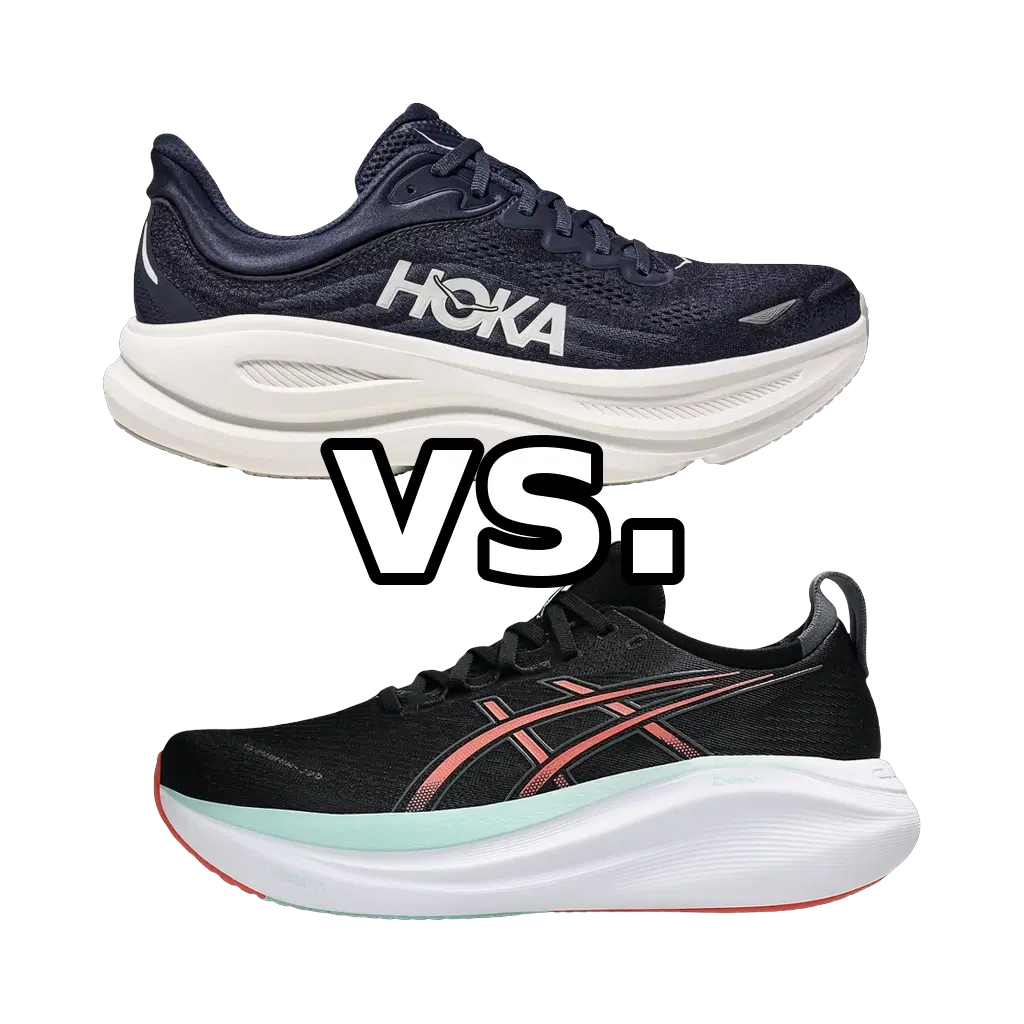
Hoka Bondi 9 vs Asics Gel-Nimbus 27:
Which to Choose
Verdict
These are close cousins — same max cushioning, nearly the same weight, the same wide and stable platform — so it comes down to geometry and range, not quality. Go Bondi 9 if you want a lower 5mm drop and a rocker-driven recovery ride capped at half-marathon distance; go Gel-Nimbus 27 if you want the steeper 8mm drop, slightly more responsive foam, and the headroom to take the same plush shoe all the way to the marathon.
Pace
2 of 6
Cushioning
6 of 6
Responsiveness
3 of 6
Stability
5 of 6
Drop
5 mm
Support
Stable Neutral
Plate
None
Distances
10KHalf
Pace
3 of 6
Cushioning
6 of 6
Responsiveness
4 of 6
Stability
5 of 6
Drop
8 mm
Support
Neutral
Plate
None
Distances
10KHalfMarathon
At a Glance
Hoka Bondi 9Asics Gel-Nimbus 27
Who Should Choose Each Shoe
Choose
Hoka Bondi 9
Choose the Bondi 9 if you want the most forgiving, planted recovery-day ride and prefer a lower 5mm drop that keeps you closer to level — a good match for forefoot and midfoot strikers, heavier runners, and beginners piling on easy volume. Its strong rocker does the work of rolling you through each stride at conversational effort, so it suits anyone who values a smooth, low-slung glide over any sense of spring. Pick it if your mileage lives in the easy-10K to steady half-marathon range and you have no interest in reaching marathon distance in this particular shoe.
Choose
Asics Gel-Nimbus 27
Choose the Gel-Nimbus 27 if you're a heel or midfoot striker who likes a more traditional 8mm drop and a slightly livelier, more forgiving foam that doesn't feel quite as dead when you nudge the pace. Its broader comfortable range — genuinely happy at 10K, half, and full marathon distances — makes it the better single do-everything cushioned trainer if your long runs stretch toward 26.2. It's also the pick if you want a plusher, more wrapped knit upper and a touch more versatility across your easy-to-steady zone.
Head-to-Head
Both shoes top out at maximum cushioning (6/6) and high stability for neutral trainers (5/6), and both carry roughly the same towering heel stack — about 43mm on the Bondi and 43.5mm on the Nimbus — so neither is meaningfully more protective underfoot. The decisive differences are geometry, foam character, and range. The Bondi runs a 5mm drop with a 38mm forefoot, while the Nimbus runs a steeper 8mm drop with a lower 35.5mm forefoot, so the Nimbus tips you forward more and tends to flatter heel and midfoot strikers through the transition, whereas the Bondi's lower offset sits more level. The two foams also feel different in kind: Hoka's supercritical-EVA in the Bondi is plush but comparatively muted and dead when pushed, and the shoe relies heavily on its pronounced rockered geometry to roll you forward; the Nimbus's FF Blast Plus Eco, backed by rearfoot gel, is a touch livelier and more forgiving, which is reflected in its slightly higher responsiveness rating (4/6 vs 3/6) and a marginally faster effective ceiling — roughly 5:15–5:30 min/km versus the Bondi's ~5:30. Range is the other real gap: the Nimbus comfortably handles 10K, half, and full-marathon-distance efforts, while the Bondi is happiest at 10K and half-marathon long runs before its plush foam starts to feel heavy. On fit, the Bondi's engineered mesh upper is the more straightforwardly breathable, while the Nimbus's engineered knit is plusher and more sock-like around the foot.
Similar Comparisons
Asics Gel-Nimbus 27 vs Asics Gel-Cumulus 27
Hoka Bondi 9 vs Asics Gel-Nimbus 28
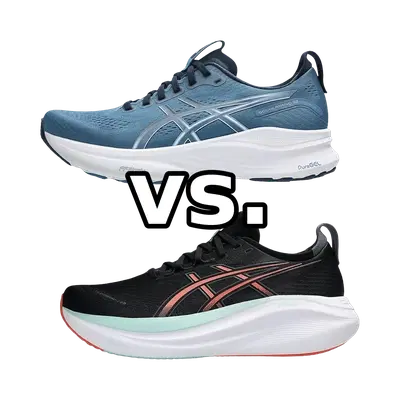
Asics Gel-Kayano 32 vs Asics Gel-Nimbus 27
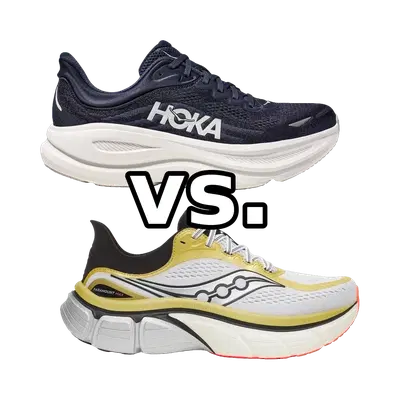
Hoka Bondi 9 vs Saucony Paramount Max
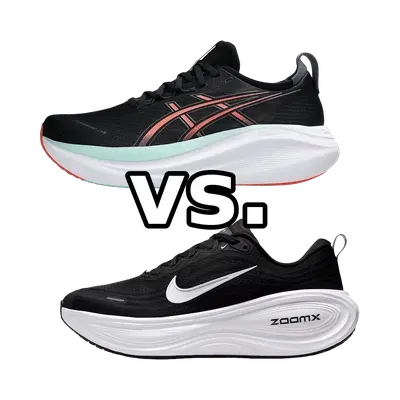
Asics Gel-Nimbus 27 vs Nike Vomero Plus
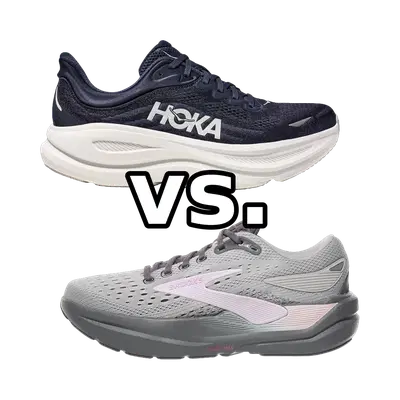
Hoka Bondi 9 vs Brooks Ghost Max 3
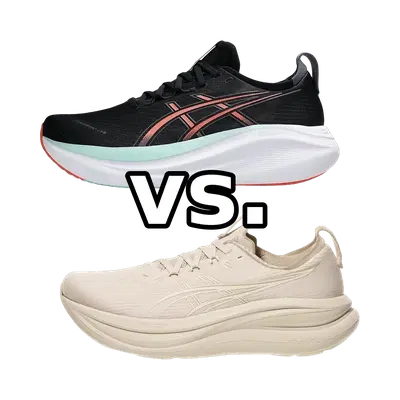
Asics Gel-Nimbus 27 vs Asics Gel-Nimbus 28
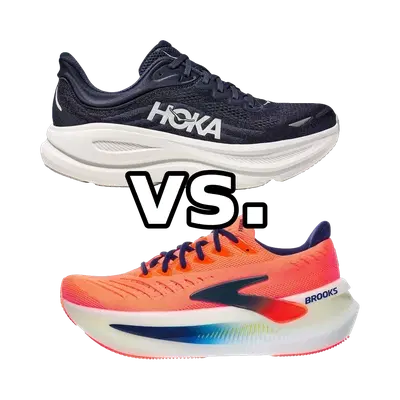
Hoka Bondi 9 vs Brooks Glycerin Max 2
© 2026 longrunshoes.ai | All rights reserved.
Use of materials from this site is permitted only with proper attribution and a link to longrunshoes.ai.