
Brooks Glycerin Max vs Mizuno Wave Horizon 9:
Which to Choose
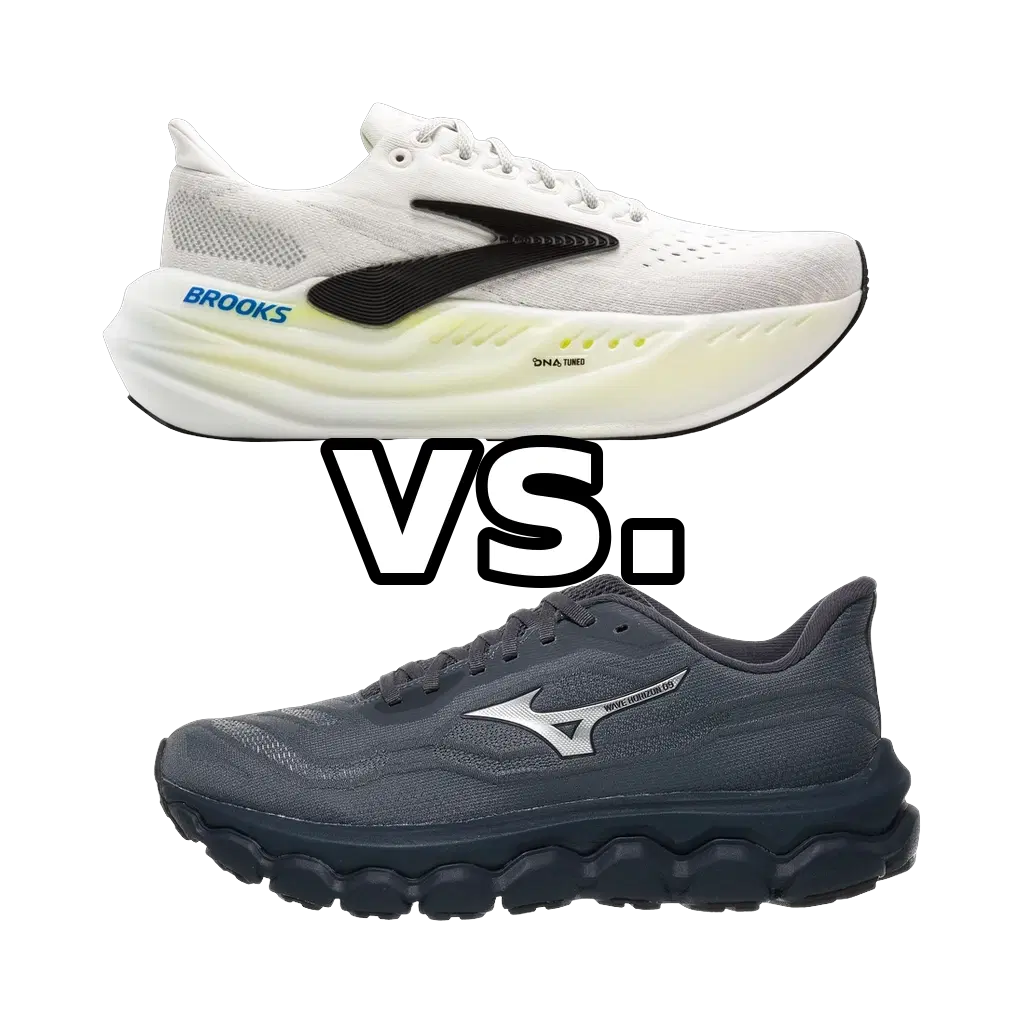
Verdict
This one genuinely comes down to your gait, not your goals — the two shoes target the same easy-to-long-run role at nearly identical cushioning and pace. If you're neutral and want the plushest, tallest, slightly lighter cruiser, take the Glycerin Max; if you overpronate or want real structured support underfoot, the firmer, guided Wave Horizon 9 is the clear call. Match the shoe to how your foot moves and either will do its job well.
Pace
3 of 6
Cushioning
6 of 6
Responsiveness
4 of 6
Stability
5 of 6
Drop
6 mm
Support
Stable Neutral
Plate
None
Distances
HalfMarathon
Pace
3 of 6
Cushioning
6 of 6
Responsiveness
4 of 6
Stability
5 of 6
Drop
8 mm
Support
Stability
Plate
None
Distances
10KHalfMarathon
At a Glance
Brooks Glycerin MaxMizuno Wave Horizon 9
Who Should Choose Each Shoe
Choose
Brooks Glycerin Max
Choose the Glycerin Max if you're a neutral runner who wants the softest, tallest, most forgiving ride you can get for recovery days, easy volume, and marathon-comfort long runs — and you don't need any built-in pronation correction. It's the pick for beginners building durability and for high-mileage marathoners who want maximum leg protection in a shoe that's actually a touch lighter and taller than the Horizon 9. If you like a rockered, cruise-forward feel and prize plushness above a planted, controlled platform, this is your shoe.
Choose
Mizuno Wave Horizon 9
Choose the Wave Horizon 9 if you overpronate or are a heavier runner who wants cushioning and genuine structure in the same shoe, rather than a neutral platform that only steadies itself through geometry. Its medial support and FOAM WAVE guidance make it the safer daily trainer for anyone whose stride collapses inward under fatigue, and its firmer, more controlled ride and lower 33 mm forefoot suit runners who want to feel planted through transitions. It's also the more versatile of the two on the low end, comfortably handling 10K efforts as well as half and full marathons.
Head-to-Head
Start with what's identical, because a lot is: both sit at maximum cushioning with no rigid plate, both lean on comfort over snap, and both fade above roughly 5:15–5:30 min/km when their tall stacks start to feel vague under a fast effort. The differences are structural. The Glycerin Max is the taller, softer shoe — a 47 mm heel / 41 mm forefoot platform of DNA Tuned nitrogen foam on a 6 mm drop, with the GlideRoll rocker doing the work of moving you forward. The Wave Horizon 9 rides lower at 41 mm heel / 33 mm forefoot on a steeper 8 mm drop, and pairs a soft, springy Enerzy NXT top layer over a firmer Enerzy base, so landings feel cushioned but transitions feel planted and controlled rather than pillowy. Despite its "substantial" reputation, the Glycerin Max is actually the lighter of the two at about 300 g in a men's US 9 versus roughly 320 g for the Horizon 9. The decisive split is support philosophy: the Glycerin Max is stable-neutral, steadying its tall stack purely through a wide base and rocker geometry with no posting, while the Wave Horizon 9 is a true stability shoe, using FOAM WAVE geometry and an enhanced medial wall to actively guide overpronation. That also shows in range — the Horizon 9 is happy dropping down to 10K, whereas the Glycerin Max is happiest from the half up through the marathon.
Similar Comparisons
Mizuno Wave Horizon 8 vs Mizuno Wave Horizon 9

Brooks Glycerin Max vs Brooks Glycerin Max 2

Asics Gel-Nimbus 28 vs Mizuno Wave Horizon 9

Brooks Glycerin Max vs Brooks Hyperion Max 3

Brooks Glycerin Max vs Saucony Hurricane 25
Asics Glideride Max vs Brooks Glycerin Max

Brooks Glycerin Max vs Asics Gel-Nimbus 28
© 2026 longrunshoes.ai | All rights reserved.
Use of materials from this site is permitted only with proper attribution and a link to longrunshoes.ai.