
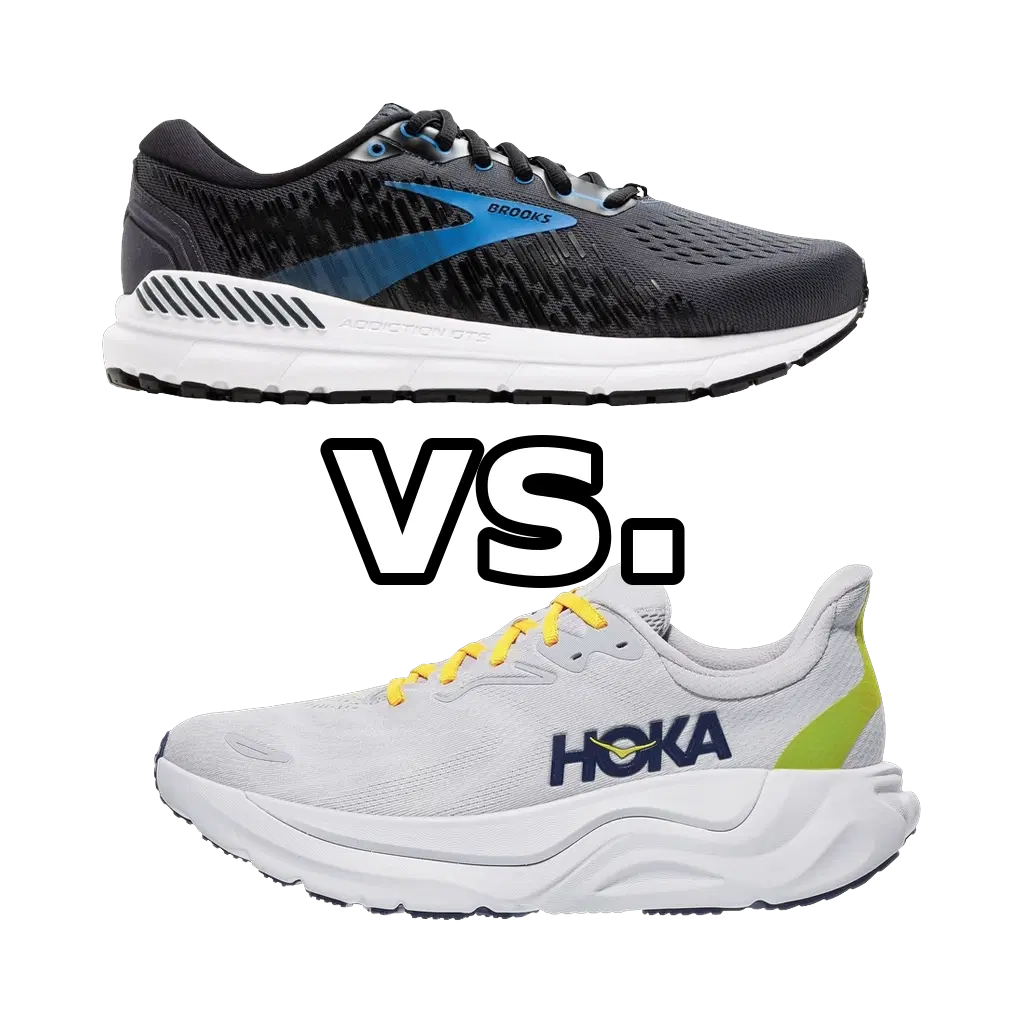
Brooks Addiction GTS 15 vs Hoka Arahi 8:
Which to Choose
Verdict
These are two takes on the same mission, so it comes down to how much control you need versus how much shoe you want to carry. If your pronation is significant and you prize maximum, no-compromise guidance and durability on shorter training distances, the Addiction GTS 15 is the more overtly corrective, planted choice. For nearly everyone else who wants structured support that stays light, cushioned, and marathon-capable, the roughly 90g-lighter, taller-stacked Arahi 8 is the more versatile everyday pick.
Pace
3 of 6
Cushioning
4 of 6
Responsiveness
3 of 6
Stability
6 of 6
Drop
12 mm
Support
Motion Control
Plate
None
Distances
10KHalf
Pace
3 of 6
Cushioning
4 of 6
Responsiveness
3 of 6
Stability
6 of 6
Drop
11 mm
Support
Stability
Plate
None
Distances
10KHalfMarathon
At a Glance
Brooks Addiction GTS 15Hoka Arahi 8
Who Should Choose Each Shoe
Choose
Brooks Addiction GTS 15
Pick the Addiction GTS 15 if you're a heavier or higher-mileage runner with pronounced overpronation who wants the most locked-down, controlling platform you can get and doesn't mind carrying more shoe to get it. Its firm DNA Loft, wide base, GuideRails, and durable outsole make it the safer bet for someone whose ankles genuinely roll and who values a planted, joint-protecting feel on steady 10K and half-marathon training over any sense of speed or pop.
Choose
Hoka Arahi 8
Choose the Arahi 8 if you want real stability without the weight penalty — a daily and long-run trainer that guides your gait but still feels light and moves through the stride more easily. It's the better call for the heel-striking overpronator chasing injury-free volume who wants a shoe that scales up to the full marathon and can handle slightly quicker steady efforts, all on a taller, marginally more cushioned platform.
Head-to-Head
Start with what's the same, because it's a lot: both score 4/6 cushioning, 3/6 responsiveness, and a maxed-out 6/6 stability, both skip a plate entirely, and both deliver a firm, workmanlike ride that supports rather than springs — neither will pop when you push, and neither is the soft recovery shoe. From there they split. The biggest, most tangible difference is weight: the Addiction GTS 15 lands around 346g in a men's pair, while the Arahi 8 comes in near 259g — that's close to 90g, and you feel it, with the Brooks reading as the more substantial, planted, old-school controlling shoe and the Hoka as the noticeably nimbler one. Stack heights push the same direction: the Arahi sits taller underfoot at roughly 39mm heel / 28mm forefoot versus the Addiction's 36.5mm / 24.4mm, so the Hoka feels a touch more cushioned and rockered, the Brooks lower and firmer. Drops are effectively a wash — 12mm on the Brooks against a measured 11mm on the Hoka (Hoka markets it as 8mm, but the caliper says otherwise), so both favor a heel-first landing. The support mechanisms differ in philosophy more than result: the Addiction uses GuideRails plus a broad base and firm DNA Loft to physically fence in excess motion — true motion-control territory for heavier or more aggressive overpronators — while the Arahi's CMEVA and active H-Frame guide the foot straight in a lighter, less overtly corrective way. Use cases overlap at 10K and the half, but the Arahi extends comfortably to the full marathon and lists a slightly quicker effective range (down to about 4:45–5:00 min/km) where the Addiction tops out closer to 5:30, reflecting its heavier, steadier bias.






© 2026 longrunshoes.ai | All rights reserved.
Use of materials from this site is permitted only with proper attribution and a link to longrunshoes.ai.