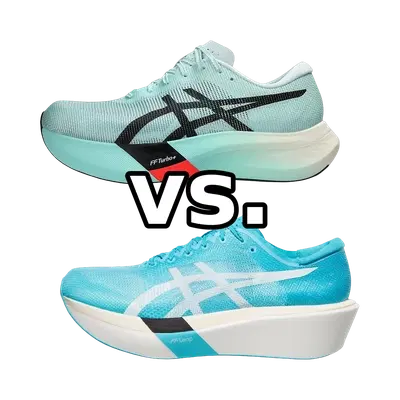
Asics Metaspeed Sky Tokyo vs Asics Metaspeed Edge Tokyo:
Which to Choose
Verdict
These are two tunings of the same superb racer, not a better-and-worse pair, so the choice hinges on your mechanics and your race calendar rather than on any quality gap. Pick the Sky if you're a stride-lengthening forefoot striker focused on half and full marathons; pick the Edge if you're a cadence-driven or heavier-heel-contact runner, want a marginally softer and steadier ride, or need one shoe that races well from 5K to the marathon. If you genuinely can't tell which describes you, the Edge's wider distance range and slightly more forgiving platform make it the safer default.
Pace
6 of 6
Cushioning
5 of 6
Responsiveness
6 of 6
Stability
2 of 6
Drop
6 mm
Support
Neutral
Plate
Carbon
Distances
HalfMarathon
Pace
6 of 6
Cushioning
5 of 6
Responsiveness
6 of 6
Stability
2 of 6
Drop
7 mm
Support
Neutral
Plate
Carbon
Distances
5K10KHalfMarathon
At a Glance
Asics Metaspeed Sky TokyoAsics Metaspeed Edge Tokyo
Who Should Choose Each Shoe
Choose
Asics Metaspeed Sky Tokyo
Choose the Metaspeed Sky Tokyo if you're a forefoot or midfoot striker who noticeably lengthens your stride when you accelerate, and if your racing centers on the half and full marathon. It rewards a light, quick, committed turnover with a firm, springy, forward-tipping ride, and it's the sharper pick for a runner whose target race is 26.2 and who wants a tool optimized specifically for holding marathon pace.
Choose
Asics Metaspeed Edge Tokyo
Choose the Metaspeed Edge Tokyo if you increase your cadence rather than your stride length to speed up, or if you land closer to your midfoot and heel and want a slightly softer, more grounded, more stable feel underfoot. Its firmer FF Turbo+ heel and rolling transition also make it the more forgiving option, and because it excels from 5K through the marathon, it's the better single-shoe choice for a racer who wants to cover everything from a fast parkrun to a goal marathon.
Head-to-Head
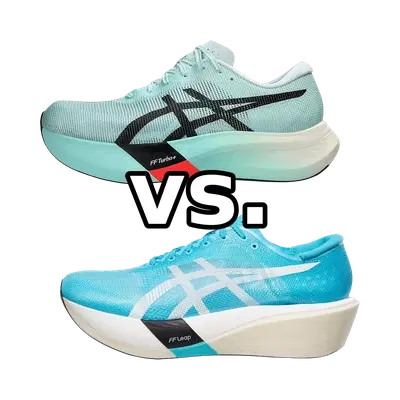
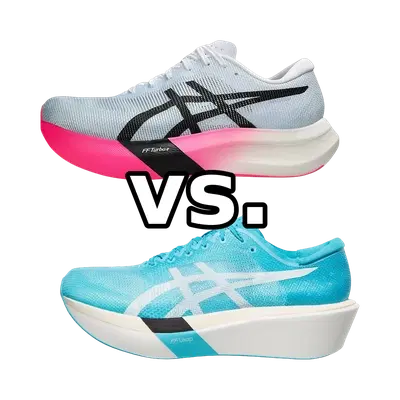
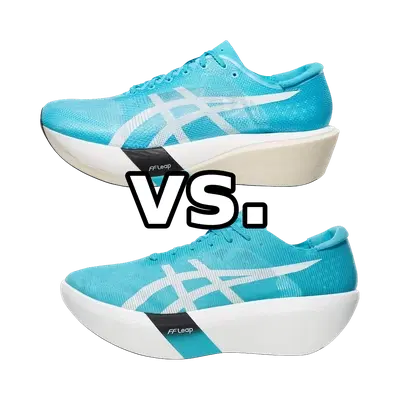
On paper these two are almost twins: both score maximally for pace and responsiveness, carry high-but-not-maximal FF Leap cushioning, sit on the same low ~5mm marketed drop, and share a narrow, low-stability neutral platform that feels tippy and out of place at jogging speeds and only comes alive around 3:00–3:15 min/km. The stack heights confirm how close they are — the Sky measures 39mm heel / 33mm forefoot, the Edge 39.5mm heel / 34.5mm forefoot — and both are feathery, with the Sky at 163g and the Edge fractionally lighter at 159g (men's US 9). The meaningful split is mechanical, and it comes down to foam distribution and plate placement. The Sky uses a flatter plate and a more even foam bed to reward runners who lengthen their stride to go faster, giving a firm, springy, distinctly propulsive push that nudges you onto your toes. The Edge pairs a soft, bouncy FF Leap forefoot over a firmer FF Turbo+ heel with a lower, more curved plate, producing a rolling ride with crisper, more grounded transitions that suit runners who instead pick up their cadence — and that firmer heel and slightly deeper forefoot stack make it a touch more forgiving and steady for midfoot-to-heel contact. Use case is the other differentiator: the Sky is a dedicated half-to-marathon weapon that's clearest at full-marathon distance, while the Edge stretches its range down to 5K and 10K, making it the more versatile racer across your season.
© 2026 longrunshoes.ai | All rights reserved.
Use of materials from this site is permitted only with proper attribution and a link to longrunshoes.ai.