
Asics Magic Speed 4 vs Asics Magic Speed 5:
Which to Choose
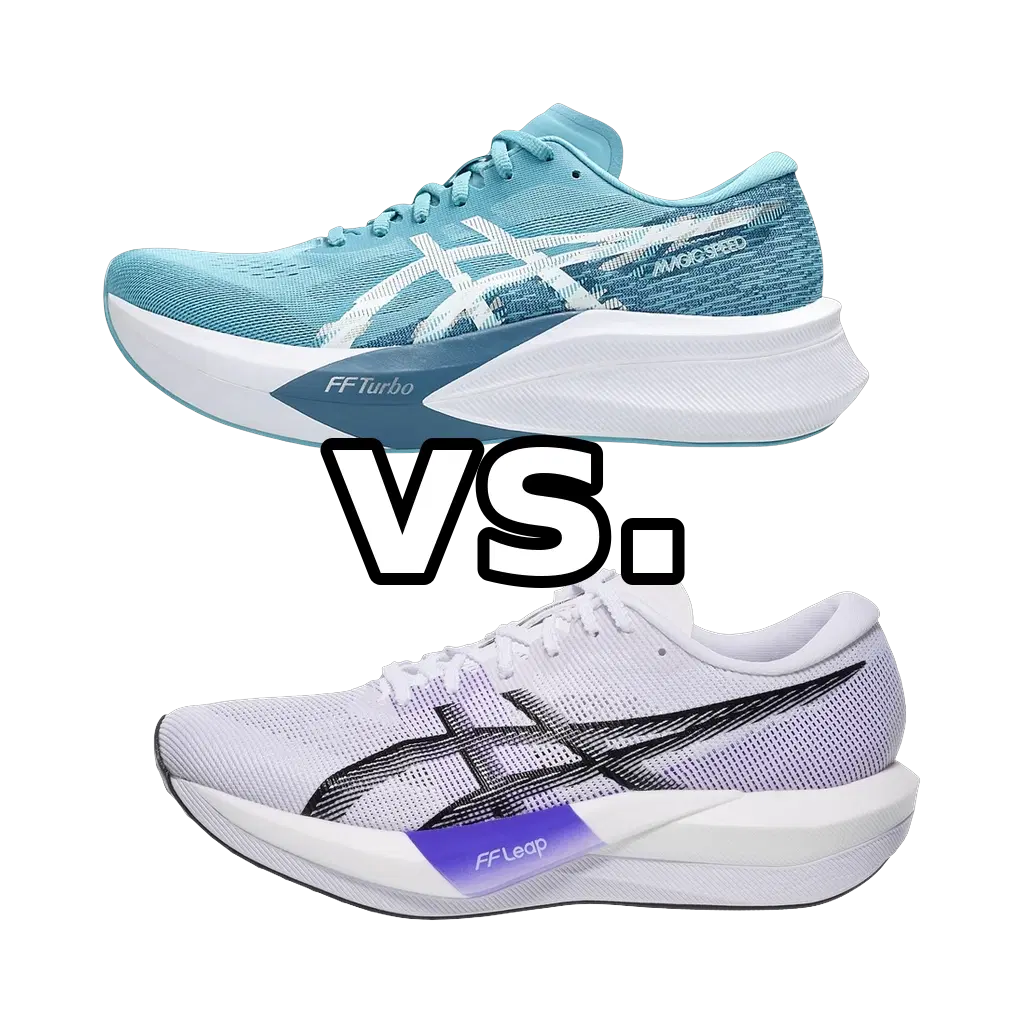
Verdict
It depends on how far you race. If you're a Magic Speed 4 owner who mostly does tempo work, intervals, and 5K–half races and would welcome a lighter, snappier, more direct shoe, the Magic Speed 5 is a real upgrade — roughly 40g lighter and more responsive at speed. But if you bought the 4 as a do-it-all racer that could carry you through the marathon, the 5's lower stack, reduced cushioning, and partial plate make it more of a specialist than a straight successor, and you may prefer to hold onto the 4's extra protection for the long stuff.
Pace
5 of 6
Cushioning
5 of 6
Responsiveness
5 of 6
Stability
3 of 6
Drop
7 mm
Support
Neutral
Plate
Carbon
Distances
10KHalfMarathon
Pace
5 of 6
Cushioning
4 of 6
Responsiveness
5 of 6
Stability
3 of 6
Drop
8 mm
Support
Neutral
Plate
Carbon
Distances
5K10KHalf
At a Glance
Asics Magic Speed 4Asics Magic Speed 5
Who Should Choose Each Shoe
Choose
Asics Magic Speed 4
Choose the Magic Speed 4 if your racing goes long — it's the more cushioned, more protective option, with a taller stack and a full-length plate that stay composed and connected through half and full marathons where the 5 starts to feel thin. It's the better single-shoe answer for a runner who wants one plated shoe for both fast workouts and longer races, and its half-marathon sweet spot suits someone whose priority is holding an efficient pace over distance rather than chasing top-end speed over 5K.
Choose
Asics Magic Speed 5
Choose the Magic Speed 5 if your fast running lives at 5K to the half and you want a lighter, snappier, more nimble tool for intervals, tempo runs, and shorter races. At 201g with a lower stack and a forked forefoot plate, it turns over quicker and feels more aggressive underfoot, rewarding an improving runner who likes to push hard and hold form — and who doesn't need the extra cushioning for marathon-distance protection.
Head-to-Head
The headline change is that the Magic Speed 5 got leaner and faster. It weighs 201g in a men's US 9, roughly 40g lighter than the Magic Speed 4's ~242g, and it sits lower underfoot — about a 35mm heel and 27mm forefoot versus the 4's taller ~39mm heel — so the ride feels more direct and ground-connected instead of cushioned. That shift shows up in the scores and the intended distances: cushioning drops from 5/6 on the 4 to 4/6 on the 5, and the wheelhouse moves down from 10K/half/marathon (with the half as the 4's sweet spot) to 5K/10K/half (with the 10K as the 5's sweet spot). The foam and plate philosophy changed too. The Magic Speed 4 runs FF Blast Plus Eco over a full-length carbon plate for a springy, moderately firm roll that comes alive at pace; the Magic Speed 5 layers livelier FF Leap over an FF Blast+ base and pairs it with a partial, forefoot-forked carbon plate, which snaps you forward hard when you're rolling but offers a bit less of the long, smooth, protected propulsion the 4's full plate and taller stack give over marathon distance. Both are neutral with a moderately planted (not ultra-wide) base, and both go stiff and a little flat at jogging pace — neither wants to go slow. Drop is nearly identical: 7mm on the 4, 8mm on the 5. And because both use an EVA-based foam rather than a PEBA superfoam, neither matches Asics' top racers for outright energy return; the 5 simply trades some of the 4's cushion and marathon composure for lower weight and quicker turnover.
Similar Comparisons
Asics Metaspeed Sky Paris vs Asics Magic Speed 5
© 2026 longrunshoes.ai | All rights reserved.
Use of materials from this site is permitted only with proper attribution and a link to longrunshoes.ai.