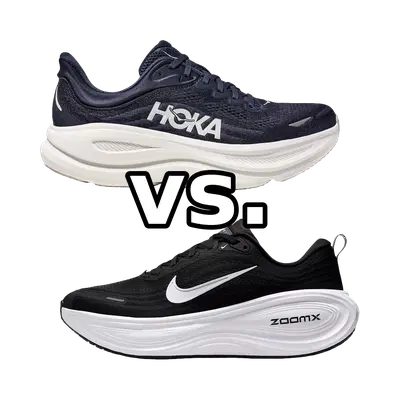
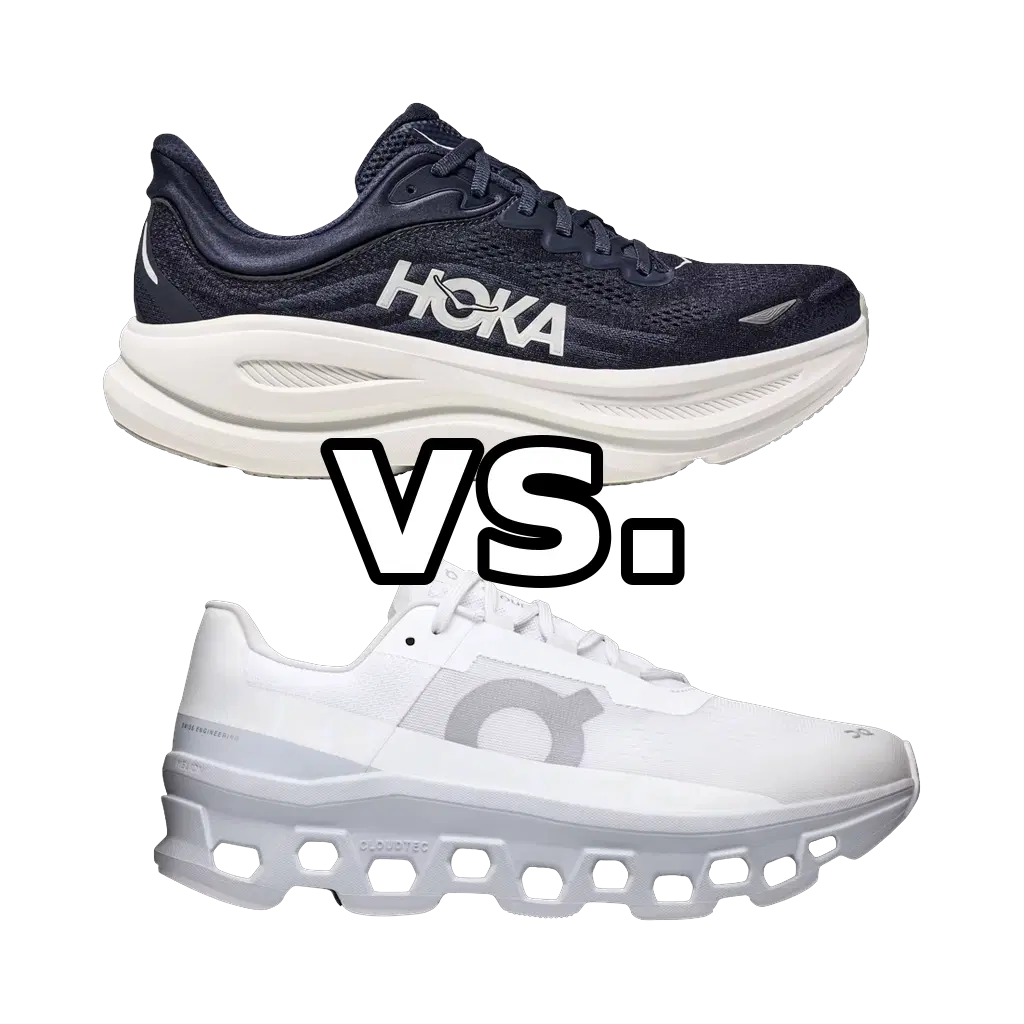
Hoka Bondi 9 vs On Cloudmonster:
Which to Choose
Verdict
It comes down to how you'll actually use the shoe. If it's for easy and recovery running where comfort and a soft, stable landing matter most, the Bondi 9 is the clearer choice; if you want a single trainer that covers everyday miles and the occasional faster, longer effort with a springier ride, the Cloudmonster is more versatile. Pick the Bondi for plush protection, the Cloudmonster for lively range.
Pace
2 of 6
Cushioning
6 of 6
Responsiveness
3 of 6
Stability
5 of 6
Drop
5 mm
Support
Stable Neutral
Plate
None
Distances
10KHalf
Pace
3 of 6
Cushioning
4 of 6
Responsiveness
4 of 6
Stability
3 of 6
Drop
6 mm
Support
Neutral
Plate
Composite
Distances
10KHalfMarathon
At a Glance
Hoka Bondi 9On Cloudmonster
Who Should Choose Each Shoe
Choose
Hoka Bondi 9
Choose the Bondi 9 if your priority is the softest, most forgiving landing you can get for easy days, recovery runs, and long slow miles — especially if you're a beginner building volume, a heavier runner, or someone whose legs want cushioning and a planted, stable base rather than snap. It's the pick if you never intend to race in this shoe and simply want maximum protection underfoot at conversational effort.
Choose
On Cloudmonster
Choose the Cloudmonster if you want one cushioned trainer that can log steady daily mileage and still pick up the pace, with a firmer, more energetic ride and the Speedboard's pop for 10K, half, and even marathon efforts. It's the better fit for neutral runners who like a rocker and a midfoot-rolling stride, don't need dedicated stability, and would rather have versatility and liveliness than a plush, sink-in recovery feel.
Head-to-Head
The clearest difference is underfoot. The Bondi 9 is the taller, more maximal shoe, sitting on roughly 43mm of supercritical-EVA foam at the heel and 38mm at the forefoot, versus about 35mm/28mm for the Cloudmonster — so the Hoka gives you noticeably more stack and a deeper, sink-in landing, while On's Helion foam shaped into oversized CloudTec pods sits lower and feels firmer and bouncier. That translates directly into ride character: the Bondi soaks up shock and feels soft and protective but muted and a little dead when you push, whereas the Cloudmonster is springy and rewards a committed midfoot roll, coming alive at a purposeful pace but feeling slightly disconnected and unsettled at a crawl. Structurally, the Cloudmonster runs an internal composite Speedboard for pop and snap; the Bondi has no plate and doesn't claim to need one. Drops are close — 5mm on the Bondi, 6mm on the Cloudmonster — so neither demands a major transition for the other's wearer, and both are relatively heavy trainers (the Bondi a touch heavier in men's sizing) that prioritize comfort and durability over speed. Stability is the Hoka's edge: its wide, sidewall-supported platform earns a stable-neutral, planted feel, while the Cloudmonster's tall segmented pods are merely stable-enough and purely neutral. The flip side is range — the Bondi's sweet spot is easy 10K and long-run aerobic mileage and it tops out around 5:30 min/km, while the Cloudmonster stretches comfortably across 10K, half, and marathon distances and holds together down to roughly 4:45 min/km.
Similar Comparisons
On Cloudmonster vs On Cloudmonster 3
Hoka Bondi 9 vs Asics Gel-Nimbus 28
On Cloudmonster vs On Cloudmonster 3 Hyper
Hoka Bondi 9 vs Saucony Paramount Max
On Cloudmonster vs On Cloudsurfer 3
Hoka Bondi 9 vs Brooks Ghost Max 3
On Cloudmonster 2 Pleasures x The Loop vs On Cloudmonster
Hoka Bondi 9 vs Brooks Glycerin Max 2
© 2026 longrunshoes.ai | All rights reserved.
Use of materials from this site is permitted only with proper attribution and a link to longrunshoes.ai.