
Brooks Glycerin 22 vs Mizuno Wave Sky 8:
Which to Choose
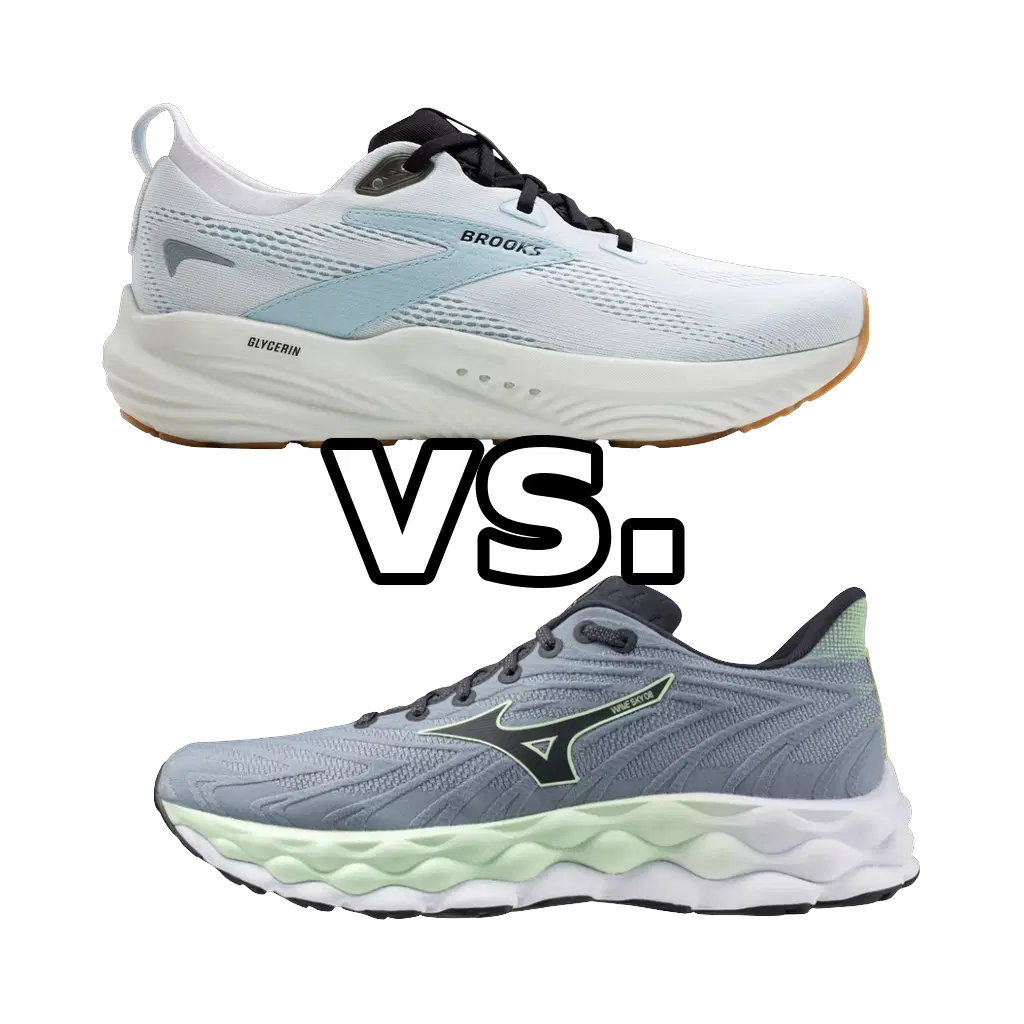
Verdict
It genuinely comes down to geometry and range, not quality — both are excellent soft neutral trainers. Go with the Brooks Glycerin 22 if you prefer a 10mm drop and want a shoe that stays comfortable all the way to the marathon; go with the Mizuno Wave Sky 8 if you want a lighter shoe with a lower 8mm drop, a slightly springier ride, and a bit of grace for mild overpronation, with the half marathon as your longest regular outing.
Pace
3 of 6
Cushioning
5 of 6
Responsiveness
4 of 6
Stability
4 of 6
Drop
10 mm
Support
Neutral
Plate
None
Distances
10KHalfMarathon
Pace
3 of 6
Cushioning
5 of 6
Responsiveness
4 of 6
Stability
4 of 6
Drop
8 mm
Support
Stable Neutral
Plate
None
Distances
10KHalf
At a Glance
Brooks Glycerin 22Mizuno Wave Sky 8
Who Should Choose Each Shoe
Choose
Brooks Glycerin 22
Choose the Glycerin 22 if you're a neutral runner — beginner or seasoned high-mileage recreational runner — who wants a plush, dependable daily trainer that can also carry you through a marathon. The taller 10mm drop suits heel strikers and anyone who likes a traditional cushioned feel, and the composed, predictable ride rewards relaxed, steady rhythm over long efforts. It's the better pick if your weekly menu runs long and you want one shoe to cover easy days through race-distance comfort.
Choose
Mizuno Wave Sky 8
Choose the Wave Sky 8 if you want the same plush protection but in a lighter, lower-drop package that tops out around the half marathon. The 8mm drop and level, deep Enerzy platform suit midfoot strikers and runners who like a slightly livelier rebound underfoot, and its stable-neutral build gives a little extra steadiness to neutral-to-mildly-overpronating runners. It's the smarter choice if most of your miles are easy daily runs and long efforts in the 10K-to-half range rather than full marathons.
Head-to-Head
On paper these shoes are close siblings — high cushioning, no plate, moderate responsiveness, and a stable-but-neutral platform that steadies the stride without a medial post. The differences are real but subtle. The Glycerin 22 runs a 10mm heel-to-toe drop over roughly a 38mm stack of nitrogen-infused DNA Tuned foam, giving it a traditional, heel-friendly geometry that favors heel strikers and a classic cushioned transition. The Wave Sky 8 sits a touch taller at about 41mm in the heel and runs a lower 8mm drop on dual-layer Enerzy foam, so it feels a little more level underfoot and rolls through the midfoot with a slightly more forgiving transition for midfoot strikers. Both foams are soft and protective rather than propulsive; the Glycerin leans toward a composed, predictable, gently springy ride, while the Wave Sky's deeper, dual-density stack gives a marginally livelier rebound but can feel floatier and vaguer the harder you push. On weight the Mizuno has the edge — roughly 271g versus about 293g for the Brooks in men's sizing — which is notable given the Mizuno's taller stack, and it makes the Wave Sky feel a shade nimbler despite both being firmly in the cushioned-trainer camp rather than the fast one. The most practical split is range: the Glycerin is comfortable stretching all the way to the marathon, while the Wave Sky is happiest topping out at the half, where its cushioned depth is at its sweet spot. Fit-wise both use accommodating engineered mesh uppers; the Mizuno's stable-neutral build also extends a little grace to mild overpronators, whereas the Glycerin is a purer neutral shoe.
Similar Comparisons

Mizuno Wave Sky 8 vs Mizuno Wave Sky 9

Brooks Glycerin 22 vs Brooks Glycerin Flex
Asics Gel-Cumulus 27 vs Mizuno Wave Sky 8

Brooks Glycerin 22 vs Brooks Glycerin GTS 23

Mizuno Wave Sky 8 vs Saucony Ride 19

Brooks Glycerin 22 vs Salomon Aero Glide 3

Puma Magnify Nitro 3 vs Brooks Glycerin 22

Brooks Glycerin 22 vs Saucony Ride 19
© 2026 longrunshoes.ai | All rights reserved.
Use of materials from this site is permitted only with proper attribution and a link to longrunshoes.ai.