
Asics Dynablast 5 vs Asics Dynablast 6:
Which to Choose
Verdict
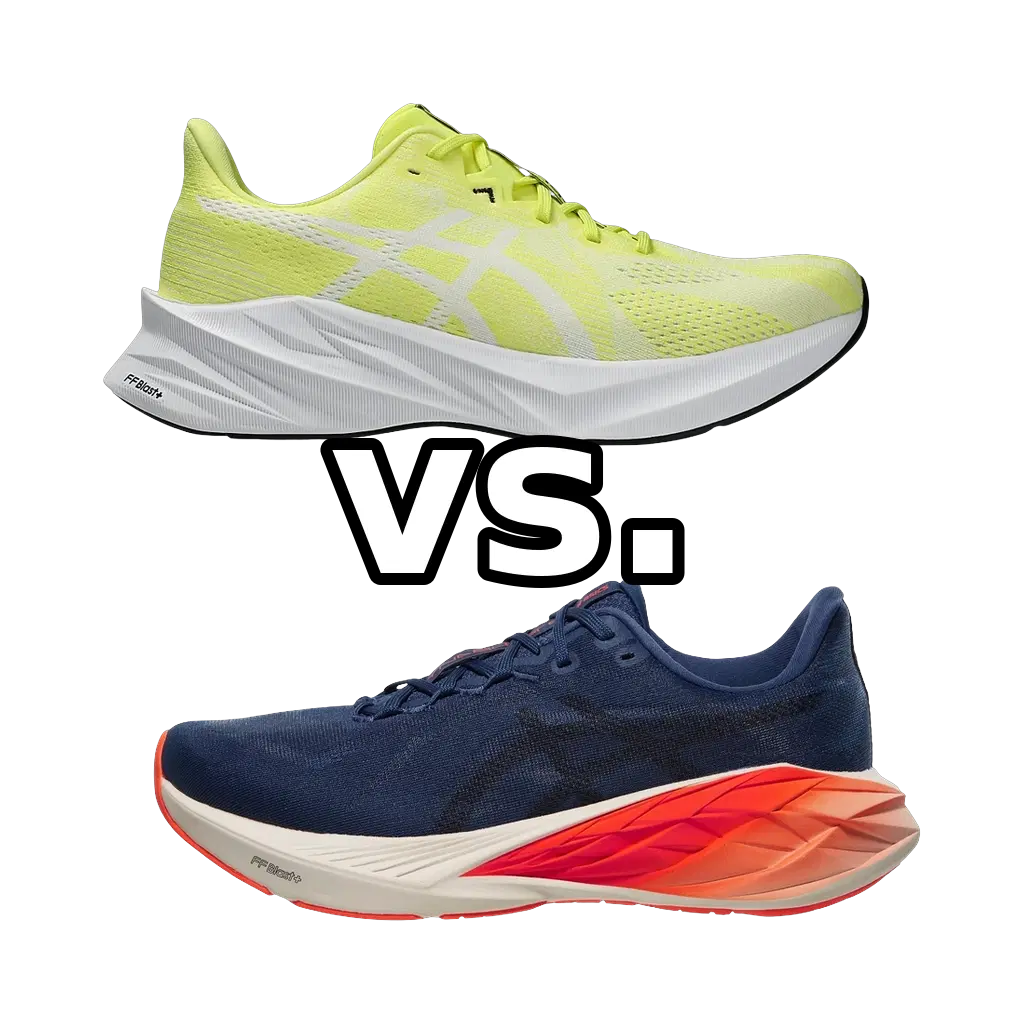
It comes down to distance and how much you value ground feel over cushioning. If most of your work is fast and short — 5K to half — and you like a light, connected, controllable ride, the Dynablast 5 still does exactly what it's meant to and doesn't need replacing. But if your mileage is trending longer and you want one trainer that comfortably covers everything from easy days to the marathon, the Dynablast 6 is a genuine step up: taller, more cushioned, and more responsive at the cost of a little weight and some low-speed stability. Upgrade for the extra range; stay put if the 5 already matches your training.
Pace
4 of 6
Cushioning
4 of 6
Responsiveness
4 of 6
Stability
3 of 6
Drop
8 mm
Support
Neutral
Plate
None
Distances
5K10KHalf
Pace
4 of 6
Cushioning
5 of 6
Responsiveness
5 of 6
Stability
3 of 6
Drop
8 mm
Support
Neutral
Plate
None
Distances
10KHalfMarathon
At a Glance
Asics Dynablast 5Asics Dynablast 6
Who Should Choose Each Shoe
Choose
Asics Dynablast 5
Choose the Dynablast 5 if your running skews toward shorter, faster efforts — 5Ks, 10Ks and tempo work — and you want one lightweight, lively shoe for uptempo and progression days rather than long, slow accumulation. Its lower stack and slightly lighter build give a more connected, ground-feel ride that's easy to control at any pace, which suits runners who like feeling the road and picking it up. If you already have a Dynablast 5, are happy with how it handles your fast short stuff, and don't need more cushioning for long runs, there's little reason to change.
Choose
Asics Dynablast 6
Choose the Dynablast 6 if you log regular daily mileage and want one shoe that stretches from easy runs to steady efforts and up to half and full marathon distances without the cushioning feeling thin late. The taller platform and higher cushioning add protection and a bit more toe-off pop for developing and experienced recreational runners who value a springy ride over maximum plush. For a current Dynablast 5 owner, the 6 is a real upgrade — not a tweak — specifically if your training has been trending longer and you've wanted more foam under you for those extended miles.
Head-to-Head
On paper these two share a lot: same 8mm drop, same neutral single-density setup, same lack of a plate, and the same FF Blast+/FF BLAST PLUS foam family that trades pillowy plush for a bouncy, springy ride you can feel the ground through. The differences are in scale and intent. The Dynablast 6 sits on a distinctly taller platform — a 41mm heel and 33mm forefoot versus roughly 39mm and 32mm on the 5 — and Asics dialed the cushioning up to a genuinely high level (5/6) against the 5's more moderate everyday softness (4/6). That extra foam, built on Novablast-4-style tooling with an energizing central pod under the foot, also lifts responsiveness (5/6 vs 4/6): the 6 delivers a small extra snap at toe-off that the plate-free 5 gets purely from foam. The trade-offs are weight and slow-pace manners — the 6 comes in around 270–275g in a men's US 9 versus about 260g for the 5, and its tall neutral tooling can feel a touch tippy at casual paces, whereas the lower-profile 5 keeps a cleaner, more grounded sense of the road. Stability is medium-neutral on both (3/6), so neither offers pronation control. Crucially, the use case shifts: the 5 shines at 5K, 10K and half efforts and starts to feel thin past the half, while the added stack pushes the 6's competence out to the marathon and longer easy runs. Both feel most alive around 4:30–5:00 min/km, but the 6's comfortable daily zone extends a bit slower and longer.
© 2026 longrunshoes.ai | All rights reserved.
Use of materials from this site is permitted only with proper attribution and a link to longrunshoes.ai.