
Asics Dynablast 5 vs Brooks Launch 12:
Which to Choose
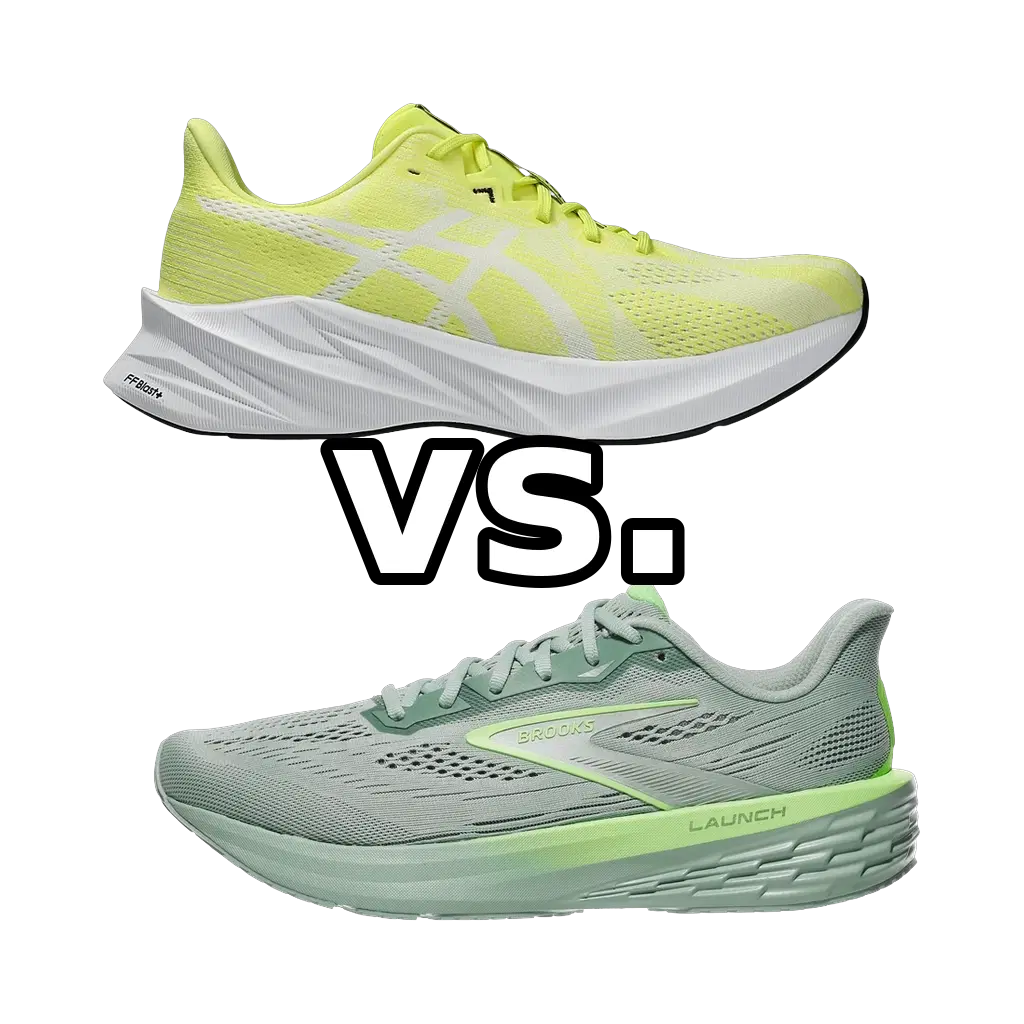
Verdict
It comes down to cushioning versus connection. Go Dynablast 5 if you want slightly more foam and a smoother, more protected ride that stretches comfortably toward the half; go Launch 12 if you want the lighter, firmer, more flexible shoe that feels crispest when you're running fast over shorter distances. Both are genuine uptempo neutral trainers — pick the ride feel, not the spec sheet, because the numbers are nearly a wash.
Pace
4 of 6
Cushioning
4 of 6
Responsiveness
4 of 6
Stability
3 of 6
Drop
8 mm
Support
Neutral
Plate
None
Distances
5K10KHalf
Pace
4 of 6
Cushioning
3 of 6
Responsiveness
4 of 6
Stability
3 of 6
Drop
8 mm
Support
Neutral
Plate
None
Distances
5K10KHalf
At a Glance
Asics Dynablast 5Brooks Launch 12
Who Should Choose Each Shoe
Choose
Asics Dynablast 5
Choose the Dynablast 5 if you want a little more foam and protection under the midsole while keeping a lively, uptempo feel — it's the better pick for runners whose weekly rotation leans toward the longer end of this range (steady 10Ks into the half) and who want transitions to roll smoothly rather than feel the pavement on every stride. It suits runners coming off a moderately cushioned daily trainer who want something quicker without dropping all the way to a firm, minimal ride.
Choose
Brooks Launch 12
Choose the Launch 12 if you prize a light, flexible, ground-connected ride and value turnover and road feel over cushioned isolation — it's the sharper tool for 5K-to-10K tempo efforts and shorter races where its lighter weight and snappy DNA Flash forefoot shine. It's ideal for runners who like a firm, responsive platform and don't need plush protection for tired legs, or who want one versatile trainer that can still handle easier daily miles.
Head-to-Head
On paper these two score almost identically — pace 4/6, responsiveness 4/6, stability 3/6 neutral, an 8mm drop, and no plate in either, so the pop in both comes purely from the foam rather than from a stiff propulsion element. The real split is cushioning versus ground feel. The Dynablast 5 carries a taller, more protective platform — roughly 39mm of heel stack filled with Asics' FF Blast+ foam — and rates a notch higher for cushioning (4/6), giving it a bouncy, moderate everyday softness that holds up better as the miles stack toward half-marathon distance. The Launch 12 is the firmer, more minimal of the pair: a lower 33mm heel / 25mm forefoot stack of nitrogen-infused DNA Flash foam (snappier v2 in the forefoot, v1 in the heel) that sits at 3/6 cushioning and feels firm-leaning and ground-connected rather than pillowy. That firmness is deliberate — the Launch is flexible and snappy through the forefoot, rewarding quick turnover and letting you feel the road, whereas the Dynablast gives you a touch more isolation and a smoother, rolling transition. Weight favors the Launch, at a light 244g versus roughly 260g for the Dynablast, which reinforces the Launch's crisper, more race-like character; its fastest effective zone (around 4:15–4:45 min/km) edges slightly quicker than the Dynablast's (around 4:30–5:00 min/km). Both go flat and unremarkable at slow plodding paces and come alive when you pick it up — so neither is your easy-day cruiser.
Similar Comparisons
Brooks Launch 11 vs Brooks Launch 12
Asics Dynablast 5 vs Asics Dynablast 6
Salomon Aero Blaze 2 vs Brooks Launch 12
Asics Dynablast 5 vs Brooks Hyperion 3
On Cloudsurfer 2 vs Brooks Launch 12
Asics Dynablast 5 vs Hoka Mach 7
Brooks Ghost 17 vs Brooks Launch 12
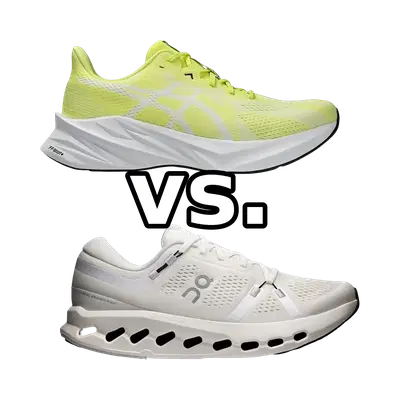
Asics Dynablast 5 vs On Cloudsurfer 2
© 2026 longrunshoes.ai | All rights reserved.
Use of materials from this site is permitted only with proper attribution and a link to longrunshoes.ai.