
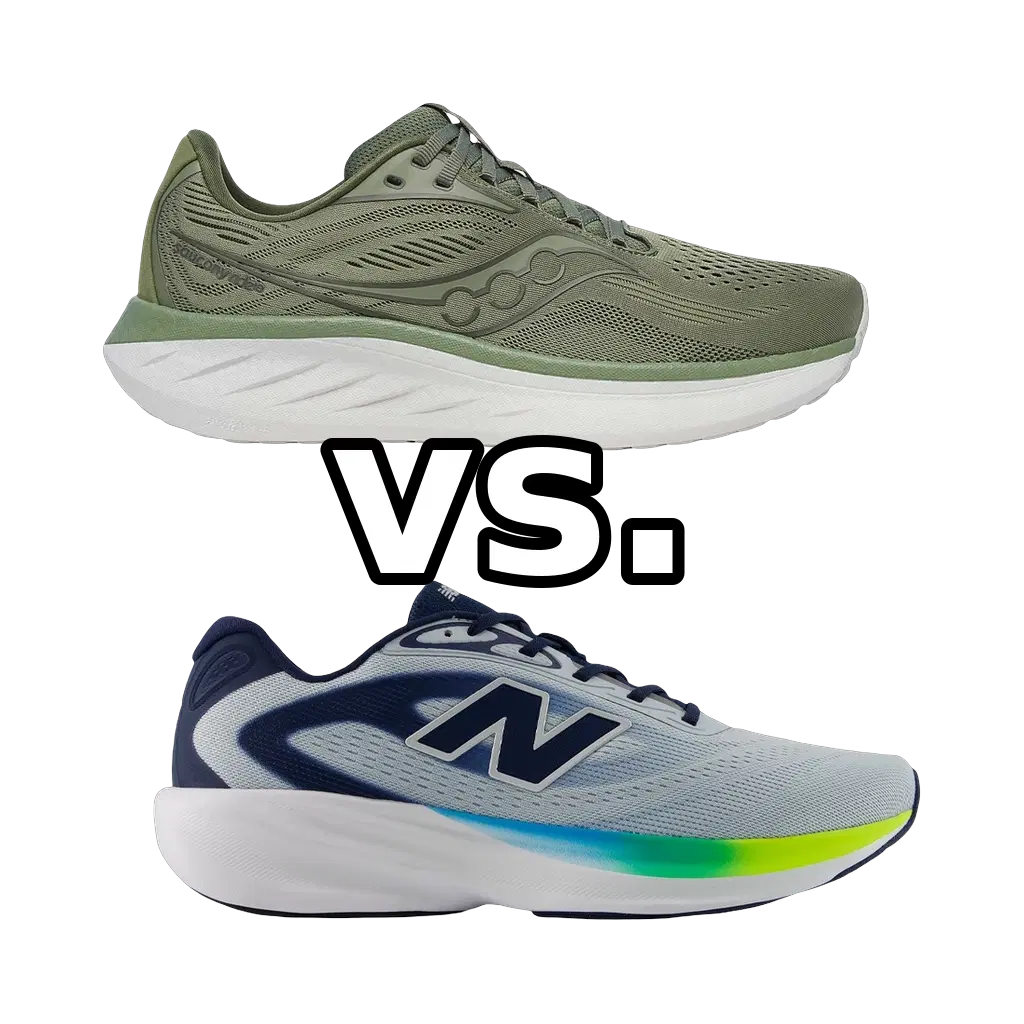
Saucony Ride 18 vs New Balance Fresh Foam 680v9:
Which to Choose
Verdict
For most shoppers choosing between these two today, the newer Ride 18 is the more versatile buy: it matches the 680v9's comfort and stability but adds a firmer, more responsive ride and the range to cover everything from easy runs to the marathon. The 680v9 makes sense specifically if your running is all easy, conversational mileage capped at the half and you prefer a softer, lower-energy feel. In short, it comes down to range and ride energy — pick the Ride 18 if you want one shoe that can do more and push faster, and the 680v9 if you only need a soft, steady easy-day trainer.
Pace
3 of 6
Cushioning
4 of 6
Responsiveness
3 of 6
Stability
4 of 6
Drop
8 mm
Support
Neutral
Plate
None
Distances
10KHalfMarathon
Pace
3 of 6
Cushioning
4 of 6
Responsiveness
2 of 6
Stability
4 of 6
Drop
8 mm
Support
Neutral
Plate
None
Distances
10KHalf
At a Glance
Saucony Ride 18New Balance Fresh Foam 680v9
Who Should Choose Each Shoe
Choose
Saucony Ride 18
Choose the Ride 18 if you want one dependable neutral trainer to handle the bulk of your mileage and still stretch to half and full marathon distance, including the occasional steady or faster-paced effort. It's the better pick for runners who prefer a firmer, protective ride that holds its shape over long runs rather than a soft one, and who want a bit more pop and a touch more stack without moving to a plated racer. If you're training for a longer goal race and would rather not own two shoes, this is the more capable single choice.
Choose
New Balance Fresh Foam 680v9
Choose the Fresh Foam 680v9 if you're a beginner or base-building runner whose weekly diet is easy, conversational miles and who values soft, grounded comfort over any sense of spring. It's well suited to relaxed daily training and the occasional steady 10K or half, as long as you're not planning to push the pace or chase tempo work. It's also the lighter, lower-profile, no-fuss option for someone who just wants a calm, forgiving easy-day shoe and doesn't need marathon-day range.
Head-to-Head
On the spec sheet the overlap is real: both are neutral, both run an 8mm drop, both skip a plate, and both land at a moderate cushioning and a wide, planted, good-stability platform. The separation shows up in ride feel and range. The Ride 18's single-density PWRRUN midsole is tuned firm-but-protective — it never wallows on long runs and still works down to roughly 4:45–5:00 min/km, which is why it genuinely covers 10K, half, and full marathon. The 680v9's older-generation Fresh Foam is softer and more grounded but gives little back; it feels flat and a touch dead the moment you try to accelerate, tops out effectively around 5:00–5:30 min/km, and is happiest at an easy conversational jog over 10K-to-half distances rather than a marathon. That gap matches their responsiveness scores — the Ride 18 rates higher and feels more honest and lively underfoot, while the 680v9 is deliberately the calmer, lower-energy ride. They also differ in the hard numbers: in a men's US 9 the Ride 18 weighs about 274g against the 680v9's 258g, and it sits on a slightly taller stack (around 35mm at the heel versus 33mm), so the Ride 18 trades a little extra weight for more foam underfoot and a broader pace range, while the 680v9 is the lighter, lower-profile, simpler shoe.

© 2026 longrunshoes.ai | All rights reserved.
Use of materials from this site is permitted only with proper attribution and a link to longrunshoes.ai.