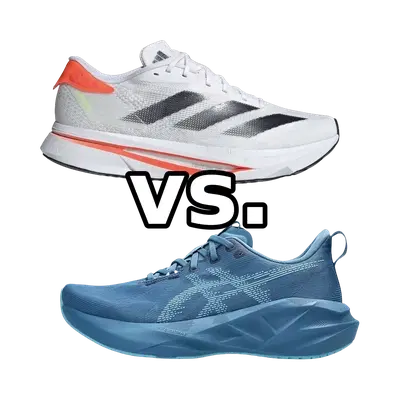
Asics Novablast 5 vs Asics Noosa Tri 16:
Which to Choose

Verdict
It depends on the job you're hiring the shoe for, not on which is "better." If you need one versatile shoe to carry your weekly mileage and long runs in comfort, the Novablast 5 is the clear choice; if you want a light, firm, low-drop shoe strictly for tempo and short races, the Noosa Tri 16 wins. For many runners the honest answer is that these are complementary rather than competing — the Novablast for the easy and long days, the Noosa for the fast ones — so let the pace you'll spend the most time at decide.
Pace
4 of 6
Cushioning
5 of 6
Responsiveness
5 of 6
Stability
4 of 6
Drop
8 mm
Support
Neutral
Plate
None
Distances
10KHalfMarathon
Pace
5 of 6
Cushioning
3 of 6
Responsiveness
4 of 6
Stability
3 of 6
Drop
5 mm
Support
Neutral
Plate
None
Distances
5K10KHalf
At a Glance
Asics Novablast 5Asics Noosa Tri 16
Who Should Choose Each Shoe
Choose
Asics Novablast 5
Choose the Novablast 5 if you want one cushioned, energetic shoe to cover most of your week — daily miles, long runs, and the occasional pickup — and you like a tall, bouncy platform with plenty of protection for half and marathon efforts. It's the better pick for runners who spend most of their time at easy-to-steady paces and want underfoot comfort over ground feel, especially heel and midfoot strikers who appreciate the 8mm drop.
Choose
Asics Noosa Tri 16
Choose the Noosa Tri 16 if you're a neutral runner or triathlete chasing speed over shorter distances — tempo sessions, 5K to half races, and fast transitions — and you want a light, breathable, low-slung shoe that rewards quick turnover. Its firmer foam, 5mm drop, and ~215g weight make it ideal if you already have a cushioned trainer for easy days and want a dedicated fast shoe, particularly for warm-weather or race-day use where ventilation matters.
Head-to-Head
The clearest split is the platform. The Novablast 5 stacks 41.5mm at the heel and 33.5mm at the forefoot on an 8mm drop, with FF Blast Max foam that gives it that soft, trampoline-like rebound; the Noosa Tri 16 sits far lower at 34.5mm heel and 29.5mm forefoot on a 5mm drop, using firmer, snappier FF Blast+. That's roughly 7mm less stack underfoot in the Noosa, which translates directly into ride feel: the Novablast is plush and springy with a slightly floaty, protective roll, while the Noosa is connected, firm, and low to the ground, feeding back more of the road. Weight reinforces the difference — the Noosa is about 215g versus the Novablast's 255g, a noticeable ~40g gap you feel most when turnover gets quick. Their optimal pace windows barely overlap: the Novablast is tuned for easy-to-steady running (roughly 4:45–5:45/km) and only comes alive at tempo, whereas the Noosa is sharpest at genuine tempo-to-race pace (around 3:40–4:20/km) and feels busy and firm if you slow it down. Neither has a plate, so in both cases the energy comes from the foam itself, and both are neutral with moderate, no-added-support stability. On fit, the Novablast's engineered mesh gives a more everyday, structured wrap, while the Noosa's bright, airy triathlon mesh is more breathable but offers looser lockdown. Durability also tilts toward the Novablast's more substantial build and outsole coverage, though its tall exposed foam asks for some care; the lighter Noosa is simply a leaner, more race-focused construction.
Similar Comparisons

Asics Noosa Tri 16 vs Brooks Hyperion 2
Adidas Supernova Solution 2.0 vs Asics Novablast 5

Asics Noosa Tri 16 vs Salomon S/Lab Phantasm 2

Adidas Adizero Boston 13 vs Asics Novablast 5

Asics Novablast 5 vs Asics Dynablast 5
Asics Superblast 2 vs Asics Novablast 5
Asics Novablast 5 vs Asics Novablast 6

Asics Novablast 5 vs Asics Superblast 3
© 2026 longrunshoes.ai | All rights reserved.
Use of materials from this site is permitted only with proper attribution and a link to longrunshoes.ai.