
Asics Noosa Tri 16 vs Brooks Hyperion 2:
Which to Choose
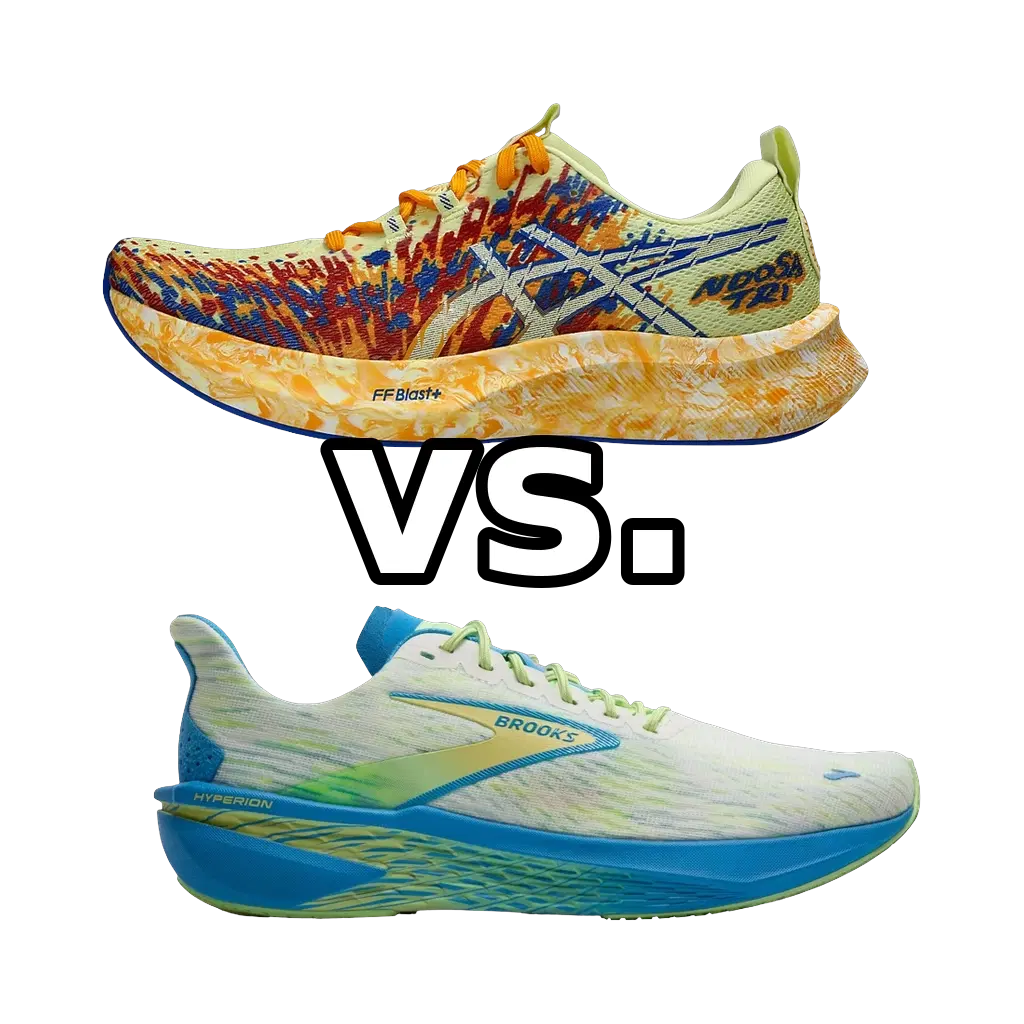
Verdict
These are genuinely close shoes serving the same purpose, so it comes down to three concrete things: drop preference, fit, and use case. Go Hyperion 2 if you want the lighter, more locked-down road racer with a conventional 8mm drop; go Noosa Tri 16 if you want the airier, triathlon-ready upper and a lower 5mm, midfoot-oriented ride. If you run exclusively on the road and care most about foothold and weight, the Hyperion edges it; if you race in heat, do triathlon, or simply prefer a low drop, the Noosa is the one.
Pace
5 of 6
Cushioning
3 of 6
Responsiveness
4 of 6
Stability
3 of 6
Drop
5 mm
Support
Neutral
Plate
None
Distances
5K10KHalf
Pace
5 of 6
Cushioning
3 of 6
Responsiveness
4 of 6
Stability
3 of 6
Drop
8 mm
Support
Neutral
Plate
None
Distances
5K10KHalf
At a Glance
Asics Noosa Tri 16Brooks Hyperion 2
Who Should Choose Each Shoe
Choose
Asics Noosa Tri 16
Choose the Noosa Tri 16 if you're a triathlete or a warm-weather racer who values a breathable, easy-on upper and fast transitions, and if you prefer a low 5mm drop that encourages a flat, midfoot-driven stride. Its slightly fuller forefoot and firmer, honest FF Blast+ ride suit a runner who already turns over quickly and wants a connected, no-frills tempo-to-race feel in the 3:40–4:20 min/km range. It's the better pick when ventilation and quick entry matter as much as outright lockdown.
Choose
Brooks Hyperion 2
Choose the Hyperion 2 if you want the lighter, more locked-down of the two for road tempo sessions, intervals, and short races, and if you're more comfortable with a traditional 8mm drop and its smoother heel-to-toe roll. Its springy DNA Flash v2 and snug engineered mesh reward a runner who wants a secure, race-oriented foothold and a slightly broader optimal pace window (4:00–4:45 min/km). It's the stronger option for a pure road racer who doesn't need triathlon-specific ventilation or transition features.
Head-to-Head
On paper these two are near-twins: both rate the same for pace, cushioning, responsiveness, and stability, both are neutral, both run plateless, and both call the 10K their sweet spot while spanning 5K up to the half. The real separators are geometry and fit. The Hyperion 2 runs an 8mm drop and comes in lighter at about 201g in a men's 9, with a stack of roughly 34mm at the heel and 26mm up front, giving it a smoother midfoot-to-toe roll. The Noosa Tri 16 sits at a 5mm drop and weighs about 215g, with a comparable ~34.5mm heel but a more generous ~29.5mm forefoot — that lower differential and fuller forefoot push you toward a flatter, more aggressive midfoot strike and quicker turnover. Underfoot the foams tell a similar story through different accents: the Noosa's FF Blast+ reads a touch firm and snappy, honest and connected, while the Hyperion's nitrogen-infused DNA Flash v2 leans springy and lively, both close to the ground and both asking you to speed up rather than cruise. The biggest practical gap is the upper and its purpose. The Noosa is, by design, a triathlon shoe — its bright, extremely airy Noosa mesh prioritizes ventilation and quick transitions over structured lockdown, which is ideal for warm-weather and sockless/transition use but gives up some foothold. The Hyperion's thinner engineered mesh hugs the foot more snugly for pure road-racing lockdown. Both want to be run fast, and the Hyperion's quoted optimal zone (4:00–4:45 min/km) sits just a hair more forgiving than the Noosa's (3:40–4:20 min/km), which skews slightly faster.

© 2026 longrunshoes.ai | All rights reserved.
Use of materials from this site is permitted only with proper attribution and a link to longrunshoes.ai.