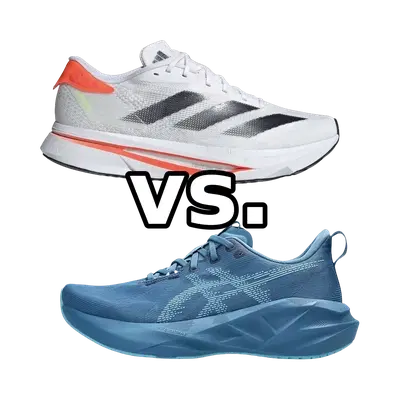
Asics Novablast 5 vs Asics Gel-Cumulus 27:
Which to Choose
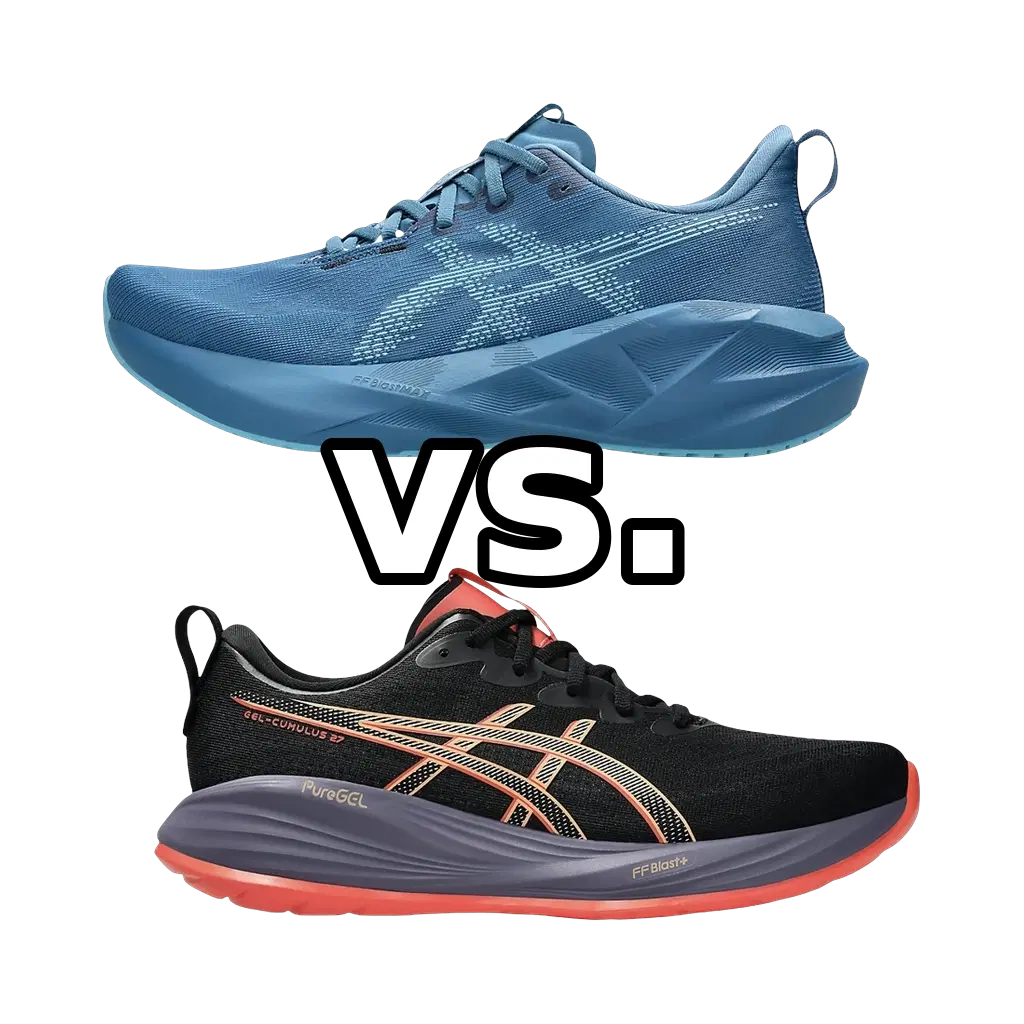
Verdict
These two are closer than their names suggest — same brand, same drop, same cushioning level, same distance range — so it comes down to ride personality, not quality. Pick the Novablast 5 if you want energy, a taller platform, and the ability to push the pace; pick the Gel-Cumulus 27 if you want a lower, softer, more planted shoe for steady easy miles and slightly better outsole longevity. If you only run easy and never surge, the Cumulus is the more natural fit; if you want one shoe that can do both easy days and faster efforts, the Novablast is the more flexible choice.
Pace
4 of 6
Cushioning
5 of 6
Responsiveness
5 of 6
Stability
4 of 6
Drop
8 mm
Support
Neutral
Plate
None
Distances
10KHalfMarathon
Pace
3 of 6
Cushioning
5 of 6
Responsiveness
4 of 6
Stability
4 of 6
Drop
8 mm
Support
Neutral
Plate
None
Distances
10KHalfMarathon
At a Glance
Asics Novablast 5Asics Gel-Cumulus 27
Who Should Choose Each Shoe
Choose
Asics Novablast 5
Choose the Novablast 5 if you want one shoe that covers daily miles and long runs but still rewards you when you drop the hammer for a tempo segment or a steady half effort. It suits recreational runners who like a tall, lively, bouncy platform and want their trainer to feel energetic rather than purely protective, and who are comfortable managing foam durability in exchange for that pop. If your easy pace sits around 4:45–5:45 min/km and you occasionally dip faster, this is the more versatile pick.
Choose
Asics Gel-Cumulus 27
Choose the Gel-Cumulus 27 if your running is mostly easy and moderate base-building and you value a calm, forgiving, planted ride over bounce — it's the stronger pick for beginner-to-intermediate runners logging steady volume at 5:15–6:15 min/km. The lower stack, PureGEL-softened landings, and hard-wearing AHAR outsole make it a dependable, long-lasting daily trainer for anyone who isn't chasing turnover. If you prefer a shoe that feels grounded and predictable rather than tall and springy, this is it.
Head-to-Head
Start with what's identical: both are neutral shoes with a moderate 8mm offset, no plate, a broad and flared base for predictable stability (both 4/6), and a high cushioning rating (5/6) that carries them comfortably from 10K up to a relaxed marathon. The divergence is in stack and in character. The Novablast rides on a tall, maximal platform — around 41.5mm at the heel — of FF Blast Max, and that superfoam gives it a distinct trampoline-like rebound: it transitions smoothly once you're moving and genuinely comes alive when you lift the tempo, holding its best bounce down to roughly 4:15–4:30 min/km. The Cumulus sits noticeably lower, closer to 37.5mm at the heel, and pairs FF Blast+ ECO with a PureGEL heel unit tuned for softened, rounded landings rather than snap; it's happiest at conversational paces and starts to feel flat and muted if you push past about 5:00–5:15 min/km. That gap shows up in the responsiveness scores (Novablast 5/6, Cumulus 4/6) and the pace ratings (Novablast 4:45–5:45 min/km, Cumulus 5:15–6:15 min/km). Weight is close — both land in the mid-to-upper 250g range for a men's 9, with the Novablast a touch lighter — so weight is not the deciding factor here; ride feel is. One practical trade-off cuts the other way: the Cumulus uses a durable AHAR outsole over its high-wear zones, while the Novablast's more exposed foam asks for a little more care over the long haul. The Novablast can also feel slightly tall and floaty at very easy, plodding paces before its geometry finds a rhythm — exactly the zone where the planted Cumulus feels most at home.
Similar Comparisons
Asics Gel-Nimbus 27 vs Asics Gel-Cumulus 27
Adidas Supernova Solution 2.0 vs Asics Novablast 5
Asics Gel-Cumulus 27 vs Asics Gel-Cumulus 28
Adidas Adizero Boston 13 vs Asics Novablast 5
Asics Gel-Cumulus 27 vs Saucony Ride 19
Asics Novablast 5 vs Asics Dynablast 5
Asics Gel-Cumulus 27 vs Mizuno Wave Sky 8
Asics Superblast 2 vs Asics Novablast 5
© 2026 longrunshoes.ai | All rights reserved.
Use of materials from this site is permitted only with proper attribution and a link to longrunshoes.ai.