New Balance Foam X More v5 vs New Balance Foam X More v6:
Which to Choose
Verdict
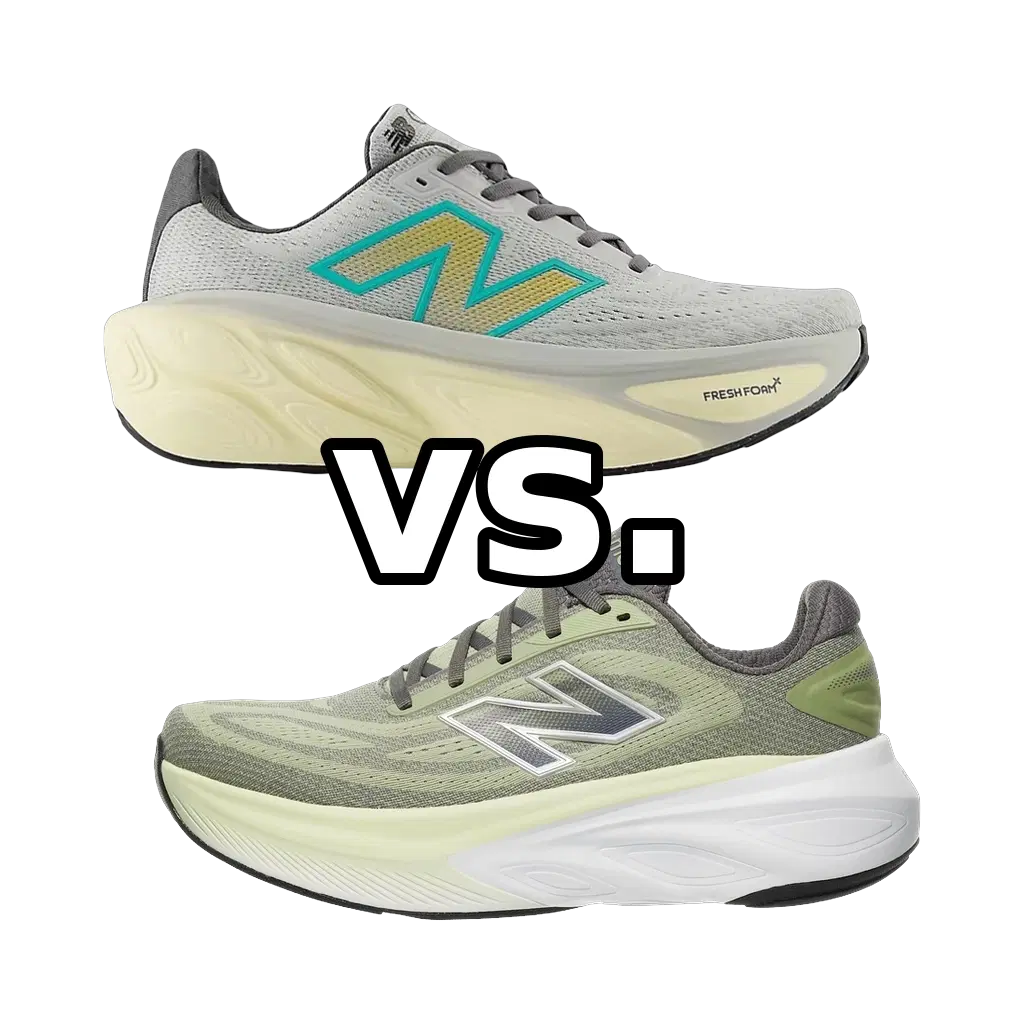
It depends on what you use your v5 for. If you mostly run easy and recovery miles, or you ever found the v5 a bit tall and tippy, the v6 is a worthwhile upgrade: same plush Fresh Foam X, but lower, flatter, wider, and more stable, with smoother transitions. If you love the v5's taller stack and lean on it for marathon-length long runs at a slightly brisker clip, there's no urgent reason to switch — these are the same kind of max-cushion, plateless, neutral protector, and the v6 is an evolution rather than a leap.
Pace
3 of 6
Cushioning
6 of 6
Responsiveness
3 of 6
Stability
4 of 6
Drop
4 mm
Support
Neutral
Plate
None
Distances
HalfMarathon
Pace
2 of 6
Cushioning
6 of 6
Responsiveness
3 of 6
Stability
5 of 6
Drop
3 mm
Support
Neutral
Plate
None
Distances
10KHalf
At a Glance
New Balance Foam X More v5New Balance Foam X More v6
Who Should Choose Each Shoe
Choose
New Balance Foam X More v5
Choose the More v5 if you're a neutral runner who wants maximum plush protection that stretches all the way to the marathon, and who likes a slightly taller platform with a touch more pace range on tap for steady long-run efforts. Existing v5 owners who are happy with the ride, use the shoe primarily for long training days, and don't find the tall stack tippy have little reason to feel they're missing out — the core cushioning experience is largely unchanged in the successor.
Choose
New Balance Foam X More v6
Choose the More v6 if your miles are mostly easy days, recovery jogs, and tired-legs long runs, and you value a planted, controlled platform over outright height. It's the better pick for heavier runners and beginners building durable aerobic mileage who want a wide, stable, forgiving base and the smoother heel-to-toe transition the v6 adds — and for v5 owners who sometimes found the older shoe a little tall or vague, the lower, wider, more stable v6 is the meaningful refinement.
Head-to-Head
Start with what's identical, because most of the DNA carries over: both use soft, plush Fresh Foam X tuned for comfort rather than bounce, both run max cushioning (6/6), both skip a plate, and both land at a moderate responsiveness that soaks up energy instead of snapping it back — push either past an easy rhythm and the foam goes vague. The differences are in the geometry and tuning. The v5 sits on the taller platform at roughly 44mm at the heel, while the v6 trims the stack a touch to 42mm heel / 39mm forefoot and lowers the offset from a 4mm drop to 3mm, so the v6 rides fractionally lower and flatter. The bigger practical change is stability: the v6 widens and tightens the base into a high stable-neutral setup (5/6 vs the v5's 4/6) with a smoother, more deliberate rocker, which makes that tall stack feel more planted and controlled underfoot and less inclined to feel ponderous at shuffle paces. Use-case positioning shifts slightly too — the v5 is rated out to the half and full marathon with an optimal window around 5:30–6:30 min/km, whereas the v6 is pitched squarely at easy and recovery running, topping out comfortably at 10K-to-half distances with a mellower 5:45–7:00 min/km window. In other words, the v5 stretches a little further and a little faster on paper, while the v6 doubles down on being the planted, forgiving easy-day shoe. Both are genuinely heavy, substantial trainers — the v6 comes in around 302g in a men's US 9 — and neither is the shoe you reach for when you want to run fast.
Similar Comparisons
Hoka Bondi 9 vs New Balance Foam X More v6
© 2026 longrunshoes.ai | All rights reserved.
Use of materials from this site is permitted only with proper attribution and a link to longrunshoes.ai.