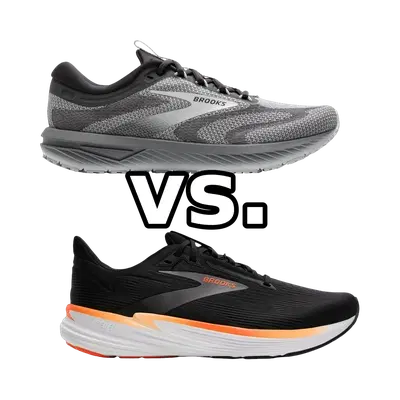
Brooks Revel 7 vs Brooks Launch 11:
Which to Choose
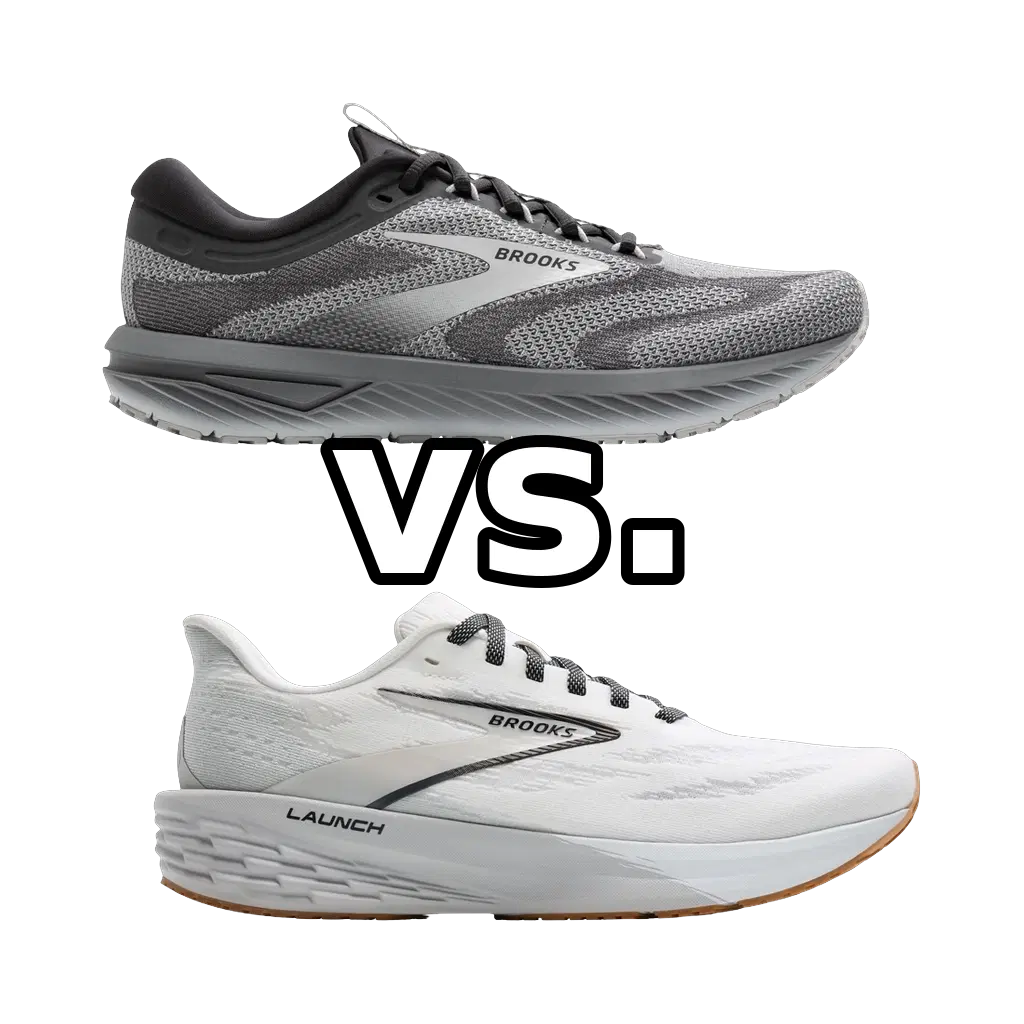
Verdict
These are close cousins, not opposites, so it comes down to pace, not purpose. Both are firm, durable, neutral 10mm trainers for the same distances — but the Launch 11 is lighter, more responsive, and more stable, making it the better all-around buy for anyone who ever wants to run quick. Go with the Revel 7 only if your running is almost entirely easy and you specifically want the simplest, most entry-level option; for most runners weighing the two, the Launch 11 is the more versatile shoe.
Pace
3 of 6
Cushioning
3 of 6
Responsiveness
2 of 6
Stability
3 of 6
Drop
10 mm
Support
Neutral
Plate
None
Distances
5K10KHalf
Pace
4 of 6
Cushioning
3 of 6
Responsiveness
3 of 6
Stability
4 of 6
Drop
8 mm
Support
Neutral
Plate
None
Distances
5K10KHalf
At a Glance
Brooks Revel 7Brooks Launch 11
Who Should Choose Each Shoe
Choose
Brooks Revel 7
Choose the Revel 7 if you're a beginner or recreational neutral runner who wants one straightforward, affordable trainer for steady easy mileage and don't plan to chase pace. Its firm, 10mm-drop platform is forgiving for heel-strikers, eases calf strain, and is built to rack up durable, no-drama miles at a relaxed 5:30–6:30 min/km. If most of your running is conversational and you'd rather not pay for performance you won't use, this is the simpler, more honest everyday pick.
Choose
Brooks Launch 11
Choose the Launch 11 if you still run mostly easy miles but want a single trainer that can also handle strides, tempo days, and the occasional faster 10K or half without feeling leaden. It's the lighter, more responsive, more stable of the two, with a crisp, connected ride that rewards quicker turnover around 4:45–5:30 min/km and still holds up when you drop toward 4:15. Runners coming off a flat-feeling trainer who want more eagerness underfoot — without jumping to a plush or plated shoe — will prefer it.
Head-to-Head
On paper these two look like twins — both neutral, both no plate, both a traditional 10mm heel-to-toe drop, both rated at the same moderate level of cushioning (3/6) and sharing the same 5K/10K/half best-distance band. Where they genuinely diverge is turnover. The Launch 11 is the quicker shoe across the board: it scores higher for pace (4/6 vs 3/6), responsiveness (3/6 vs 2/6), and stability (4/6 vs 3/6), and it's noticeably lighter on the foot at about 235g versus roughly 258g for the Revel 7 (men's size 9) — a ~23g gap you feel on faster reps. Its optimal zone sits at 4:45–5:30 min/km, with a fastest effective range down around 4:15–4:45, whereas the Revel 7 is happiest at a more relaxed 5:30–6:30 min/km and starts to feel flat if you push much past 5:15. Underfoot the Launch 11 actually carries a touch more stack (roughly 35mm heel / 27mm forefoot) than the Revel 7 (around 32mm heel / 22mm forefoot), yet it feels livelier and more connected rather than softer, with a planted, wide platform that holds its shape as you roll into an uptempo effort. The Revel 7's foam, by contrast, is tuned for protection and durability over rebound — smooth and predictable at conversational paces, but it gives little energy back and reads as dead when you try to run fast. Neither has a plate, neither coasts on superfoam bounce, and both use a breathable engineered-mesh upper over a hard-wearing rubber outsole, so durability and basic daily comfort are a wash; the deciding axis is really pace capability and foot-feel, not use case.
© 2026 longrunshoes.ai | All rights reserved.
Use of materials from this site is permitted only with proper attribution and a link to longrunshoes.ai.