
Adidas Adizero Takumi Sen 10 vs Adidas Adizero Takumi Sen 11:
Which to Choose
Verdict
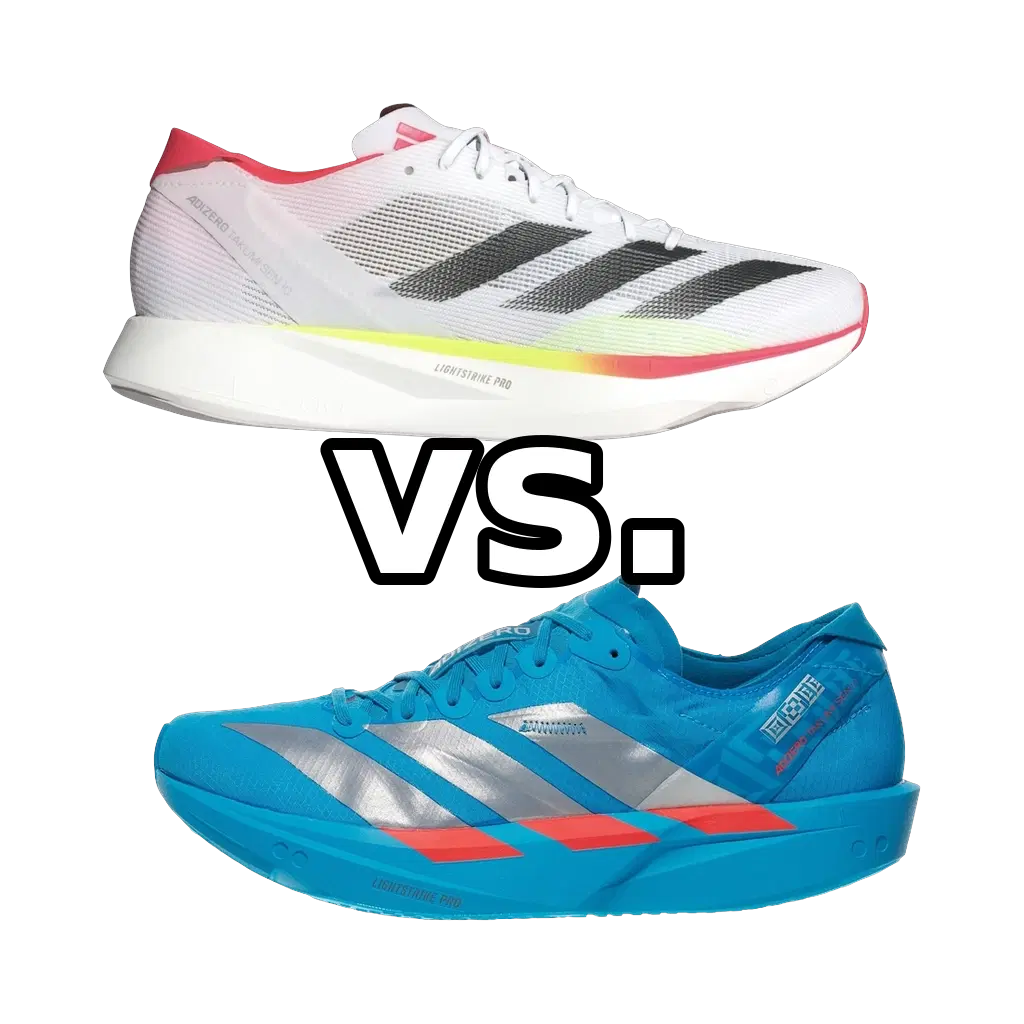
It depends mostly on whether you already own the Sen 10. If you do and it's still holding up, an upgrade isn't necessary: same low stack, same glass-fiber EnergyRods 2.0, same firm forefoot-driven character — the 11's meaningful changes are that it's lighter (~184 g vs ~200 g) and slightly livelier, not a reinvention. If your 10s are worn out or you're buying into the range for the first time, go with the Sen 11 — it's the lighter, freshest version of a shoe you'd otherwise be replacing with a near-identical model anyway.
Pace
6 of 6
Cushioning
4 of 6
Responsiveness
6 of 6
Stability
3 of 6
Drop
6 mm
Support
Neutral
Plate
Carbon
Distances
5K10K
Pace
6 of 6
Cushioning
3 of 6
Responsiveness
6 of 6
Stability
2 of 6
Drop
7 mm
Support
Neutral
Plate
Composite
Distances
5K10K
At a Glance
Adidas Adizero Takumi Sen 10Adidas Adizero Takumi Sen 11
Who Should Choose Each Shoe
Choose
Adidas Adizero Takumi Sen 10
Pick the Sen 10 if you already own a pair and like them — there's little compelling reason to retire a shoe that still has life in it, because the platform, plate, and low stack are effectively unchanged in the successor. It's also the choice if you prefer a whisper more forgiveness and a slightly more planted feel underfoot at your 5K–10K race efforts, and don't prioritize shaving every last gram off your race-day setup.
Choose
Adidas Adizero Takumi Sen 11
Choose the Sen 11 if you're buying fresh into this line and want the lightest, most current version — the roughly 15 g weight saving and marginally more energetic foam are real gains for a forefoot-striking racer counting grams on the start line. It's the better pick for runners who like a touch more forefoot ramp (the 7 mm drop over the 10's 6 mm) and who want the newest iteration of the same proven glass-fiber-rod race platform.
Head-to-Head
The honest headline here is that these are extremely close relatives, not two different shoes. Both ride on full-length Lightstrike Pro, a TPEE-based superfoam, stiffened by full-length glass-fiber EnergyRods 2.0 — so neither shoe has a carbon plate; they share the same composite-rod propulsion system, which is why both feel firm, snappy, and forefoot-driven rather than plush, and why both come alive at speed but feel stiff and unforgiving at an easy jog. The low-stack geometry carries over almost unchanged: heel stack sits at essentially the same ~30.6 mm on both, so the sharp ground feel and planted, close-to-the-road transition are shared traits. The concrete differences are modest. Weight is the clearest one: the Sen 11 comes in around 184 g in a men's US 9 versus roughly 200 g for the Sen 10, so the successor is noticeably lighter — the payoff of a new, thin Lightlock woven upper and a trimmed build. The forefoot stack rises slightly, from about 22.8 mm to 23.7 mm, nudging the drop from 6 mm up to 7 mm and giving the 11 a fractionally more pronounced forefoot ramp. The 11's Lightstrike Pro is also tuned to feel a touch livelier and bouncier, though it reads as firm and narrow with little margin for an off-center landing — as does the 10. Both peak in the same 3:00–3:30 min/km zone, both name the 5K as their sweet spot, and both trade long-term durability for low weight through minimal outsole rubber and a bare-bones racing upper.
Similar Comparisons

Adidas Adizero Adios Pro 4 vs Adidas Adizero Takumi Sen 11
© 2026 longrunshoes.ai | All rights reserved.
Use of materials from this site is permitted only with proper attribution and a link to longrunshoes.ai.