Adidas Adizero Evo SL vs Asics Magic Speed 4:
PEBA Foam Rocket or Carbon-Plated Racer?
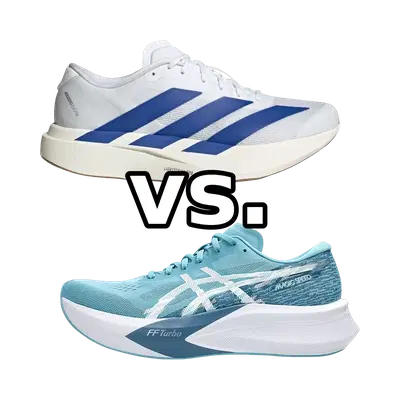
These shoes are genuinely different tools despite near-identical headline ratings. If your primary goal is 5K–10K speed, pick the Evo SL — the PEBA foam delivers more energetic rebound and a softer, bouncier ride that suits shorter, faster efforts. If you're training for and racing halfs or marathons, pick the Magic Speed 4 — the carbon plate earns its place over longer distances by enforcing a smooth, efficient forward roll that the Evo SL's foam-only platform can't replicate at those efforts. The one overlap is the 10K and half marathon runner who trains at roughly 4:00–4:30 min/km: either shoe works, and the choice genuinely comes down to whether you prefer foam-driven bounce or plate-driven propulsion.
136.00 USD
Drop
Support
Plate
Distances
128.00 USD
Drop
Support
Plate
Distances
Who Should Choose Each Shoe
Choose the Adidas Adizero Evo SL if your race calendar centers on 5K through 10K, or if you want a lively tempo trainer that doubles as a shorter-distance racer. Runners who prefer the soft, bouncy sensation of premium PEBA foam over the more rigid feel of a carbon plate will find the Evo SL more satisfying — it rewards a punchy, high-cadence stride without the stiffness. It's also the better pick for runners who occasionally want to use the same shoe for fast workouts and the odd half marathon but don't need it to carry them through full marathon efforts.
Choose the Asics Magic Speed 4 if the half marathon or marathon is your target race and you want a carbon-plated shoe built to hold up over those longer efforts. The plate-driven forward roll becomes more valuable as distance increases — it smooths transitions and reduces the muscular cost of maintaining pace late in a race in a way foam alone doesn't. Runners who prefer the feeling of a structured, propulsive geometry guiding each stride (rather than a soft, squishy rebound) will feel more at home in the Magic Speed 4, particularly in the 4:00–4:45 min/km range where the plate and foam combination works best together.
The Adidas Adizero Evo SL and Asics Magic Speed 4 occupy nearly the same pace band and share identical cushioning and responsiveness ratings on paper, but they reach those numbers through opposite philosophies: the Evo SL bets entirely on Lightstrike Pro PEBA-class foam to generate rebound with no plate, while the Magic Speed 4 pairs a full-length carbon plate with FF Blast Plus Eco EVA-based foam for a stiffer, more geometrically guided ride. Both reward runners who push the pace, both feel slightly awkward at an easy jog, and both suit intermediate-to-experienced runners chasing faster times. The decision comes down to what kind of speed sensation you want underfoot — and how far you intend to race.
Head-to-Head
The most consequential difference is the technology stack. The Evo SL relies on Lightstrike Pro, a PEBA-class (superfoam-grade) midsole with no plate — all the energy return comes from foam compression and rebound, producing a soft, bouncy, springy sensation that rewards a quick turnover. The Magic Speed 4 takes the opposite route: its FF Blast Plus Eco foam is EVA-based, a step below PEBA in raw rebound, but a full-length carbon plate compensates by enforcing a stiff, smooth forward roll and a snappy toe-off. In practice this means the Evo SL feels more cushioned and lively underfoot while the Magic Speed 4 feels more structured and propulsive — reviewers consistently describe the Evo SL ride as "bouncy" and the Magic Speed 4 as "snappy." Drop is close but not identical: 6mm on the Evo SL versus 7mm on the Magic Speed 4, a minor difference that slightly favors a midfoot cue on the Evo SL. Both shoes share a moderate, neutral stability platform (no pronation control, moderately wide base), so neither suits overpronators. Where they diverge most usefully for a shopper is distance range: the Evo SL is designed around 5K, 10K, and the half, with 10K as its stated sweet spot and an optimal pace zone of 3:45–4:30 min/km. The Magic Speed 4 extends meaningfully into the marathon, lists the half as its sweet spot, and operates best between 4:00–4:45 min/km — slightly slower-leaning, which is consistent with a carbon plate smoothing out the stride over longer efforts rather than maximizing raw spring for shorter bursts. Both shoes feel less natural at a slow jog, but the carbon plate in the Magic Speed 4 makes it fractionally stiffer at easy paces. Weight and upper construction are comparable across both: lightweight engineered mesh, airy and race-ready.
© 2026 longrunshoes.ai | All rights reserved.
Use of materials from this site is permitted only with proper attribution and a link to longrunshoes.ai.